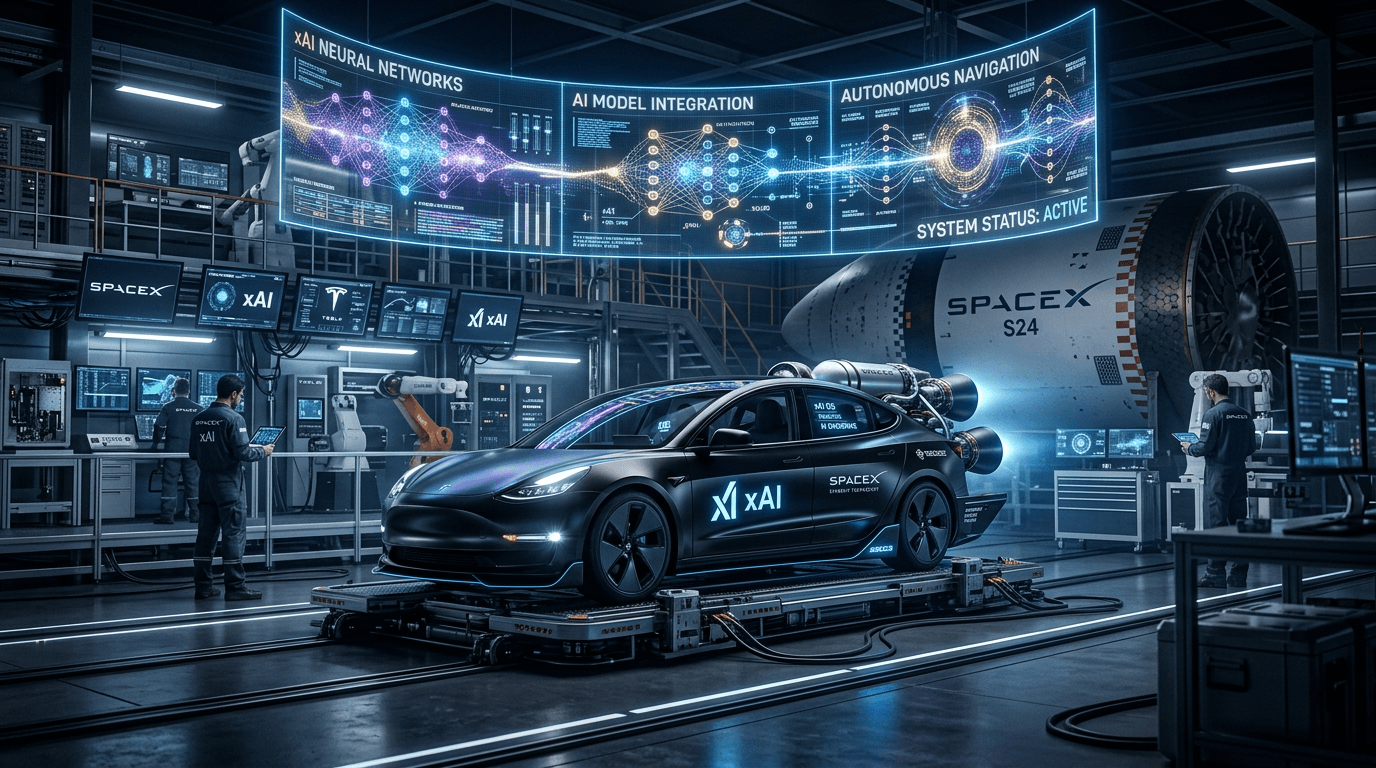
Hold on tight to your wallets and seatbelts, because the Tesla Model 3 and the broader vision of future transport are entering a new, galactic phase. Elon Musk decided that earthly business gravity is merely a suggestion, not an iron rule.
We are in March 2026, and the visionary is planning a move that makes a Volkswagen-with-a-sausage-maker merger look dull. The talk is about a grand union of giants: Tesla, SpaceX and xAI.
Your Tesla Model 3, a reusable rocket, and an artificial intelligence fed by your posts are set to become a single, powerful, roaring cash-burning machine under the shared banner of "X Holding".
Elon Musk reached the conclusion that selling cars is a job for mortals. Now he wants to sell you a lifestyle in which the car thinks for you, and the profits from your daily commute to work finance the colonisation of Mars. It is either absolute genius or complete madness.
This is not a simple reshuffle in Excel sheets. It is an attempt to build a technological Leviathan that will know what time you leave the house, what you think about politics, and what the weather is like in orbit.
Critics are scratching their heads, asking what metalwork has in common with training neural networks, but Musk has a simple answer: data. Vast quantities of data meant to power the brain of Optimus – a robot slated to become a more important project than the company's entire automotive division.
Check our catalogue to see how this technology shapes the current lineup.
The end of luxury and the new role of the Tesla Model 3
Before you start looking for a SpaceX logo on the bonnet of your new Tesla, look at the facts. Production of the luxury flagships – Model S and Model X – at the Fremont factory is now entering the history books.
Why? Because Elon decided that building complicated cars for humans is too… human and, above all, not scalable enough.
The production line that for a decade defined luxury electric cars is being dismantled to make room for an army of humanoids.
Instead, Optimus Gen-3 robots are meant to roll off the assembly lines. This only makes sense in a billionaire's twisted logic: Tesla is battling margin stagnation, xAI is burning billions of dollars on graphics cards to chase Google, and SpaceX is the only one truly making money thanks to government contracts.
The merger is a classic manoeuvre of the type "save the drowning man by tying him to a rocket". Investors looking at a business model in which the Tesla Model 3 becomes a base for AI algorithms have decidedly mixed feelings.
Moving engineers from the Autopilot division to AI projects at other companies is already the norm, and merging these entities is simply meant to legalise that process.
Attractive Tesla Model 3 pricing in Polish showrooms
Despite the corporate chaos in Texas, Polish roads in 2026 are being flooded by cars from Austin more than ever before.
The reason is not ideological – it is brutally prosaic: the Tesla Model 3 and its strikingly competitive price. Buying this car has become so cost-effective here that choosing anything combustion-powered with similar performance starts to look like self-sabotage.
Entry into Musk's world today costs just 167,600 PLN for the base version. For that amount you get a car that hits 100 km/h in 6.2 seconds and will cover almost 400 kilometres on the motorway in real conditions.
For those suffering from chronic range anxiety, the Long Range RWD variant is on offer. A true marathon runner – 750 km of WLTP-rated range for 204,990 PLN.
In practice, that means a trip from Warsaw to Berlin on a single charge. It is a car for people who value their time, especially when a home charger lets you top up cheaply overnight.
At the other end of the scale sits the Model X at the absurd price of 562,890 PLN, which already looks a bit archaic, or the legendary Cybertruck. This steel monolith has finally received European type approval and is effectively scaring passers-by in Polish car parks.
But it is the Tesla Model 3 that remains the undisputed sales leader.
Software in a metal skin
In 2026, Tesla is no longer a classic manufacturer. It is a software company that accidentally bolted wheels to its servers.
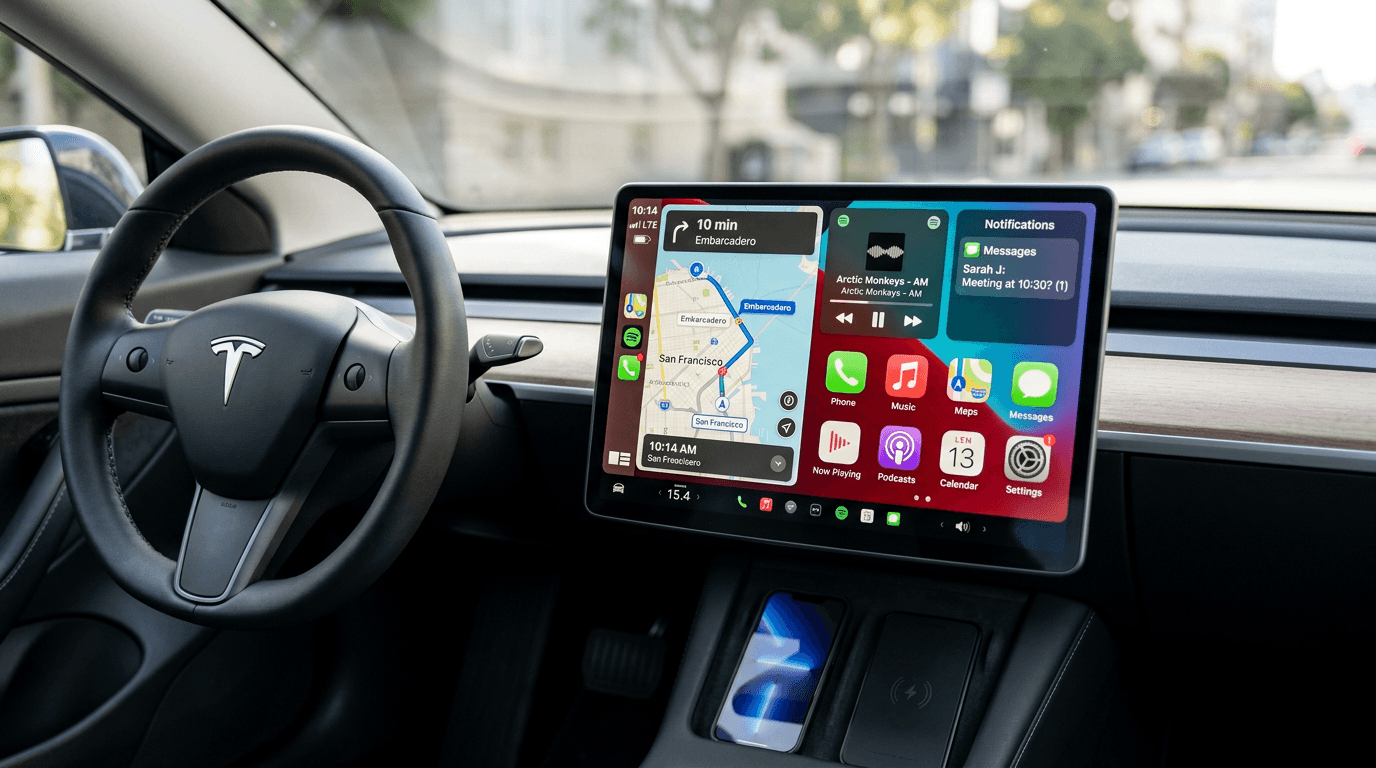
The Model Y and Tesla Model 3 have gone through facelifts that completely eliminated physical switches. It looks minimalist and menacing, as if the interior designer decided that every physical knob is a step backwards in evolution.
Everything is handled through a massive 15-inch touchscreen, which may be a shock for fans of tradition. But watch out – the golden age of Musk's dominance is slowly drawing to a close.
Chinese giants such as BYD and Xiaomi are breathing down Tesla's neck, betting on physical luxury. The Chinese offer better standard sound insulation and seats in real leather.
Yet the Tesla Model 3 still wins on infrastructure. The Supercharger V4 network in Poland is growing rapidly, and the stability of the V12 operating system makes the competition still look like first-generation Android smartphones.
The interior of the new Tesla is so sterile you could perform open-heart surgery in it. The lack of buttons is not minimalism – it is cost optimisation dressed up as a futuristic revolution. But you know what? It really works.
Tesla's system simply does its job, planning routes with precise accounting for wind and temperature.
An engineering masterpiece beneath the Tesla Model 3's skin
Do not be fooled by the simplicity of the interior. Beneath its skin, the Tesla Model 3 hides technology that keeps engineers in Munich and Stuttgart awake at night screaming.
It is gigacasting – casting entire sections of the underbody from a single piece of aluminium. That dramatically lowers production costs, although it means even a minor parking bump can end in a total write-off.
Add to that a new generation of 4680 cells, offering the energy density needed for rapid charging. The efficiency of the drivetrain remains unmatched.
Permanent-magnet motors and inverters based on silicon carbide are pure technical jewellery. The Tesla Model 3 consumes on average 20–30% less energy per kilometre than competing SUVs.
In a world where the price of a kilowatt-hour can make your head spin, that difference becomes a key argument. It is not magic – it is an obsessive fight for every fraction of a percent of efficiency, from the aerodynamics of the wheels to the software running the heat pump.
These aspects are why this brand's electric cars still dominate efficiency rankings.
Verdict: buy or run?
Is it worth investing in a car like the Tesla Model 3 in 2026? If you are looking for pure efficiency, this vehicle still has no equal.
Energy consumption of 13–16 kWh in the city is a figure the competition can only dream of. You are buying a technologically mature product, even if raw in form.
It is worth checking the market offering through our catalogue to compare specifications with other models.
Elon Musk may be a mad visionary who spends more time on memes than in the factory, but his cars – including the popular Tesla Model 3 – are still the best "gadgets on wheels" you can buy.
Just remember that you are also financing the development of robots and space technology. If, however, your priorities are range, charging speed and rare visits to public chargers, the choice remains obvious.
The Tesla Model 3 is an evolution that, despite all the controversy, defines modern motoring.
FAQ – frequently asked questions
❓ Will the Tesla–SpaceX merger affect car servicing?
The operational merger will not change the physical structure of service centres, but it will integrate diagnostic systems with Starlink technology. This means that cars like the Tesla Model 3 will be able to send telemetry data in real time straight to the cloud, speeding up remote diagnostics. Quality control standards will be unified with aviation norms.
❓ Why is Tesla retiring the flagship Model S and X in favour of Optimus robots?
The decision stems from a profitability analysis. Model S and X production is highly complex. Focusing on high-volume sales, where the Tesla Model 3 dominates, allows better cost optimisation. Converting the line to assemble Optimus Gen-3 robots lets the company enter a new automation market while reusing the same batteries and AI processors.
❓ What is the real-world range of the Model 3 Long Range RWD in Polish conditions?
Although the standard points to 750 km, in real Polish road conditions the Tesla Model 3 will cover about 560–580 km. In winter that range drops to roughly 420–440 km because of the heat pump's workload. Tesla still remains the efficiency leader, consuming very little energy per 100 km on average.
❓ Is controlling every function from the touchscreen safe?
Engineers argue that 95% of functions in the Tesla Model 3 are automated by AI. The V12 operating system introduced advanced voice shortcuts based on the xAI Grok model. They let you control climate or media without taking your eyes off the road, which compensates for the lack of physical buttons.
❓ How does gigacasting technology affect bodywork repairs?
Gigacasting in the Tesla Model 3 means replacing many components with large castings. In a serious impact, traditional straightening repairs are difficult. Service centres prefer module replacements, which require the highest level of certification and push up the cost of comprehensive insurance.