Kia EV4: A Korean manifesto against the SUV dictatorship
The world has gone crazy for tall bodies that resist the air with the grace of a clinker brick. Kia, however, decided to remind us that other forms of life still exist.
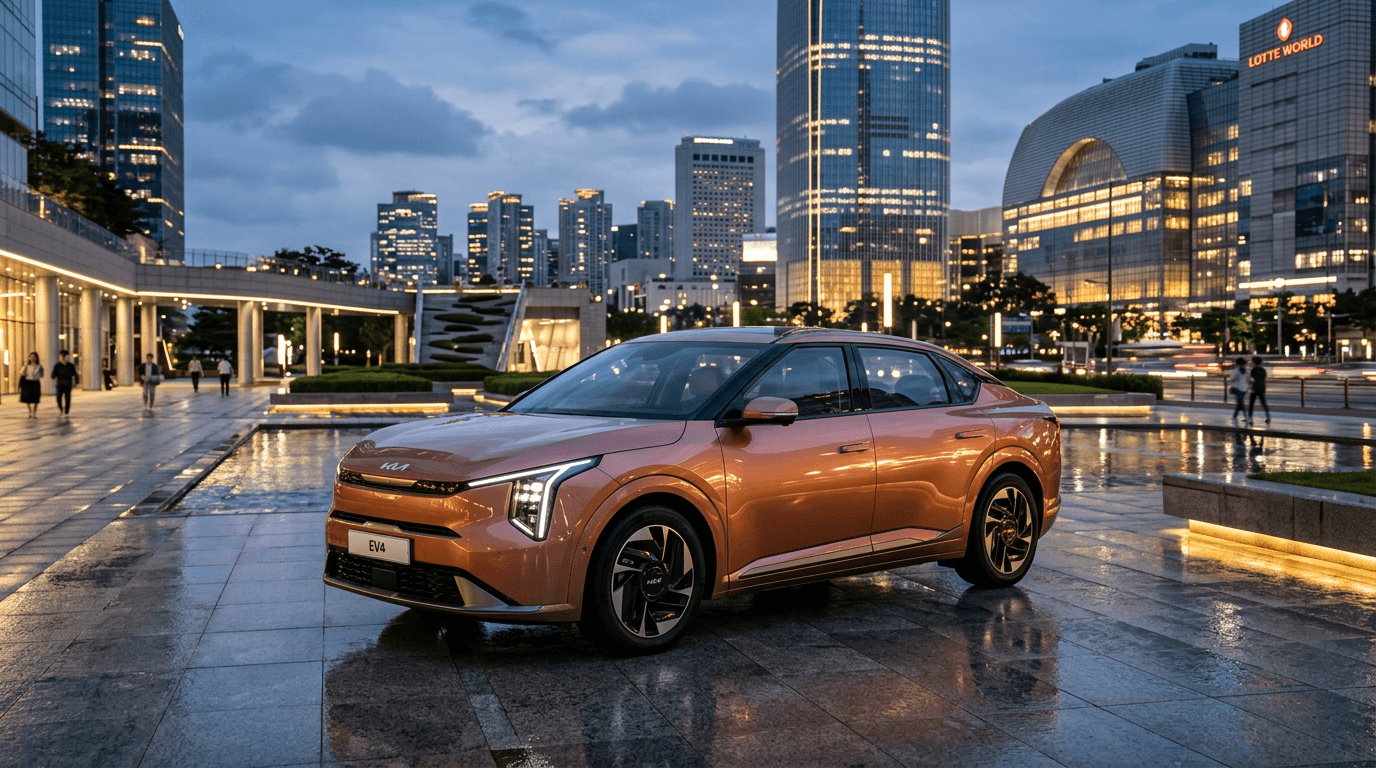
Meet the Kia EV4. A car that looks as if it escaped the set of an 80s sci-fi film, and was then smoothed out by someone who sincerely hates the Tesla Model 3.
It's a bold move. It's like showing up to a wedding in a tracksuit – but a five-thousand-zloty one – controversial on the surface, yet you can feel the class and the idea behind it.
In a world where every new car resembles a puffy loaf of bread called a "crossover", the Kia EV4 acts like a cold shower after an all-night party. It is low, sharp, and makes the Tesla Model 3 suddenly look like a soap dish designed by a committee of dullards next to it.
At a time when manufacturers keep pushing more crossovers, the Koreans are putting an ostentatiously low and aerodynamic design on the table. Above all, however, it is visually fascinating.
Looking at modern electric cars, this particular model stands out with the uncompromising boldness of its designers.
Kia EV4 styling: how to stop being afraid of aerodynamics
The Kia EV4 does not try to be elegant in the traditional sense of the word. It is simply different.
The designers abandoned the rounded, egg-like shapes that dominate the EV segment under the dictate of strict air-drag norms.
Instead, we got the "Opposites United" design language. In the case of the Kia EV4, it shows itself through sharp lines, vertical LED headlights, and a rear that looks as if it were cut with a samurai sword.
The model will be offered in two body versions: a classic hatchback and a more prestigious fastback.
The latter variant is clearly longer, measuring 4,730 mm, and features a roofline that slopes toward the rear in a way suggesting excellent aerodynamics despite the angular details.
A solid wheelbase of around 2,770 mm promises interior space that owners of mid-size combustion sedans can only dream of.
Browsing the available catalogue of models, it is hard to find a second car this distinctive in this class.
Inside, things get even more interesting. Instead of one giant tablet that forces you to take your eyes off the road every time you change the temperature, Kia kept the buttons!
Real switches and physical volume rollers are a revolution in a world where manufacturers assume drivers have fingers with surgical-laser precision.
The dashboard architecture is minimalist but not stark. We get a triple screen setup with a combined diagonal of nearly 30 inches, covering the instrument cluster, climate panel and multimedia centre.
The Kia EV4 uses AI technology to help plan routes, but fortunately does not try to decide for us what music we should listen to.
An electric heart and front-wheel drive in the Kia EV4
Under the body you will not find technology from a space shuttle, which is paradoxically great news for your wallet.
While the flagship EV6 uses the expensive 800V architecture, the EV3, Kia EV4 and EV5 models are based on the proven 400V system.
What does that mean? Using an external DC charger, topping up the energy from 10 to 80% takes about 30 minutes.
This is not lightning-fast, but thanks to a refined thermal management system the charging curve remains extremely stable.
The car maintains high charging power even at low temperatures, which in our climate is key for travel comfort.
Two NMC (nickel-manganese-cobalt) battery packs are available. The smaller 58.3 kWh unit is an ideal solution for the city and shorter trips.
The larger 81.4 kWh battery promises a range of up to 625 km (according to WLTP) in the fastback version. This is a result that allows motorway trips without nervously looking for a free socket.
The Kia EV4 proves that the optimal battery size is the foundation of success for modern electrification.
The drivetrain, however, may spark a discussion at the Sunday barbecue. Power of 204 hp (150 kW) and 283 Nm of torque go to the front axle only.
In a world of EVs promoting rear-wheel drive, the Kia EV4 bets on predictable handling and high energy efficiency.
Acceleration? 7.4 seconds to 100 km/h in the base Air version. That is enough to embarrass most combustion compacts and pull away briskly from the lights.
How much does this piece of the future cost?
Let's get down to specifics, because the real fun starts here. The Kia EV4 enters showrooms with a price list that should make the competition start nervously flipping through spreadsheets.
Production at the Slovak plant in Žilina helped avoid high logistics costs, which is visible in the final offer. For people looking for modern electric cars, this proposition is extremely strong.
- Kia EV4 Hatchback (Air trim, 58.3 kWh): Price starts from PLN 173,900. With the subsidy from the "Mój Elektryk" programme, the amount drops to PLN 143,900.
- Kia EV4 Fastback (Earth trim, 58.3 kWh): From PLN 192,900 (or PLN 162,900 with the subsidy).
- GT-Line with 81.4 kWh battery: A proposition for the demanding – PLN 237,900 for the fastback version.
A base price around 144 thousand zlotys (after subsidies) is the moment when the combustion engine should start packing its bags. Kia proved that futuristic design does not have to cost a fortune.
Importantly, Kia has run rigorous cell degradation tests. They declare that after 100,000 kilometres of intensive use, the battery retains 95% of its capacity.
That is an impressive result. A 7-year (or 150,000 km) warranty for the whole car and 8 years for the battery give the driver peace of mind.
All technical data for the model can be checked in our catalogue.
Editor's verdict
The Kia EV4 is not a car for setting track records nor for off-road fans who believe that minimal ground clearance is enough for a mountain expedition.
It is a car for people who are tired of sitting as high as on a bar stool in an SUV. For those who want a coherent car that looks like it came off the set of "Blade Runner" and is sensibly priced.
It is not a champion of charging speed and does not offer 4×4 drive, but the Kia EV4 is thought through to the point of pain. Keeping physical buttons in 2026 is almost an act of rebellion against the tablet dictatorship.
If you are looking for an EV that does not annoy you with software bugs, offers real range and makes passers-by stop on the street – the Kia EV4 is currently one of the most interesting choices.
One request: skip the boring grey. Those sharp creases and the futuristic rear deserve a paint that fully brings out their three-dimensionality.
FAQ – Frequently asked questions
What is the real motorway range of the larger battery version?
With a net capacity of 81.4 kWh and excellent aerodynamics, the Kia EV4 at 120 km/h consumes on average 18-20 kWh per 100 km. That means a real motorway range of 400-420 km. At 140 km/h, range drops to around 330-350 km.
Why did Kia choose front-wheel drive (FWD) instead of rear-wheel drive (RWD)?
The decision to use FWD comes from optimising the E-GMP platform costs for smaller models and the desire to maximise cargo space. A front motor allows a simpler rear suspension design, which translates into a lower loading sill.
Isn't the 400V architecture outdated compared to the 800V from the EV6?
It is a price compromise. The 400V system allows the purchase price to be cut by roughly PLN 30-40 thousand compared with 800V technology. The Kia EV4 charges at up to 150 kW, which adds about 100 km of range in roughly 10-12 minutes.
What are the differences in boot capacity between the hatchback and fastback?
The hatchback offers around 440 litres of space. The fastback, despite its slimmer silhouette, fits around 470 litres thanks to its longer overhang. Both models have an additional 25-litre "frunk" under the bonnet.
Does the Kia EV4 have a heat pump as standard?
On the Polish market, the heat pump is standard on Earth and GT-Line trims. On the base Air trim it may require an extra charge. This device can reduce the energy used to heat the cabin by up to 25% on cold days.
How does the V2L (Vehicle-to-Load) system work in this model?
The V2L system in the Kia EV4 allows powering external devices with 230V AC at up to 3.6 kW. You can easily plug in a coffee machine, a laptop, or even charge another electric vehicle.