Dear children of e-mobility, put down your soy lattes for a moment and look at this: Scout Motors is coming.
For the uninitiated, it is as if you took an old, armoured Land Rover, sent it to the gym and put it in an Armani suit that doesn't mind the mud. Scout Motors, once an icon of American off-road, returns from the beyond under the wings of Volkswagen.
But that's not the most shocking part of this story. The real jolt is the fact that almost everyone who ordered it just flipped the bird at the vision of a world powered exclusively by socket.
You might think that in 2026 we'd only debate electrolyte density and processor speeds. Yet Scout Motors, Volkswagen's American child, has run into brutal reality.
Out of 150,000 reservations, as much as 85 percent are for the Harvester versions. What does that mean? That the world doesn't want "clean" EVs at all.
The world wants an EV that hides a small combustion generator in the boot. We are mortally afraid of being stranded in open country with a flat battery and zero dignity. It's a revolt against an imposed revolution, dressed in a steel body and chunky tyres that mock kerbs.
Building an EV with a combustion engine in the boot sounds like trying to make a non-alcoholic vodka that still kicks a bit. And you know what? It's the only way to convince anyone beyond the residents of California's suburbs to give up a traditional diesel.
Harvester: how Scout Motors bridges two worlds
The Harvester system is the brilliant cheat we've all been waiting for. It isn't a regular plug-in hybrid where the combustion engine fights with the wheels like a dog on a short leash, trying to take over at higher speeds.
Under the bonnet works an inline, turbocharged engine that has just one job: to be your personal power plant for the batteries. The combustion engine never drives the wheels — it simply feeds the roughly 63 kWh battery with juicy current when it starts to fade.
It's an EREV (Extended Range Electric Vehicle) system that, unlike classic hybrids, preserves the driving characteristics typical of electric cars for the entire trip.
The result? Instead of a miserable range that disappears faster than politicians' post-election promises, you get over 800 kilometres of freedom.
You can cover 240 kilometres on pure electric power, gliding silently through the city. And when every nearby charger turns out to be busy, or you head off-road into the Arizona desert, petrol steps in.
Scout Motors offers a solution like a powerbank the size of a small car that you refuel in two minutes. The engineers understood that the battery mass needed for 800 km would kill this vehicle's off-road capability. Instead of mounting a ton of cells, they added proven mechanics.
Traveler and Terra: Scout Motors' American dream
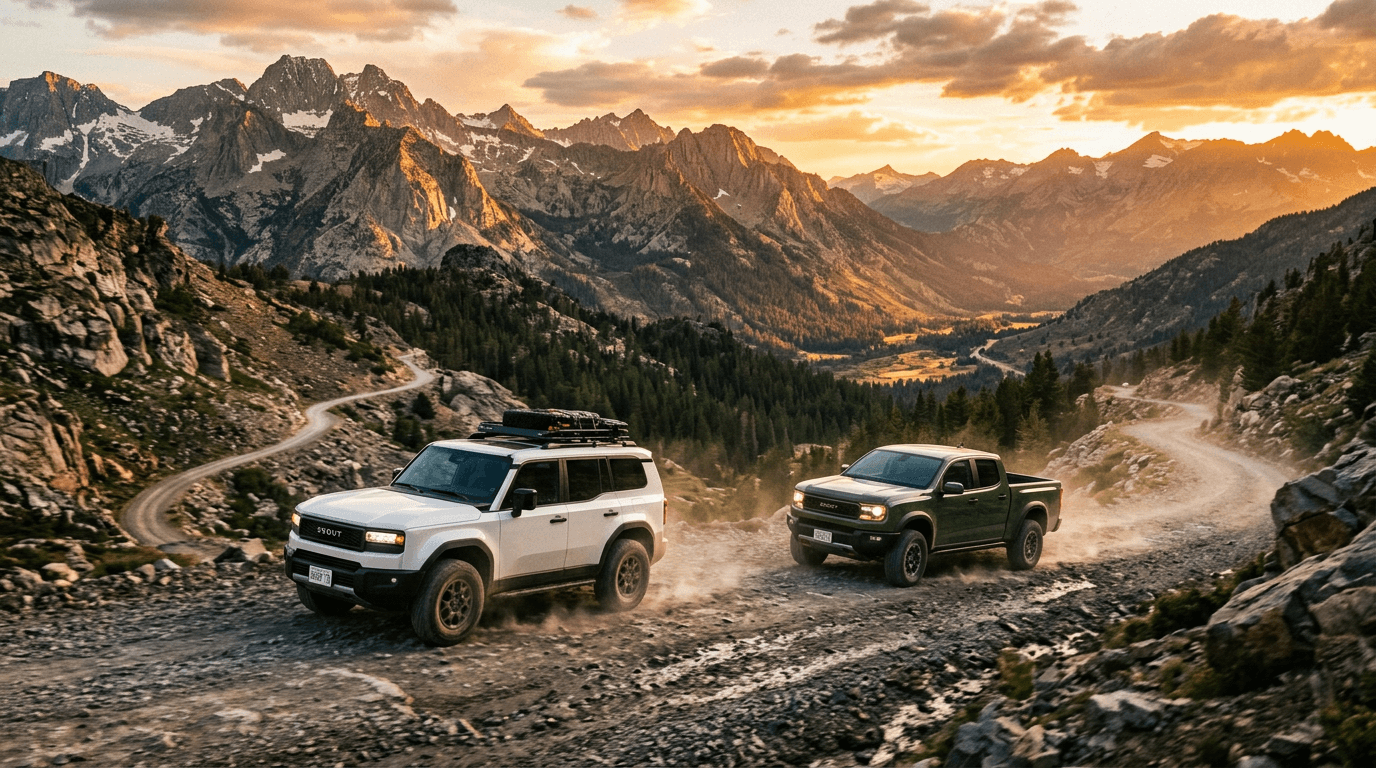
There are two models to choose from, looking as if they were hewn from a single granite block. Traveler, the SUV, is a tribute to the classic 1970s Scout II, reinterpreted. It looks like it could drive through a building without a single scratch on the paint.
Terra, on the other hand, is a pickup for people who actually have things to haul, not just pose as heroes of lumberjack movies. Both are classic body-on-frame constructions, which makes Scout Motors stand out in today's world of "soft" crossovers.
Browsing our catalogue, it's hard to find another build as solid as this.
There's a solid rear axle, differential locks at both ends, and ground clearance exceeding 30 centimetres. These aren't toys for a hipster café, although thanks to the minimalist design they'll look great there too.
Wading capability of up to one metre of water means Scout Motors is ready for the flood. Meanwhile, your neighbour in an electric compact will be desperately looking for a dry parking spot.
The interior is a love letter to ergonomics and common sense. There are real buttons, solid knobs and handles you can feel in your hand. Yes, you read that right.
In a world where manufacturers make you operate wipers via a screen buried in the third submenu, Scout Motors gives you physical switches. It's as refreshing as a cold shower on a July afternoon.
Add hemp-wood trim and durable fabrics — it's eco-friendly without the taste of boredom or cheap recycled plastic.
Performance that snaps your head right off your hips
If you thought a combustion generator and off-road character would make these cars slow, you're wrong. The drivetrain Scout Motors has prepared, based on two powerful electric motors, promises 1,350 Nm of torque.
That's a figure that could rip the Bartek oak out by the roots or shift a small apartment block. Acceleration? This luxury sideboard reaches 100 km/h in roughly 3.5 seconds. That's the pace of top electric cars with a distinctly sporty edge.
3.5 seconds to a hundred in something with the aerodynamics of the Palace of Culture? Proof that Scout's engineers cared less about drag than about making the driver check after every throttle stab whether their fillings are still in place.
Prices? This is where it gets really interesting — and, surprisingly, optimistic. Scout Motors targets a segment not reserved exclusively for oligarchs.
We expect that when these behemoths reach us around 2027, prices will start from around 230,000 – 250,000 PLN. That's a fair sum for a vehicle that will tow over 4.5 tonnes and won't force you to plan your holiday around a charger that might be out of service.
Other off-road vehicles covered by our catalogue rarely offer such versatility.
Architecture and future tech from Scout Motors
The designers don't cut corners on charging. The 800V architecture allows the use of the fastest DC units at up to 350 kW.
That means, if you do find a working point, topping up from 10 to 80 percent takes less time than drinking that latte. Plus, the V2H (Vehicle-to-Home) system lets you use the car as a giant energy store for your home.
In the event of a grid failure, Scout Motors can power your fridge for several days. It's not just a car; it's a mobile insurance policy against the apocalypse.
Worth mentioning is the unique "Cabana Fold" roof. It's a huge, soft covering that opens almost the entire cabin to the sky, giving a sense of freedom without wrestling with heavy, leaky panels.
Scout Motors even thought of details like a built-in compressor in the boot, to inflate a mattress or adjust tyre pressure for loose sand.
Verdict: pragmatism triumphs over ideology
The brand has proved something the other big players were afraid to say out loud: we love driving on electric for its silence and brutal dynamics, but we hate the cable's captivity.
Scout Motors' Harvester system is a bridge over a chasm other manufacturers couldn't cross in a way that satisfies the traditional customer.
It's a car for someone who wants to live in the 21st century, but won't ask permission to travel where Wi-Fi and charging infrastructure don't reach.
It's a return to the days when a car was a tool of freedom, not a gadget that needs an update to open the glovebox.
If this is the future Scout Motors is promoting, I'm in without hesitation. Nothing lifts your mood quite like knowing your ultra-modern EV has a good old explosion in its cylinders as a fallback when things go sideways.
FAQ – Frequently asked questions
How exactly does the Harvester system differ from a traditional hybrid?
In a traditional hybrid (PHEV or HEV), the combustion engine is mechanically connected to the wheels through a gearbox. In the Harvester (EREV) system, the combustion engine serves solely as a current generator (range extender). It has no physical connection to the drive axles. Its job is to top up the 63 kWh battery pack when the energy level drops below a threshold. As a result, the car retains the torque characteristics of the electric motor (1,350 Nm) across the entire operating range.
What is the real range of the all-electric and Harvester versions?
The fully electric (BEV) version has been designed to offer a range of around 560 kilometres. The Harvester version, despite a smaller battery pack, extends that distance to over 805 kilometres with the support of the generator and fuel tank. It's worth noting that in pure-electric mode the Harvester will cover around 240 kilometres, covering the needs of most daily drives without starting the combustion engine.
Will Scout offer off-road capability comparable to combustion vehicles?
Yes, and in many respects it will exceed them. The construction is based on a solid steel ladder frame, providing the required rigidity. The car is equipped with a mechanical, rigid rear axle and electric locks for both differentials. Scout also has a front stabilizer disconnect system, which increases axle articulation. Thanks to the instant access to maximum torque, obstacle-clearing precision is significantly higher than in traditional off-road vehicles.
How fast does Scout charge, and does it support NACS?
Scout uses an 800V architecture, allowing DC charging at up to 350 kW. That enables topping up from 10% to 80% in under 20 minutes. The car will come from the factory with an NACS (North American Charging Standard) connector, giving direct access to the Supercharger network, and will support bidirectional V2L and V2H energy flow.
What are the towing and payload figures for the Terra and Traveler models?
The Terra (pickup) offers a braked trailer capacity exceeding 4,500 kg, while the Traveler SUV can tow over 3,100 kg. The payload of both models has been set at above 900 kg. Such high figures are possible thanks to a reinforced frame and a specially designed cooling system that prevents the system from overheating under sustained load.