
Real-world range: 475 km
2026 Polestar 2 Long Range Single Motor: the EV that quietly became excellent
The 2026 Polestar 2 Long Range Single Motor gains rear-wheel drive, an 82 kWh gross battery and 659 km of WLTP range. A look at how evolution turned this EV into one of the segment's strongest contenders.
EvCompass Editorial TeamPublished Updated 9 min read
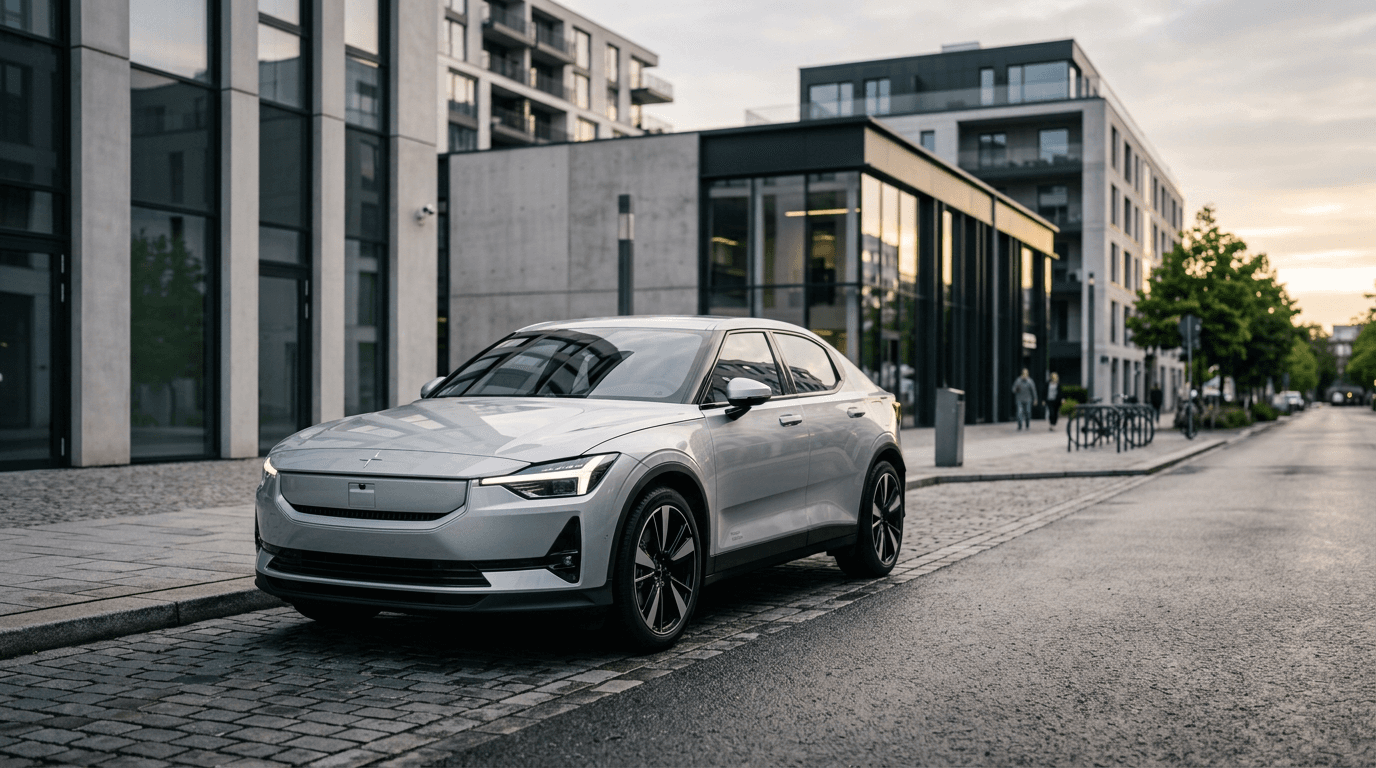
2026 Polestar 2 Long Range Single Motor: the EV that quietly became excellent
Swedish minimalism or a Chinese offensive?
Look at the Polestar 2. It looks like something designed by a person who hates unnecessary lines, probably living in a glass house at the edge of a fjord where the only entertainment is watching moss creep over stones.
In a world where new electric cars tumble out of factories every week like toast from a toaster, this model is already a few years old.
And you know what? That's the best news you'll hear today, because in the technology industry "old" often means "refined", not "outdated".
The Polestar 2 is like a well-tailored suit in a world sprinkled with neon tracksuits. It does not shout about its modernity, but when you drive it, you feel that the engineers spent more time on the suspension than on choosing the colour of the ambient lighting.
The latest 2026 incarnation of the Polestar 2 is the ultimate proof that evolution can be far better than violent revolution. Remember the early versions of this model?
They were like a Swedish crime novel – supposedly interesting, dark and complex, but at times heavy, clunky and front-wheel drive. Fitting a front-wheel-drive layout into a car with those ambitions and that much torque made about as much sense as installing sails on a nuclear submarine.
The wheels scrabbled for grip in every drizzle, and the steering precision felt like wrestling with an angry lawn mower. Now, however, the brand has come to its senses and performed an engineering heart transplant.
Polestar 2 engineering that stopped being temperamental
| Model (2026 Spec) | Drivetrain / Power | Battery (Net) | WLTP Range | Indicative Price |
|---|---|---|---|---|
| Polestar 2 Long Range SM | RWD / 220 kW | 79 kWh | 659 km | approx. EUR 54,475 |
| Tesla Model 3 Long Range | AWD / 258 kW | 75 kWh | 629 km | approx. PLN 230,000 |
| BMW i4 eDrive40 | RWD / 250 kW | 80.7 kWh | 589 km | approx. PLN 270,000 |
| Hyundai Ioniq 6 Long Range | RWD / 168 kW | 77.4 kWh | 614 km | approx. PLN 220,000 |
The key change in the 2026 model happened where the average lease customer's eyes cannot reach, yet where all the mechanical magic lives. Moving the drive to the rear wheels on the Long Range Single Motor version completely reset the DNA of this car.
Now, instead of tugging at the front wheels and fighting for traction every time you press the accelerator harder, the Polestar 2 bites into the tarmac with the grace of a ballerina mixed with the brutality of a sprinter.
Under the bonnet – or rather deep within the underbody structure – we find a new battery with a gross capacity of 82 kWh. Output of 299 horsepower (220 kW) sent to the rear axle and nearly 500 Nm of torque mean that this not-quite-two-tonne car catapults to 100 km/h in 6.2 seconds.
That pace is enough to leave most combustion hot hatches behind, and refined enough that you won't spill a hot latte on the vegan upholstery during launch. Browsing our catalogue, you'll quickly notice these figures put it at the top of the segment.
The real ace up its sleeve is energy efficiency. 659 kilometres of WLTP range sounds like optimistic fiction, but in the real world, with calm driving, 500 kilometres is absolutely achievable.
That means you can drive from Warsaw to Gdańsk without nervously trembling hands when the low-battery icon appears. Of course, provided you don't try to set a record on the A1 motorway, because aerodynamic drag at 140 km/h is still electrons' greatest enemy.
If you do run out of charge, the new DC charging architecture with up to 205 kW will bring the cells back from 10 to 80 percent in under 28 minutes.
A suitable high-power charger lets you just about eat a station hot dog, drink an espresso and catch up on world news. That's real convenience that changes how you perceive EV travel.
Importantly, the Polestar 2's charging curve is far more stable than its predecessor's. That means the high power holds for longer, rather than dropping sharply after just a few minutes of a session.
An interior built for purists and gymnasts
Inside, the Polestar 2 remains a raw, almost ascetic temple of Google. The Android Automotive system, which manages everything from music to the wipers, has been given a new, faster processor.
As a result, Google Maps navigation no longer dwells on the meaning of existence for too long, and switching between apps is as smooth as the movements of a Swiss watch. Everything is clean and simple, which delights minimalism fans but may frustrate traditionalists.
Using the touchscreen to adjust the mirrors is like trying to tie your shoelaces with a fork. You can do it, but why put yourself through it when a physical button simply works better?
The problem appears in the ergonomic approach to life. Adjusting regenerative braking, changing the fan strength or setting the mirrors sometimes requires too many clicks in the central tablet.
It's as if you had to email the power plant just to turn on the kitchen light. The Polestar 2 suffers from a lack of physical "meat" – knobs you can feel without taking your eyes off the road.
What's more, the car still pays a tax on its past. It shares the CMA platform with Volvo models originally designed with combustion engines in mind.
The result? A huge centre tunnel inside the cabin cutting through the rear floor. If you plan to carry three adult passengers back there, make sure the middle person is short – or simply really likes you.
The 407-litre boot is adequate, though next to the cavernous trunks of the Tesla Model 3 it looks modest. Fortunately, up front we have a 41-litre "frunk" – the perfect home for cables that are always muddy after charging in the rain. Our catalogue contains the detailed dimensions of these spaces.
Polestar 2 pricing and Polish reality
How much does this Swedish elegance cost in 2026? In Polish showrooms, the Polestar 2 Long Range Single Motor commands around EUR 54,475.
After conversion, that means an outlay of roughly PLN 235,000 – 240,000. That figure puts the car in direct competition with the BMW i4 and the Tesla Model 3.
What hurts, however, is the options policy. For things that should be standard in this class – such as a heat pump, the upgraded Bowers & Wilkins audio or the Pilot Pack systems – you still have to pay extra in packages.
Configuring a Polestar 2 can sometimes be as frustrating as trying to assemble an IKEA wardrobe without instructions, armed with only one borrowed Allen key.
For buyers on a tighter budget there is the Standard Range version with a smaller 69 kWh battery and 272 hp, priced at around EUR 50,775.
Let's be honest, though: buying a Polestar 2 with the small battery is like ordering a non-alcoholic whisky. The colour is right and the glass is nice, but it's missing that crucial kick. Other electric cars at this price often include a heat pump as standard.
Verdict
The 2026 Polestar 2 is a car for a specific customer. It's hardware for someone who wants to drive an EV but does not want to be associated with the technological evangelists of Silicon Valley.
This car doesn't shout that it is the future – it simply is, dressed in a perfectly tailored, grey suit. It is more mature, better balanced and more efficient than ever before.
Yes, the Polestar 2 has its flaws: a tight rear, an overly minimalist system and a lack of physical buttons. These are evident sins against ergonomics.
Yet the way this car drives, and how precisely it reacts to steering inputs, lets you forgive those stumbles. It's a proposition for people who value engineering substance over gadgetry.
The Polestar 2 doesn't try to be a smartphone on wheels – it tries to be, first and foremost, a very good car. If you're planning to buy, remember that a proper home charger will make day-to-day ownership much easier.
FAQ – Frequently asked questions
What is the real-world winter range of the Polestar 2 Long Range?
In Polish winter conditions, at temperatures around freezing, the real-world range of the Polestar 2 Long Range Single Motor drops to roughly 380-420 kilometres. The optional heat pump is key, cutting cabin-heating energy use by up to 50%. On the motorway at 130 km/h in winter, consumption typically sits at 24-26 kWh/100 km.
Is rear-wheel drive safe for less experienced drivers?
Yes. The switch to rear-wheel drive has not turned the Polestar 2 into a temperamental sports car. The traction control systems are calibrated very safely. Thanks to a better (close to 50:50) weight distribution, the car behaves more neutrally than the front-wheel-drive version, and eliminating steering wheel tug under acceleration improves ride comfort.
How quickly can the Polestar 2 be charged on the road?
The new Long Range version supports DC charging at up to 205 kW. At an ultra-fast station, topping up from 10% to 80% takes about 28 minutes. On 50 kW chargers, the process extends to roughly 70-80 minutes. The Polestar 2 automatically pre-conditions the battery before charging, provided the station is selected as the destination in Google Maps navigation.
How is Polestar's operating system different from those in other cars?
Polestar was the first to roll out a native Android Automotive system. Unlike Android Auto, this system does not require a phone – the car itself is an Android device. That means full integration with Google Maps, access to Google Play and precise Google Assistant voice control, which works more smoothly than the competition's.
Is the Polestar 2 suitable for towing a trailer?
Yes, the Polestar 2 offers solid towing figures. The Long Range Single Motor version can tow a braked trailer weighing up to 1,500 kg. The optional tow bar is electrically extendable via a button in the boot. Bear in mind, though, that towing a heavy camper trailer significantly reduces the vehicle's range.
Does the car's construction stay solid after several years of use?
The Polestar 2 is built on Volvo's CMA platform, which guarantees high body rigidity and durability. The trim materials age very well, often better than traditional leather. The batteries show low degradation, and the advanced cell temperature management system means the car stays in good shape for many years. Other electric cars in this class rarely offer this level of build solidity.
About the author
EvCompass Editorial Team
Cars in this article
EvCompass rankings related to this topic
- Ranking EvCompass: Real-world winter range at −10 °C
Ranks 280 families
What real-world range do electric cars get at −10 °C?
- Ranking EvCompass: Heat pump and winter range (−10 °C / 23 °C)
Ranks 280 families
What share of combined range at 23 °C remains at −10 °C?
Related articles
Avatr 06T: China's premium estate offensive with Huawei tech
The Avatr 06T is a Chinese Shooting Brake powered by Huawei electronics and CATL batteries. We examine its performance, range, interior and estimated price in the premium segment.
Apr 13, 20269 min read

Gravity vs. lithium: a mountain-less pumped hydro storage system
UK startup RheEnergise proposes HD Hydro – a gravity energy storage system based on a dense mineral fluid that operates without massive dams and targets a lifespan of up to 80 years.
Apr 3, 202610 min read
Kia EV4: A Korean manifesto against the SUV dictatorship
The Kia EV4 is a low, aerodynamic electric sedan (or fastback) with up to 81.4 kWh battery, up to 625 km WLTP range and 204 hp front-wheel drive. Prices from PLN 173,900.
Mar 23, 20268 min read