A classic pumped-storage power plant is a monumental project that usually requires digging up half the Beskids and flooding the valley where your grandmother used to pick blueberries. You need a huge mountain and two gigantic water reservoirs.
It's engineering straight out of the Victorian era – effective, but impossibly blunt. In Poland or the UK, the number of places where you can put such infrastructure without starting a local war with ecologists is about the same as honest deals on a used car portal.
When we choose electric cars, we count on being eco-friendly, while traditional dams destroy local ecosystems.
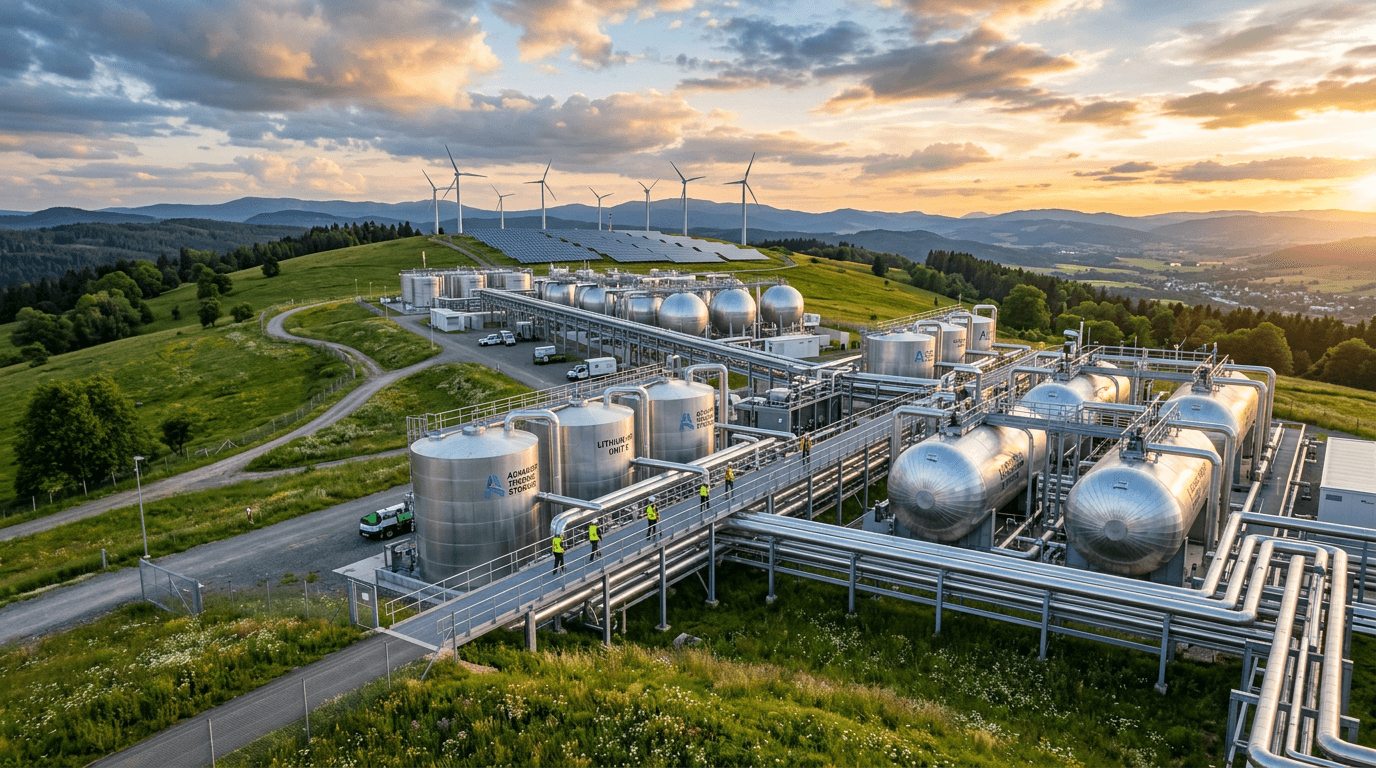
Startup RheEnergise decided, however, that mountains are overhyped. Their High-Density Hydro (HD Hydro) system is a closed loop of two reservoirs connected by a pipe, hidden underground, with one brilliant "twist".
The key is not the height from which we drop the liquid, but its mass. Instead of ordinary water, whose density is as exciting as the dashboard in an old Dacia Logan, a special, dense mineral fluid is used.
This "magic fluid" has a consistency close to liquid chocolate, but is two and a half times heavier than water. Thanks to this, electric cars can be charged from storage units that take up much less space.
The result? You can achieve the same power as in a gigantic dam, building the system on a small hill near Radom or along the A2 motorway. The level difference needed to operate is only a few dozen metres, not hundreds, as with traditional power plants.
It's as if you put a fighter jet engine into a Fiat Panda – suddenly parameters that seemed unattainable at such a small scale become everyday reality. The system is smaller, cheaper to build and completely invisible, because most of the installation ends up underground.
For people browsing the catalogue of new models, such grid stability is the key to low running costs.
Electricity prices and electric cars
Now the most important thing for the wallet – costs. The energy industry uses the term LCOS (Levelized Cost of Storage), i.e. the total cost of storing a unit of energy over the entire device lifecycle.
The HD Hydro system, on an eight-hour cycle, costs a fraction of what a lithium-ion battery pack of the same capacity costs. While a battery after 10 years is mostly good for recycling, a gravity system can operate for 60 or even 80 years.
You only replace seals in the turbine and lubricate the bearings, while the mineral fluid never loses its properties. Average electric cars require their battery fleet to be refreshed much more often.
In a world where the price of electricity at public chargers in Poland can hit 3.50 PLN per kWh, any technology that lowers storage costs is worth its weight in gold.
The main problem is not a lack of sun or wind – the challenge is what to do with that electricity at 2:00 PM on a Sunday when nobody needs it, and where to get it at 7:00 AM on a Monday when everyone is brewing coffee.
Chemical batteries do not scale well to the city level, and electric cars need energy precisely during peak hours. Gravity scales perfectly.
While we get excited about a cheap Chinese EV entering Europe and the new Kia EV2 promising great range for just under 100,000 PLN, the real revolution is happening "under the hood" of infrastructure.
RheEnergise claims that in Texas alone they have found over six thousand sites suitable for their "liquid batteries". In Europe those numbers run into tens of thousands. Every railway embankment or post-mine heap can become a power plant.
Global electric cars will finally gain a foundation that does not depend on the whims of the lithium market.
The Polish electric landscape 2026
In Poland at the start of 2026 we have an interesting situation. On one hand, luxury models promise us over 700 km of range and charging that takes as long as drinking an espresso.
On the other hand – the second-hand market is being flooded by used electric cars that lose value faster than pre-election promises. Valuations of cars from the first electrification wave are today often 25 percent lower than equivalent combustion models.
This is due to fears about the cost of replacing a degrading battery. In a system based on gravity, "degradation" does not exist. It's Newton's physics, not quantum chemistry.
If energy storage becomes as simple as in the British concept, home charging for a fraction of the cost of fuel will no longer be a pipedream.
Imagine: you charge your car with electricity that was pumped up a hill behind the estate at night using surpluses from wind farms. Suddenly, electric cars become the most logical choice for every block resident.
The idea that dense sludge flowing in a pipe under a local overpass can power your luxury EV is wonderfully ironic. It's proof that real progress often requires returning to the basics of physics rather than blindly rushing after expensive rare earth metals.
We do not need to cover the country with hectares of panels and count on the Gobi not running out of elements. It is enough to use mass and height. This approach democratises access to energy.
You don't need permission from a global cell supply monopoly; you need an excavator, pipes and a common mineral that nobody will go to war over.
In such a world electric cars become a tool of energy freedom, not dependence on imports.
Technical challenges and project reality
Of course, not everything is that rosy. Pumping a dense fluid requires powerful pumps and turbines that must cope with erosion. This is not ordinary hydraulics, it is a fight with matter that puts up resistance.
RheEnergise engineers have designed special turbine blades that do not wear out instantly. However, compared to the challenges of lithium thermal stability, these are purely mechanical problems.
By solving them, we make it so that electric cars can use systems with an 80-year lifespan. Another aspect is round-trip efficiency.
Lithium batteries return about 85-90% of energy. HD Hydro systems target 80%. Is that 10% loss a problem? On a global scale – absolutely not, given the significantly lower construction costs.
In energy, what counts is the average cost. When you park new electric cars in your driveway, you won't ask about a few percent loss in storage if your electricity bill drops by half.
Verdict: will electric cars benefit?
The RheEnergise system is a rare case of engineering genius combined with simplicity. We don't need lithium mines visible from space or gigantic dams destroying entire ecosystems.
All you need is a pipe, a dense fluid and good old gravity, which – unlike EV range at -20 degrees – will never let us down.
Electric cars gain a real chance to be truly "green" at every stage of the energy supply chain.
If this solution goes mainstream, the only worry will be whether our car rusts faster than we manage to charge it with that wonderfully cheap electricity.
Gravity systems are a return to the roots of mechanics in the service of tomorrow's technology. It is the most sensible direction electric cars have taken in decades.
When choosing a model from the catalogue, it is worth remembering that the energy driving it may soon come from a nearby hill.
FAQ – Frequently asked questions
What exactly is the High-Density fluid and is it environmentally safe?
The fluid used in the HD Hydro system is a proprietary mixture of water and high-density powdered minerals, such as magnetite or barite. The density of this suspension is about 2.5 g/cm³, meaning it is 2.5 times heavier than water. It is chemically inert, non-flammable and non-toxic. Thanks to this, every charger powered by it uses a safe source. In the event of a leak, the minerals simply settle on the ground, causing no contamination, which gives an advantage over battery electrolytes.
What is the energy efficiency of such a system compared to the Tesla Powerwall?
The round-trip efficiency of the HD Hydro system ranges from 75% to 82%. For comparison, home lithium-ion storage units, such as the Tesla Powerwall, achieve around 88-90%. Although HD Hydro is slightly less efficient, it makes up for it with longevity. While batteries used in electric cars lose efficiency after a few thousand cycles, a gravity system can work for decades without a drop in parameters.
Can the system freeze in Polish winter conditions?
The system is installed underground, below the ground frost line. Moreover, the high density of the minerals and the continuous movement of the fluid prevent crystallisation. HD Hydro is much more resistant to frost than classic electric cars, whose cells at -20°C lose a significant part of their performance. Gravity works regardless of the weather.
What terrain slope is required for proper operation?
This is the biggest advantage of this technology. Thanks to the high density of the fluid, HD Hydro requires an elevation difference of only 30-100 metres. This allows installation on gentle hills, of which there is no shortage in Poland. It will facilitate mass powering of fleets by electric cars without a thorough network rebuild.
How much energy can one such installation store?
The scalability of the system is huge. Standard RheEnergise modules have a power output from 100 kW to 50 MW. A 5 MW installation could power a medium-sized housing estate for a whole day. This means hundreds of electric cars can be charged simultaneously without the risk of overloading the local grid.