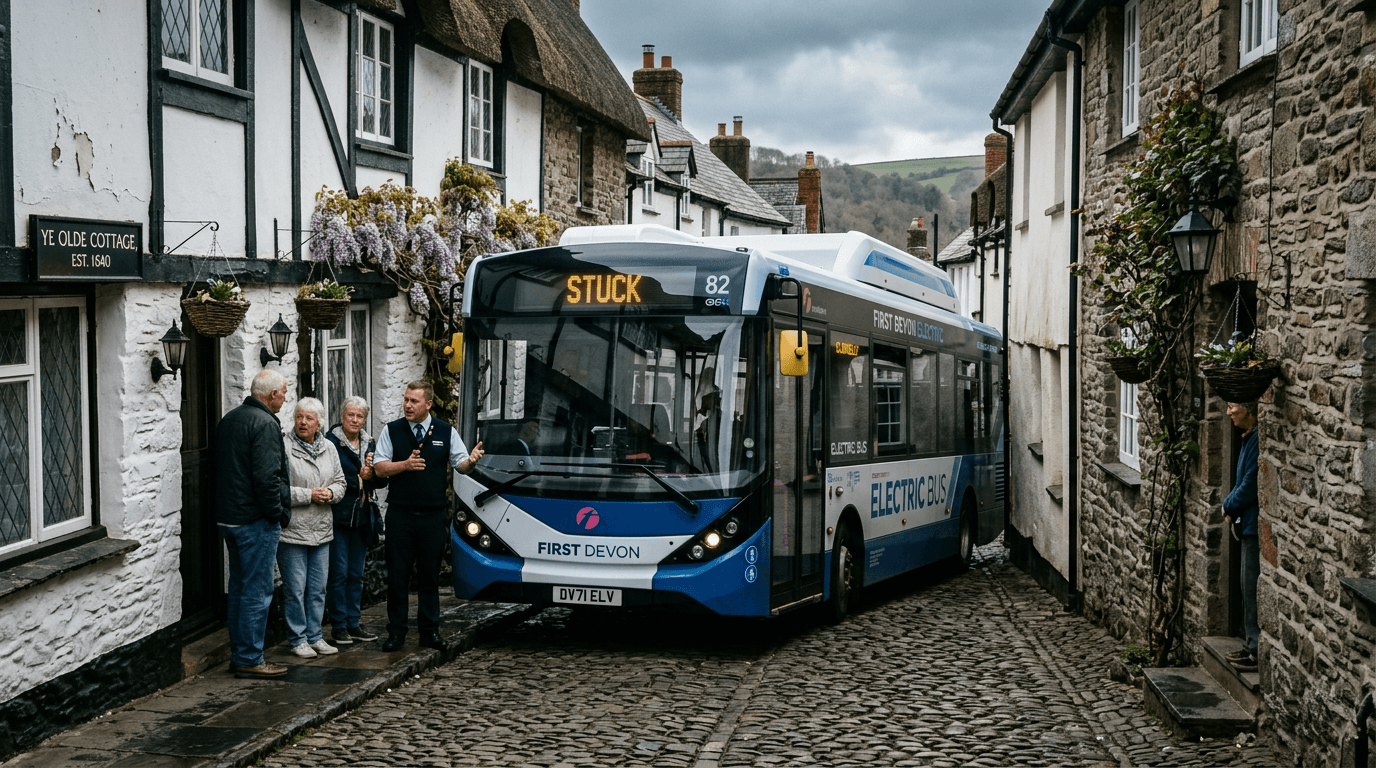
In Devon, UK, passengers can wave at their new electric buses… from a distance. The modern battery-powered colossuses turned out to be a little too hefty for narrow English streets.
On paper the dimensional difference is marginal, often measured in centimetres. But in a world of physics where roads are gutter-wide, those "few centimetres" turn the bus into a stationary barricade. Stagecoach engineers had to admit the mistake, which generates huge delays and forces sudden route changes.
The problem is prosaic but brutal: batteries. For these electric cathedrals to cover more than the distance from the depot to the nearest kiosk, they must haul hundreds of kilograms of cells. The mass of lithium-ion packs in a modern 12-metre bus can exceed three tonnes.
This requires a sturdier structure and a wider axle track for stability. Suddenly, what was an agile diesel becomes an oversized celebrity that cannot squeeze between parked cars. These XXL electric vehicles require new road geometry.
The turning geometry of an electric bus is different. Because of the high mass often placed on the roof, the centre of gravity shifts in a way that forces drivers to take corners much wider.
What an old Jelcz or Solaris with a combustion engine handled in one move becomes a surgical operation for the electric giant. The result? Routes are cut, stops are relocated, and passengers train for cross-country runs to the main arteries. Often the only way to check the parameters of such machines is a professional technical catalogue.
Poland's fight for electric vehicles and centimetres
You think it is different here? Not at all. From 1 January 2026, Polish cities above 100,000 inhabitants have a knife at their throat – national electromobility rules are clear: you may buy only zero-emission vehicles.
That means either you buy an electric vehicle or you ask passengers to push a smoky old Ikarus, as long as it is "zero-emission". It is an ambitious plan that completely ignores the fact that most of our cities were designed when the pinnacle of transport technology was the steam locomotive.
Modern electric vehicles in public transport are becoming everyday reality. Warsaw is going for a record, planning to put 248 new electric buses on the streets, which together with infrastructure will cost astronomical sums.
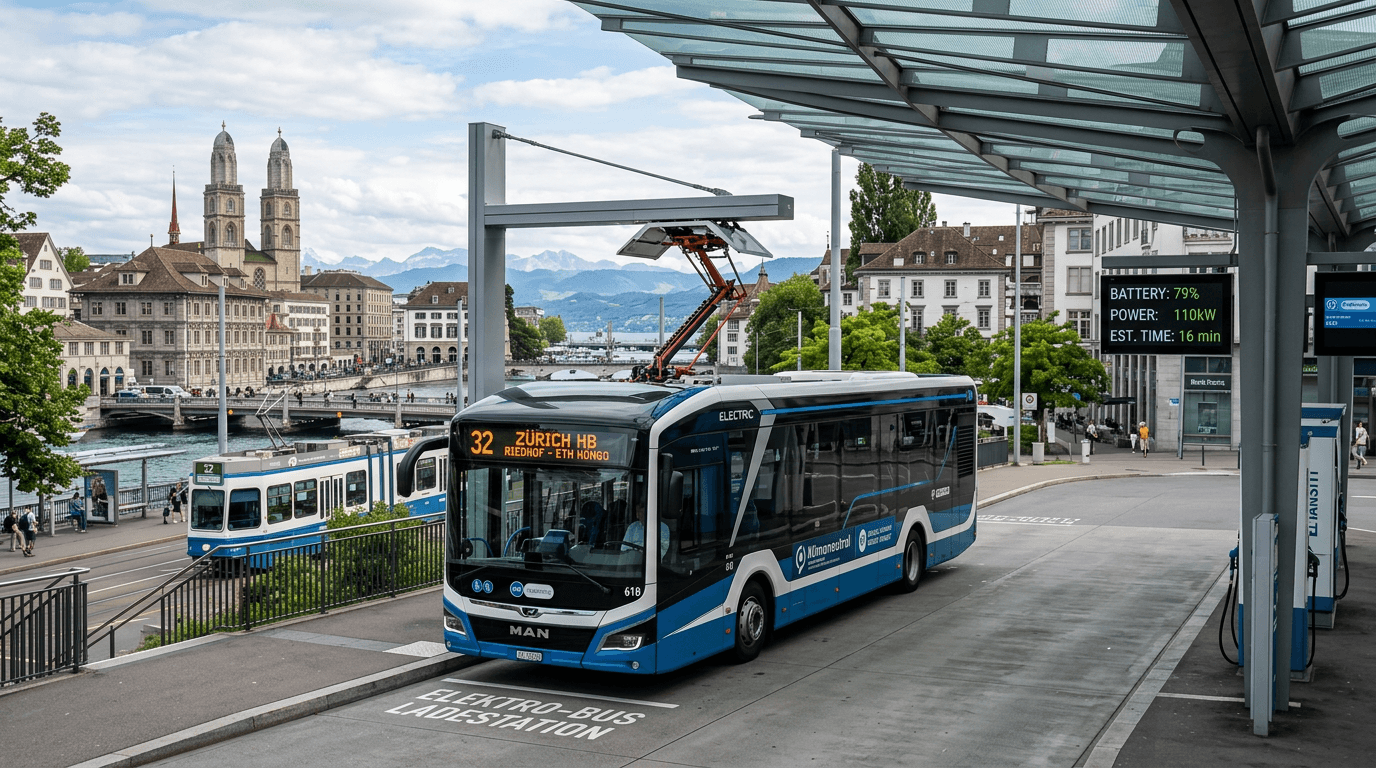
Krakow and Lodz are not far behind. They are ordering dozens of machines, including hydrogen inventions that theoretically offer greater range but require building refuelling stations at 350 bar pressure. This is technology that is more expensive and demanding than a Mars mission. Even a standard charger for such large units must deliver enormous power.
Polish cities, with the tight fabric of Old Towns and 1970s housing estates, face a dilemma: demolish tenement houses or give up on transport? Although EU programmes shower hundreds of millions of zloty in subsidies, nobody asks whether all those Chinese Yutongs or German eCitaros will pull a Devon-style stunt on us.
Replacing an old diesel with an electric vehicle in the centre of Krakow without rebuilding streets is like playing Tetris with blocks that have suddenly swollen two sizes. The outcome is a foregone conclusion.
Polish urban infrastructure can welcome these novelties with the same hospitality as a tight shoe can welcome a giant's foot. Already, drivers in Wroclaw and Poznan report that manoeuvring new models in dense traffic requires serious acrobatics.
Moreover, every collision involving electric vehicles carries the risk of a fire that is hard to extinguish without a specialised water container. These are challenges rarely mentioned in cheerful press releases.
The technological race of luxury fridges
One thing must be admitted: these machines are engineering masterpieces. The new Mercedes eCitaro with NMC4 batteries is a rolling energy bank whose energy density has grown by nearly 50% compared with the first generation.
With capacity reaching 777 kWh in the articulated version, it could power a small village for a week, while covering up to 600 kilometres on a single charge – provided the route is as flat as a billiard table. Such electric vehicles are reshaping cities.
Service costs? Here electric vehicles shine. No gearbox, no complex injectors, no DPF filters and no AdBlue systems mean that, in theory, maintaining such a vehicle is 30-40% cheaper than a diesel.
Regeneration also makes brake pads last three times longer. That sounds like a fairy tale for city treasurers – until you have to replace the entire battery pack after seven years, which costs roughly half a new vehicle.
There is a dark side of power too. In winter, lithium chemistry in batteries behaves like me without morning coffee – it simply refuses to cooperate dynamically. Although manufacturers already install advanced heat pumps, you cannot cheat physics.
At -15 degrees Celsius, real-world range can drop by 40% versus the brochure promises. This means operators must keep more vehicles in reserve to maintain timetables. So if you live on an estate with narrow alleys, your electric vehicles may in winter become the most expensive ice sculptures in the world.
Efficiency and electric vehicles in cities
The electrification of transport after 2026 is not evolution – it is a brutal invasion of technology onto the urban fabric. We buy buses with the capabilities of spaceships to run them on streets designed for horse-drawn carriages and the Fiat 126p.
The truth is this: until we teach batteries to levitate, we will keep watching the comic fight of giants with kerbs. Larger electric vehicles are heavier, wider and behave completely differently from classic diesels.
It is progress, yes, but served as subtly as trying to fit a concert grand piano into a phone booth. Have a pleasant journey – provided your stop still exists and the modern charger on the route actually works.
The basic catalogue of advantages highlights ecology but forgets physics. Electric vehicles in bus format require rebuilt intersections. If cities do not invest in infrastructure, even the best drivetrain will not help keep services on time.
Zero-emission transport is the future, but it must respect spatial limits. In the end, electric vehicles will only be as effective as the roads they are allowed to use.
FAQ – Frequently asked questions
Are electric buses really wider than combustion buses?
Formally, vehicle width is regulated by law (usually up to 2.55 metres), but the real issue lies in "operational width". Because of the huge battery mass on the roof and different component layout, modern electric buses have a longer wheelbase, which dramatically increases the turning radius. While a classic diesel "breaks" into a tight corner, an electric bus often needs extra lateral margin.
What is the actual battery lifespan in a city bus?
The lifespan of NMC batteries is estimated at around 3,000-4,000 full charging cycles, which translates to 7 to 10 years of city operation. After that, capacity drops below 80%, disqualifying them from intensive line service. These batteries then move into stationary energy storage, and the vehicle requires costly cell replacement.
How are cities solving winter range problems?
The key solution is CO2 heat pumps, which are far more efficient than classic heaters. In addition, pantograph charging at terminal loops is used to top up the battery with high current during a few minutes of layover. In extreme conditions, some systems use auxiliary heating so the main battery is not drained.
How much electricity do large electric vehicles use per 100 kilometres?
The average energy consumption of a modern 12-metre bus ranges between 100-140 kWh per 100 km. For comparison, an articulated bus at full load with air conditioning running can use up to 200-250 kWh per 100 km. These values are many times higher than those of a typical passenger electric car.
Can city power infrastructure handle charging hundreds of buses?
This is a huge technical challenge. Charging a large fleet at the same time requires connections of several megawatts. Solutions include smart charging management systems that balance the grid load overnight, and energy storage units that collect electricity during the day to feed vehicles at peak demand.
Why are hydrogen buses considered an alternative?
Hydrogen buses eliminate the problem of huge battery mass. Hydrogen tanks and fuel cells are lighter, which improves driving dynamics. Refuelling is quick, and range is stable regardless of temperature. However, the cost of producing fuel and building stations is currently much higher than for traditional electric charging infrastructure.