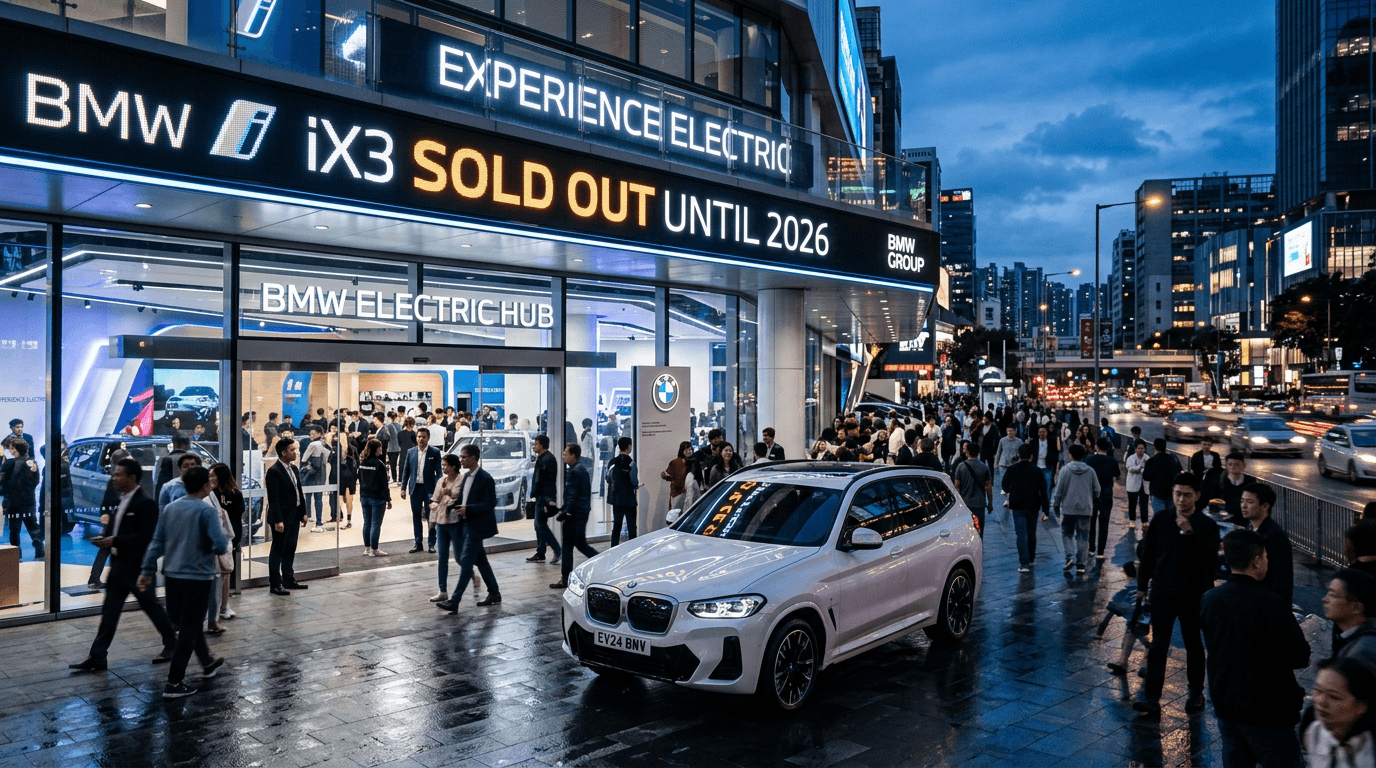
It's April 2026, and the automotive world has just experienced a collective loss of its senses. If you planned to drop into a BMW dealership in the morning and drive out in a brand-new BMW iX3 before lunch, here's the news: you might as well try to buy a business-class ticket to Mars, launching from your back garden.
The factory in Debrecen, Hungary is smoking like a 19th-century Łódź textile mill at the height of the industrial revolution, and still, the entire production for this year – and most of next year – evaporated faster than election promises. The Germans had to fire up a second, and then a third shift, to satisfy the hordes of customers who bought the car before they even touched its steering wheel.
Have they gone mad? Or is this simply the best SUV your tired eyes, accustomed to boring plastic boxes on electricity, have ever seen? The situation in showrooms resembles a siege. Salespeople, instead of encouraging purchases, play the role of psychologists, explaining to desperate company CEOs that their unit will only roll off the line when their children have grown up.
Building an SUV with queues like in the old PRL era is either a marketing masterstroke or proof that the rest of the world is still producing electric wheelbarrows, while BMW has just launched an intergalactic cruiser into space.
This is not an ordinary launch. It is market paralysis, showing that when the Bavarians get serious about designing from a clean sheet of paper, the rest of the world might as well hand in their resignations and start producing chargers for phones instead of cars. Demand for the BMW iX3 has exceeded analysts' boldest expectations.
Technological knockout with the "Heart of Joy"
Remember all those EVs that drove like a heavy fridge on wheels with loose hinges? Forget them. The BMW iX3 is the first model of the long-awaited Neue Klasse family, and I have to admit, the name is not overstated in the slightest.
This is not another facelift in which the stitching pattern on the seats was changed and three new colours of ambient lighting were added. It is a foundation built from scratch, a revolution on the scale of the move from horse-drawn carriages to combustion engines. Under the bonnet – or rather, deep in the chassis – sits a system that engineers proudly named Heart of Joy.
Yes, I know it sounds like the name of a Japanese cartoon or a cheap air freshener, but in reality it is a supercomputer with 20 times more computing power than the systems previously used in the iX or i7. This silicon brain manages everything in real time.
From the intelligent xDrive system, which juggles torque faster than you can think, through the active air suspension, to your confidence on wet asphalt. The new BMW iX3 redefines how modern premium electric cars should drive.
The result? The top version delivers 469 hp and catapults to 100 km/h in 4.9 seconds, doing so with the grace of a ballerina who has just had three strong espressos and intends to win the Olympics. There is no trace of the understeer so typical of heavy SUVs.
There is only pure, Bavarian precision. The steering transmits information about the road surface with such accuracy that you could drive over a coin and tell whether it is heads or tails. That is precisely why the BMW iX3 is so coveted by brand fans.
BMW iX3 range and efficiency
The biggest problem with EVs? Range. Or rather, its painful absence as soon as the temperature drops below zero, or when you dare to drive on the motorway faster than a retired teacher on a Sunday. The BMW iX3 50 xDrive, however, kicks down the door on these discussions, offering next-generation batteries with 20% higher energy density.
The 108.7 kWh net pack is a masterpiece of chemistry and physics. Officially, according to the standards, you can drive up to 805 km on it. It is worth checking the market catalogue to see how this design outclasses the competition.
During efficiency tests in real conditions between Budapest and Munich, this car covered over 1,000 kilometres on a single charge. Of course, it happened without air conditioning, on special tyres and at speeds that could put a sloth to sleep, but the fact itself is staggering.
This shows the potential of the new architecture the BMW iX3 carries. At a normal motorway pace of 140 km/h, the car easily covers 500–550 km. That puts almost the entire competition from the USA and China on its back.
When an EV drives 500 km at 140 km/h, Tesla owners suddenly start taking up knitting to keep their hands busy during stops the BMW no longer needs.
And when the power does run out? The 800V architecture allows charging at a stunning 400 kW. In eighteen minutes plugged into a super-fast charger such as Ionity, you will recover enough energy to drive from Warsaw to Gdańsk, and with a very heavy foot.
It is the first time in history that driving an EV does not feel like planning a complicated invasion, but a simple, relaxing premium journey guaranteed only by the BMW iX3.
A futuristic interior and a price that… doesn't kill?
Inside, it is at the very least… bold. Forget the traditional dashboard you have known for decades. The designers behind the BMW iX3 threw out the classic gauges behind the steering wheel and replaced them with the Panoramic Vision system – a 43-inch digital strip displaying data directly at the base of the windscreen.
It feels as if you were piloting a Star Wars cruiser rather than an SUV for the weekly shop. If you like minimalism, you will feel like you are in a modern art gallery. If not – well, you can always stroke the noble Merino leather from vegan farms and enjoy the gigantic 1,750-litre boot with the rear seats folded down.
The Germans also thought about practicality. A novelty in the BMW iX3 is the Vehicle-to-Load (V2L) system. If, while stuck in a terrible traffic jam on the Zakopianka road, you fancy a coffee from your home lever espresso machine, you simply plug it into the socket in the car.
This vehicle can easily tow a concrete mixer or a heat pump if you decide to build a house in the middle of a field. Modern electric cars rarely offer such versatility.
The biggest shock awaits in the price list. The new BMW iX3 starts in Poland at 310,000 PLN. That is almost exactly what you currently have to pay for a combustion-engined X3 with a powerful diesel under the bonnet.
It is an almost unprecedented moment when such a gigantic technological leap does not require the customer to mortgage their mother-in-law's house. Browsing the catalogue, it is hard to find a better price-to-technology ratio today.
Verdict: The king called BMW iX3
The described model is not just another boring EV thrown into the lineup to make the CO2 emission columns add up. The BMW iX3 is a powerful Bavarian middle finger pointed at the competition, which is still wondering how to build an efficient powertrain.
It is fast as a bullet, outrageously modern and offers range at which most rivals would have to be towed halfway. If you have 310,000 PLN to spare and the patience of a monk to wait for delivery until 2027 – buy the BMW iX3 without thinking twice.
This car makes every Tesla look like an old calculator next to a quantum processor from NASA. The brand has just proved that the old king has no intention of abdicating, but has merely switched fuel to clean, digital energy. By choosing the BMW iX3, you invest in a future that has already arrived.
FAQ – Frequently asked questions about the BMW iX3
What is the real charging time of the iX3 using a home Wallbox?
Using a standard 11 kW Wallbox (AC, 3 phase), charging the 108.7 kWh battery from 0 to 100% takes about 10 hours and 15 minutes. That means by plugging the car in in the evening, you always wake up to a full range in your BMW iX3. With 22 kW units, this time is cut in half.
Does the 800V architecture really shorten motorway journey breaks?
Definitely yes. Thanks to the 800V architecture, the BMW iX3 accepts charging power of up to 400 kW. In optimal conditions, topping up enough energy for another 300 km takes only 10–12 minutes. The thermal management system precisely prepares the cells before pulling into the station.
What is the BMW Panoramic Vision system and can it be switched off?
It is the new generation of Head-Up display in the BMW iX3, spanning the full width of the lower edge of the windscreen. It shows key information directly in the driver's field of view. It can be personalised through the iDrive menu, but because there are no traditional gauges, it serves as the main information panel.
How does xDrive work in a fully electric version?
In the electric BMW iX3, xDrive has no physical propshaft. There is an independent motor on each axle. The "Heart of Joy" computer distributes torque millions of times per second, delivering exemplary traction and eliminating slip before the driver even feels it.
Can the iX3 act as a powerbank for the whole home (V2H)?
Yes, the new architecture supports bidirectional energy flow (Vehicle-to-Home). It requires a suitable charging station, but the 108 kWh battery can power an average-sized household for up to 4–5 days during a grid outage.
What warranty does BMW offer on battery degradation?
BMW guarantees that the battery will retain at least 70% of its capacity for 8 years or up to 160,000 kilometres. Thanks to the new NMC cells, the expected longevity of the pack is significantly higher, making the BMW iX3 a safe long-term choice.