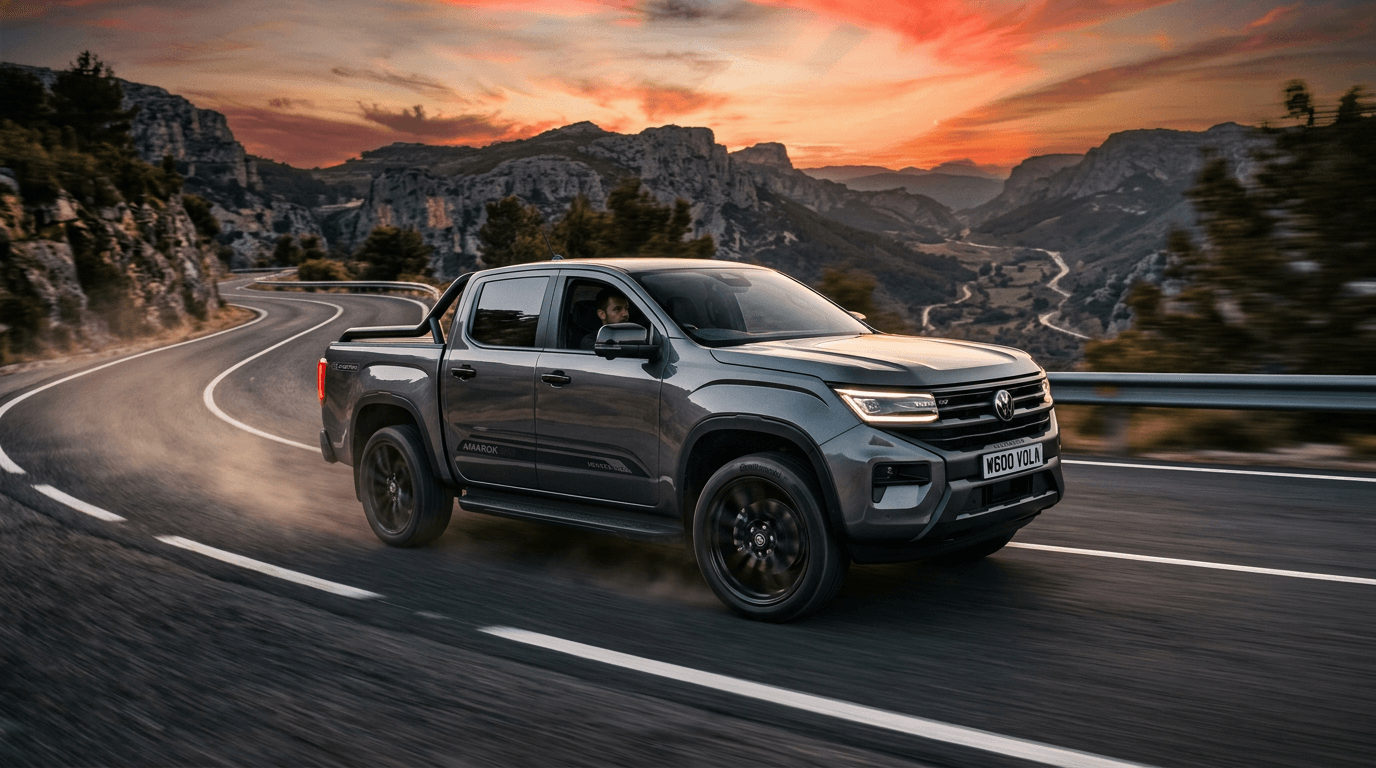
Volkswagen Amarok W600: the pickup that devours asphalt instead of mud
Imagine going to a wedding in rubber boots, but wearing thermal underwear and sprinting spikes under your tuxedo. Sounds like a recipe for disaster, right?
Meanwhile, Volkswagen, with help from the Australian magicians at Walkinshaw, decided to do exactly the same with its pickup. The new Volkswagen Amarok W600 is a car that has as much in common with digging ditches as I do with classical ballet.
It is a machine built for someone who wants a pickup, but is terrified of tipping over in a corner like a drunk elephant on a bicycle.
Building a sporty pickup on a diesel platform is like trying to win a marathon in a knight's armour – theoretically pointless, but the end result earns a perverse respect for the engineers' craft.
In a world where pickups usually compete to see who can pull a bigger log out of the mud, the Volkswagen Amarok W600 stands in opposition. It is a manifesto of road selfishness, wrapped in a body with a cargo bed that probably never tastes gravel.
The project was born from a simple, if somewhat absurd, observation: most owners of expensive pickups spend 99% of their time on tarmac, complaining that their cars handle like jelly on wheels.
Walkinshaw took the German base and breathed a sportsman's soul into it, creating unique electric cars and combustion vehicles with a sporting edge.
Volkswagen Amarok W600 and the chassis revolution
The biggest change in the Volkswagen Amarok W600 did not happen under the bonnet, but where only mechanics and very nosy dogs look. The engineers threw out the standard, anvil-hard suspension and replaced it with a set from the renowned firm Koni.
This was not a simple shock absorber swap. The entire geometry of the car was rethought. A 22-millimetre rear anti-roll bar was added, which in the pickup world is as rare as finding fresh lettuce in a fast-food restaurant.
Most cars in this segment have a rear end that lives its own life, especially when the bed is empty. Here the car is obedient like a trained German shepherd.
The result? This car is meant to be driven. Not “rolled”, not “floated”, but to precisely carve corners. While the standard model available in the market catalogue in Style trim costs around 293,970 PLN, the Volkswagen Amarok W600 holds the road uncompromisingly thanks to Michelin Pilot Sport 4 tyres.
It is like fitting professional running spikes to an old tractor. These tyres are the key to understanding this machine's philosophy – they provide phenomenal grip, which combined with 4Motion drive turns it into a highways dominator during heavy rain.
It is worth pausing on the Koni engineering itself. The dampers used feature selective damping technology, which allows them to tell apart a brutal hit into a pothole from a slow body roll in a corner.
Thanks to this, despite the stiffer setup, the driver's spine stays in place at every manhole cover. It is an engineering masterpiece that makes a car weighing nearly two and a half tonnes suddenly begin to cheat the laws of physics.
The aesthetics of a premium German pickup
The Volkswagen Amarok W600 does not try to be discreet. It received 20-inch alloys with a unique design, which look as if they were stolen from a luxury SUV, plus wider arches, making the car wider than an average runway.
Those wheel arches are not just for show – they have to accommodate the wider track, key for lateral stability. On top of that come electrically deployed side steps – a mechanism so theatrical that its only purpose is to make the neighbour jealous. If these were electric cars, their aerodynamic shape would be even more distinctive.
Inside we find aluminium pedals and the Walkinshaw logo embroidered on the headrests. It reminds you that you are sitting in something special, even though underneath it is still the solid construction Volkswagen shares with the Ford Ranger.
You can feel German precision mixed with Australian bravado – a cocktail as strange as pineapple pizza, but surprisingly digestible. The dashboard has been trimmed with great attention to detail, and the Harman Kardon audio system provides a fitting acoustic setting.
The Amarok's interior is so civilised that you forget about the bed at the back, until you glance in the rear-view mirror and realise you are transporting air with immense class.
Walkinshaw did not stop at cosmetics. The radiator grille was also changed and now looks considerably more aggressive. Dark accents replaced cheap chrome, giving the car a brooding character.
Every exterior element shouts that the Volkswagen Amarok W600 is a tarmac vehicle, not a hardcore off-roader. To service it in the garage, a modern charger would come in handy if the car were a plug-in hybrid.
Engine pragmatism versus power dreams
Under the bonnet of the Volkswagen Amarok W600 you will not find an atomic reactor, which for some may be a disappointment. Walkinshaw left the standard three-litre V6 TDI in place.
It produces 240 hp and a hefty 600 Nm of torque. That is enough to shift a barn or tow a yacht trailer through the Alps, but decidedly too little to challenge the Ford Ranger Raptor.
The Raptor with its almost 400 hp can bend space-time, while the Amarok bets on the brutal but predictable strength of a diesel.
The creators of the Volkswagen Amarok W600 claim that 600 Nm is “just right”. The truth is that this engine is a solid piece of engineering, which in Poland we appreciate in PanAmericana or Aventura versions (costing from 318,570 PLN to 343,170 PLN).
Torque available from the very bottom of the rev range lets you overtake truck columns without dropping three gears in the perfectly calibrated 10-speed automatic.
In the special Volkswagen Amarok W600 edition, the engine only received a new exhaust system with two tailpipes, which sounds slightly less like a tractor and more like… a very fast tractor.
Acoustic specialists spent hundreds of hours to squeeze out of the diesel V6 a sound that does not get tiresome on a trip, but when you floor it brings a smile to your face. It is a subtle difference that only true purists will appreciate.
Why is the Volkswagen Amarok W600 a one-off?
Does the Volkswagen Amarok W600 make sense? If you live in Australia and your passion is taking corners at high speed while hauling a tonne of fertiliser – absolutely yes.
It is a pickup that, instead of wallowing in mud, prefers to embarrass hot hatches on the motorway. It is a car of paradoxes that contradicts its class's purpose, but does so with such confidence that it is hard not to like it. When planning a purchase, it is worth checking the available catalogue and comparing it with other versions.
For us in Europe, it remains an exotic curiosity, because Walkinshaw is a product reserved for antipodeans. We have to make do with the standard Amarok V6, which still impresses with its versatility.
However, the Volkswagen Amarok W600 proves that the boundary between a “workhorse” and a “lifestyle vehicle” has long since been erased. Although a home battery charger can only handle the smaller systems of this car, its character remains fully combustion-driven.
The Volkswagen Amarok W600 is like surfing on an iceberg – utterly pointless, extremely niche, and precisely for that so brilliantly fascinating. It is a triumph of form over content, where the form is so refined that the content loses meaning.
For brand fans who regularly browse the catalogue of utility models, this version will remain a realm of dreams about ideal handling.
FAQ – Frequently asked questions
How does the Walkinshaw suspension differ from the standard Amarok?
The key difference in the Volkswagen Amarok W600 is the use of Koni dampers with Frequency Selective Damping (FSD). Unlike standard twin-tube dampers, those in the W600 have an additional valve controlling oil flow depending on vibration frequency. This lets the car stiffen during slow body movements (corners), while keeping comfort over fast bumps. In addition, a 25% stiffer rear anti-roll bar is used.
Does the Volkswagen Amarok W600 have differential locks?
Yes, despite its road-oriented character, the Volkswagen Amarok W600 uses 4Motion drive. This means an electronically controlled centre differential and a classic mechanical rear differential lock. The car offers 2H, 4H, 4L driving modes plus an intelligent 4A mode that automatically splits torque between the axles.
What are the towing and payload figures of the W600?
The suspension changes in the Volkswagen Amarok W600 did not hurt its utility figures. The machine retains the ability to tow a trailer weighing up to 3500 kg. Payload is around 1000 kg, depending on equipment (e.g. electric bed cover). Towball download is the standard 350 kg, making it a fully-fledged pickup for heavy jobs.
Why Michelin Pilot Sport 4 tyres instead of AT?
The choice of Michelin Pilot Sport 4 (275/45 R20) tyres was driven by the desire for maximum stability and shorter braking distances on tarmac. All-Terrain tyres have a tall profile and soft tread blocks that “float” during aggressive manoeuvres. Pilot Sport 4 offer significantly higher lateral stiffness, which is key to the precision of handling this colossus.
Has the V6 TDI engine in the W600 been modified for more power?
Walkinshaw deliberately does not touch the engine software (ECU) in the Volkswagen Amarok W600, in order to preserve the full warranty. The 3.0 V6 TDI unit produces a factory 250 hp peak power and 600 Nm of torque. The only mechanical change is a modified cat-back exhaust system, which improves the sound without affecting real dyno figures.