
Real-world range: 165 km
Dacia Spring: cheapest electric car in Poland – prices, range, and 2026 market reality
A March 2026 look at the cheapest electric and petrol cars in Poland. Dacia Spring, Citroen ë-C3, BYD Dolphin Surf, and other budget models compared on price, battery, and WLTP range.
EvCompass Editorial TeamPublished Updated 9 min read
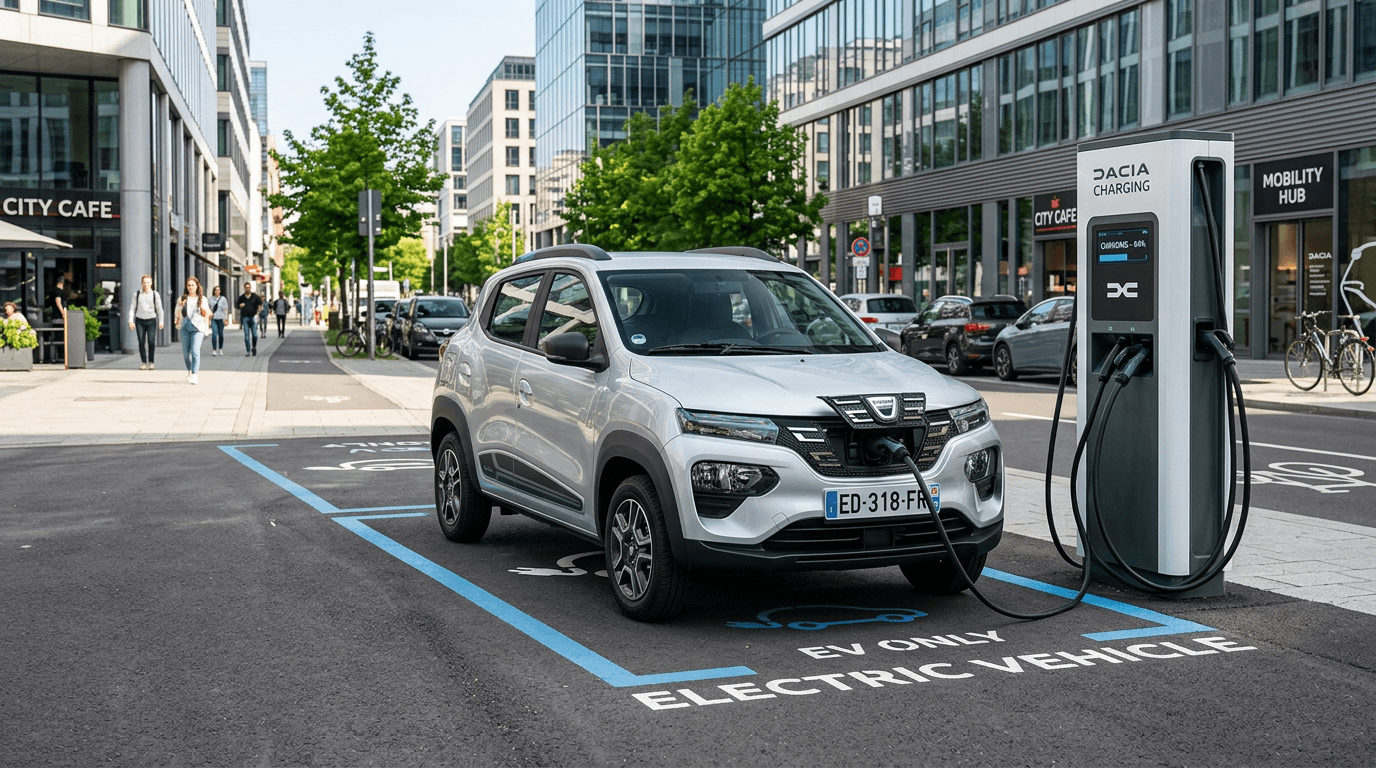
The last bastion of cheap driving, or why 2026 is an automotive purgatory
It is March 2026 and I have to say it out loud: if you are still waiting for new car prices to drop to the level of a small African country's budget, I have bad news for you.
That ship has not only sailed, it has already sunk, been salvaged, and recycled into energy-drink cans. When choosing today's dream electric or combustion cars, you have to accept that "cheap" means no longer pawning both kidneys – it is enough to hand over half of your freedom to the bank for seven years.
Inflation, Euro 7 emissions standards that came into force in a softened yet still costly form, and mandatory ISA systems have turned the budget segment into a campfire myth.
In 2026, the automotive market resembles a playground after a cyclone. Old hierarchies lie in ruins, and badges on the bonnet that once inspired prestige now only trigger sympathy for the owner's wallet.
Once, when you bought a car, you chose between suspension characteristics and engine durability. Today you choose whether your wallet will be devoured by EU regulations or by Chinese electronics that know more about you than your own mother.
The fight for the customer is no longer waged on the field of engineering excellence, but on production optimisation and access to semiconductors. Modern electric cars are becoming the standard, but their price still forms a barrier for many households.
Price and market reality in 2026
| Model | Price (from) | Battery | Range (WLTP) | Power |
|---|---|---|---|---|
| Dacia Spring Essential | PLN 66,500 | 24.3 kWh | 225 km | 40 kW |
| Citroen ë-C3 YOU | PLN 88,900 | 30 kWh | 212 km | 30 kW |
| BYD Dolphin Surf | PLN 97,700 | 43.2 kWh (LFP) | 322 km | 85 kW |
| Dongfeng Box | PLN 99,900 | 42.3 kWh | 310 km | 87.8 kW |
| Hyundai Inster | PLN 104,900 | 42 kWh | 327 km | 85 kW |
Let us start with the veteran that refuses to leave the stage – the Mitsubishi Space Star. It is like an old TV remote: it has no features worth mentioning, yet somehow it still works.
For PLN 56,990 you get a vehicle with a 1.2 engine producing 71 horsepower. Seventy-one horsepower. That is roughly enough to move a lawnmower, not a device meant to race down the highway.
With torque of 102 Nm, overtaking a truck becomes a religious event – requiring deep faith and fervent prayers.
But here is the thing: this is currently the cheapest ticket to the world of motoring in Poland. It is so bare-bones that air conditioning as standard feels like the peak of bourgeois luxury.
However, if you want something that does not look like a project drawn with a set square by a sad accountant, you must set aside PLN 63,900 for a Dacia Sandero. It is a fascinating car.
The Essential version is so "essential" that instead of a touchscreen you get a plastic smartphone holder. It is brilliant – Dacia decided your phone is smarter than its entire R&D department.
If you are interested in other models, check our catalogue to compare available options. To be honest, the manufacturer has a point.
Instead of spending millions on infotainment systems that age faster than yoghurt, they give you a piece of plastic for PLN 2. That is what you call pragmatism.
The Chinese invasion and imported electric cars
While we get excited about manual windows in the Dacia, an army that takes no prisoners is approaching from the East. Brands such as MG, BAIC, and BYD, offering dynamic electric cars, are growing rapidly in Poland.
The MG3 for just under PLN 88,000 offers equipment that makes a base Volkswagen T-Roc (starting today at the dizzying PLN 130,390!) look like a cell in a strict-regime monastery.
The Chinese understood what Europeans refuse to accept: today's customer rarely asks about handling precision on the Nürburgring. They ask whether the screen is 12 inches and whether you can connect wireless Apple CarPlay.
European manufacturers are in a panic bordering on hysteria. Volkswagen is trying to save the situation with the new ID. Polo (known as ID.2all), which was meant to be a revolution.
They promise a price around EUR 25,000, which in our reality, after margins and taxes, means well over PLN 100,000.
Let us face the truth: a base 37 kWh battery and 300 km WLTP range is a proposition for people who like visiting charging stations more often than their own kitchen.
In Polish March winter conditions those 300 km will melt faster than enthusiasm for New Year's resolutions – tests show that electric cars at -10°C lose up to 40% of real-world range.
Tesla and next-generation efficient electric cars
If you insist on electricity because you value silence or ecology, the 2026 Tesla Model 3 Long Range now promises 750 km of range on 18-inch wheels.
It is an impressive aerodynamic achievement, but remember: it is still a Tesla. A car with the build quality of a building-block set assembled by an impulsive five-year-old, yet making up for it by being faster than gossip.
A Tesla with 750 km of range is a technological masterpiece wrapped in a body whose panel gaps resemble flat-pack furniture. But hey, at least you will overtake everyone before your mirror falls off.
A 0-100 km/h time of 4.4 seconds in a car "for everyone" is madness that is fun until every public charger on the route turns out to be occupied.
On the other hand, we have a new middle class that has become a luxury. The Kia K4 starts from PLN 107,490, and the popular Kia Sportage costs at least PLN 135,500.
These are electric and hybrid cars for those who value peace of mind and a 7-year warranty. The automotive equivalent of a beige sweater – nothing special, does not stand out, but always fits.
Except that this sweater costs what a flat in a smaller city used to cost. Choosing electric cars in 2026 requires completely different calculations.
The twilight of mechanical romance
What happened to the joy of driving? In 2026 it has been effectively smothered by ADAS systems. Every new car must have a black box, drowsiness detection, and ISA.
The effect? Driving a new car feels like being supervised by a strict nanny. Want to drive more dynamically? The computer cuts power. Drift over a line without an indicator? The steering wheel will rip from your hands, "saving" you from an imagined threat.
That is why combustion cars that survived in line-ups are becoming white ravens. The Toyota Aygo X at PLN 71,900 is today's peak of dreams about an agile car that does not require a charger at every block.
The 1.0 VVT-i engine with 72 hp is no speed demon, but you know that after 15 years it will still run, and you can fix it with a socket-wrench set.
Meanwhile, the cheapest electric cars in this class cost almost twice as much.
Summary of market trends
The 2026 market is a strange and polarised place. With PLN 60-70 thousand, you buy a "box with an engine" like a Hyundai i10 or the Dacia mentioned above.
If you dream of a solid AWD SUV, you have to accept that your life savings have just evaporated.
Poland still loves hybrids, because our charging network, dominated by rare chargers of low power, still resembles Swiss cheese.
My advice? If you get the chance to buy anything with physical air-conditioning buttons and a traditional gear lever – do it.
Do it before electric cars completely dominate showrooms and older vehicles are labelled the embodiment of evil. True motoring is dying quietly to the accompaniment of safety buzzers.
The madness continues, and 2026 is only a stop on the way to a world in which a car will be a subscribed service rather than a passion.
New electric cars deliver atomic performance, but they take away much of the mechanical soul we loved so much.
If you want to see the current sales leaders, visit our catalogue and check the latest rankings.
Remember that by choosing electric cars, you gain free parking and bus lanes – in 2026 that privilege is worth its weight in gold.
Yet for many, modern electric cars will remain merely a symbol of an era that not everyone can keep up with financially.
FAQ – Frequently asked questions
Are small-car combustion engines (like the 1.2 in the Space Star) durable?
Yes, the 1.2 MIVEC unit coded 3B21 is a naturally aspirated design with multi-point injection (MPI). The lack of a turbocharger and dual-mass flywheel drastically lowers the risk of failure. It is a simple design that, with regular oil changes, can cover over 300,000 km without an overhaul – something of an event in 2026.
Why does the 2026 Tesla Model 3 Long Range have more range than older versions?
The increased range comes from the use of 4680 cells and aerodynamic optimisation (the drag coefficient dropped to 0.219). Tesla also introduced more efficient silicon carbide (SiC) inverters and a new heat pump that uses 15% less energy in low temperatures.
What is ISA and can it be switched off in new cars?
ISA (Intelligent Speed Assistance) is a system that recognises speed limits. Since July 2024 every new car must have it. Technically it can be disabled in the menu, but it reactivates automatically every time the engine is started. In 2026 manufacturers often hide this option deep in the screen settings.
Does the Dacia Sandero with a "phone holder" instead of a screen have a radio?
Yes, the Media Control system includes DAB digital radio and a USB port. After installing the "Dacia Media Control" app the phone connects to the car via Bluetooth, acting as the multimedia interface. This allows radio control from the steering wheel despite the lack of a built-in LCD screen.
Why does EV range drop so dramatically in winter?
The internal resistance of the electrolyte in cells rises in low temperatures, limiting battery efficiency. In addition, cabin heating in EVs requires PTC heaters or heat pumps that draw 3 to 7 kW per hour, which in frost shortens range by 30-40%.
Do MG and other Chinese brands offer service support in Poland?
In 2026 the service network of brands such as MG and BAIC is already developed and covers points in regional capitals. Logistics centres in Central Europe allow delivery of consumable parts within 48-72 hours, solving the old logistics problems from China.
Are Toyota hybrids (like in the Aygo X) still cost-effective in 2026?
The Aygo X comes as a frugal combustion car, not a hybrid. However, in models such as the Yaris, 5th-generation hybrids allow city consumption of 3.5-4.0 l/100 km. Given low running costs, hybrids remain one of the most rational choices in terms of total cost of ownership (TCO).
About the author
EvCompass Editorial Team
Cars in this article
EvCompass rankings related to this topic
- Ranking EvCompass: Heat pump and winter range (−10 °C / 23 °C)
Ranks 280 families
What share of combined range at 23 °C remains at −10 °C?
- Ranking EvCompass: WLTP vs real range over a year
Ranks 280 families
What share of WLTP range does real-world range reach over a year in Poland?
Related articles
Electric Cars 2026: The Norwegian Hangover and Polish Sales Bonanza
January 2026 in Norway saw EV registrations drop by over 76% after the full VAT rate kicked in. In Poland, prices are falling and the NaszEauto program cuts purchase costs by up to PLN 40,000.
Apr 20, 20269 min read
Kia EV4 and EV2: the business dilemmas of an electric revolution from Žilina
The Kia EV4, built in Žilina, proves that a segment-C EV can offer up to 625 km of WLTP range and a sensible price tag. We review its specs, costs and the upcoming urban EV2.
Mar 21, 20267 min read
Tesla Model Y in 2026: Survival Strategy and the Pivot to AI
Tesla Model Y in 2026: a look at strategy, Polish pricing, the new LG5M battery, the return of physical turn signal stalks, and the end of the Model S and Model X era.
Mar 10, 20269 min read