Tesla Cybercab caught with a classic charging port – end of the pure induction dream?
Elon Musk's vision of the future is taking clearer shape, and the latest Tesla Cybercab shows that the line between science fiction and reality is getting thinner.
Although the project was pitched as a sterile, fully autonomous revolution, recent road tests revealed a surprising detail that brings us back down to earth. The vehicle was meant to be the ultimate proof that the driver is an endangered species, with no pedals, no steering wheel and – most importantly – no cables.
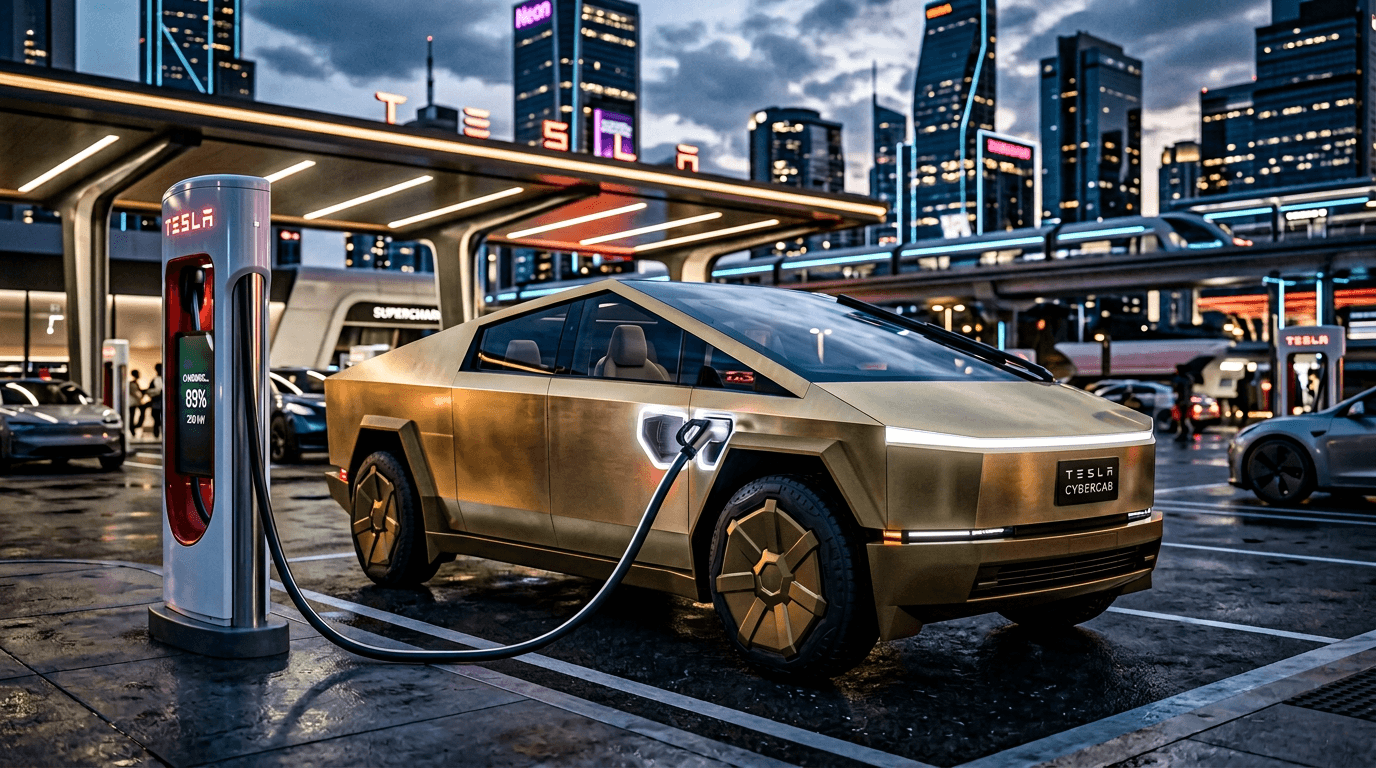
And yet, someone just caught the prototype in the act: at the rear, behind a small flap, sits the most ordinary charging port in the world. That makes the Tesla Cybercab a far more practical car than originally assumed.
It is like buying a kitchen robot that promises to cook by sheer willpower, then finding a hand crank in the box. Musk has long fed us a vision of a world in which electric cars wander to docking stations like bored Roombas, but engineering reality proved merciless.
The presence of a classic connector is a surrender to market pragmatism. For the average user, however, it is good news.
Induction magic versus brutal physics
The original plan assumed the Tesla Cybercab would use wireless charging only. The car was supposed to drive over a special magnetic pad where "electric magic" would fill the battery without touching anything.
The problem is that inductive charging currently has about as much in common with energy efficiency as refuelling a tank with a water pistol from three metres away. The laws of thermodynamics are unforgiving – when current travels through air, huge amounts of energy turn into pure heat.
On the scale of a global robotaxi fleet, those losses would be catastrophic for the profitability of the whole venture. The manufacturer evidently realised that if the fleet is actually going to earn money, it cannot spend half its life "wirelessly napping".
Inductive charging in its current form is slow and requires the vehicle to be positioned perfectly, down to the millimetre. That is why the production versions of the Tesla Cybercab, scheduled to roll off the line in April 2026, have been fitted with an NACS connector.
Every standard next-generation charger will therefore be compatible with this vehicle. It is a sensible and absolutely un-Musk-like solution. Thanks to that, the two-seater piece of furniture on wheels will be back in service within 15–20 minutes instead of roasting the asphalt for half a day.
A cheap revolution at the price of decency
Let's move on to the financial details, because they will make half of all taxi drivers nervously scan logistics job ads. The Tesla Cybercab is expected to cost around 30,000 dollars.
That sounds like the price of dreams, but let's face reality: in the Polish conditions of 2026, once duties and taxes are included, we are talking about roughly 130,000 – 150,000 PLN.
If you manage to claim government subsidies, however, the price could drop sharply, making this vehicle the cheapest ticket to the world of modern mobility. For the price of a well-equipped forklift, you get a range of around 320–480 kilometres.
The energy will come from a relatively small battery with a capacity of 35 to 50 kWh. That is not much by today's standards, but the Tesla Cybercab is not a motorway cruiser. It is an urban rat with absurd efficiency.
The manufacturer claims the car uses just 1 kWh per 9 kilometres. Such a result makes EU ecology officials blush with excitement and fuel lobbyists reach for tranquillisers. The aerodynamics of a coffee bean do their work.
There is a catch, though: there is no steering wheel inside. If the camera-only vision algorithm decides it would rather head for a ditch than your office, all you can do is send it a sad emoji through the 21-inch screen.
This is the final version of Full Self-Driving (FSD) – either you trust the code from engineers in Palo Alto, or you head for the bus stop. If you want to check other models from this brand, visit our catalogue to compare specifications.
An interior for two introverts
Inside, the Tesla Cybercab offers exactly as much room as a fridge after a mother-in-law visit – two adults and plenty of hope of arriving in one piece.
There is, however, a brilliant move: the seats are placed at a height perfectly matched to wheelchairs. That makes the car more human than its cold polyurethane roof and raw Cybertruck aesthetics would suggest.
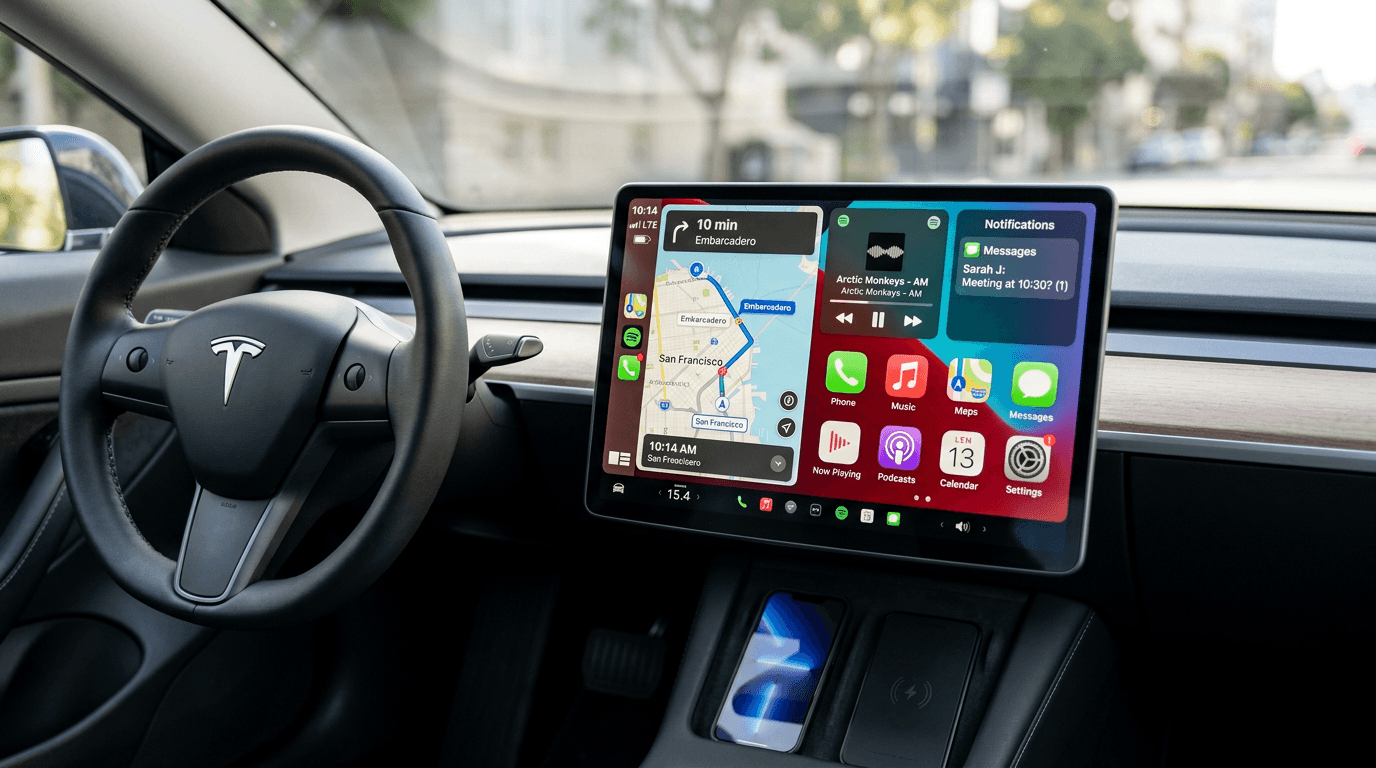
The lack of a rear window, mirrors and physical buttons is a clear signal: "Trust us, processors see better than your sleepy eyes". The cabin resembles a small home cinema rather than the interior of a traditional car.
Minimalism here is pushed to the point of absurdity – there are no door handles at all. Butterfly doors lift automatically when they sense a digital key in a smartphone. It is a vision of transport as a pure service, not an object of owner pride.
Importantly, the Tesla Cybercab is meant to be the foundation of a new fleet of autonomous taxis available through a simple app.
Race against time and regulations
Will the Tesla Cybercab be ready for April 2026? History teaches us that "Musk time" is a highly flexible unit of time. Delays on the Model 3 or Cybertruck were measured in years.
This project, however, has the advantage of being structurally simpler than an average mountain bike. The lack of a steering system, pedals and complicated manual mechanisms drastically shortens the assembly process.
The key challenge will not be the factory itself, but the regulators. Many people wonder how driverless electric cars will fit into the Polish legal system.
In Poland, road traffic law still assumes that a vehicle must have a responsible person sitting behind the steering device. The Tesla Cybercab is a legal grenade thrown into the Ministry of Infrastructure.
For this car to move legally on our roads, a revision of the rules is needed, one that gives algorithms the status of a full-fledged driver.
A new era of mobility
Is the Tesla Cybercab the saviour of transport? For now, it is more of a very expensive smartphone on wheels that humbly admitted it needs a cable and a copper contact to survive a day in the city.
If it actually enters production on schedule, it will be one of the most controversial objects on the roads since the first speed camera. It is cheap to run and looks like a prop from Blade Runner.
Buy it or rent it if you value quiet, modern mobility. Just remember that in Poland, driving with no hands on the wheel is still a legal abstraction, and the legislature is chasing modernity with a delay.
Every motoring catalogue will soon be updated with this model. Just make sure your garage has a suitable charger so you can plug your unit in without worry.
FAQ – Frequently asked questions
Does the Tesla Cybercab really have no physical steering system?
Yes, the vehicle has been designed as autonomous (SAE level 4/5). It has no steering wheel, steering column or pedals. Control is digital, based on neural networks processing camera images. All decisions about manoeuvres are made by the on-board AI computer.
What is the maximum charging voltage through the newly discovered port?
The Tesla Cybercab uses the NACS standard, suggesting compatibility with V3 and V4 Superchargers operating at up to 500V DC. Despite the smaller battery, the connector will allow a power draw of 150–200 kW, enabling a charge from 10% to 80% in less than 15 minutes.
Why was exclusive inductive charging abandoned?
The main reasons are energy efficiency and infrastructure cost. Inductive charging generates losses of around 10–15% of the energy and requires expensive coils to be installed in the ground. Moreover, high wireless charging power would significantly increase the mass and complexity of a budget vehicle.
How does the car cope in harsh weather without lidar?
The system relies on "Tesla Vision" technology and machine learning algorithms that remove image noise. The cameras have heating elements to prevent frost build-up, and the system reconstructs a 3D map of the surroundings by analysing pixel motion in real time.
What is the expected battery life in continuous operation?
The design assumes LFP cells, which are rated for 3000–5000 cycles. That means the battery should last 800,000 – 1,000,000 kilometres while retaining over 80% of its capacity, which is critical for a fleet operating around the clock.
Can the passenger take control in emergency situations?
The passenger cannot mechanically steer the vehicle. In emergencies, a "Stop" button on the screen or a physical safety switch is provided, which stops the vehicle on the shoulder. Incidents are handled by a Tesla remote monitoring centre.