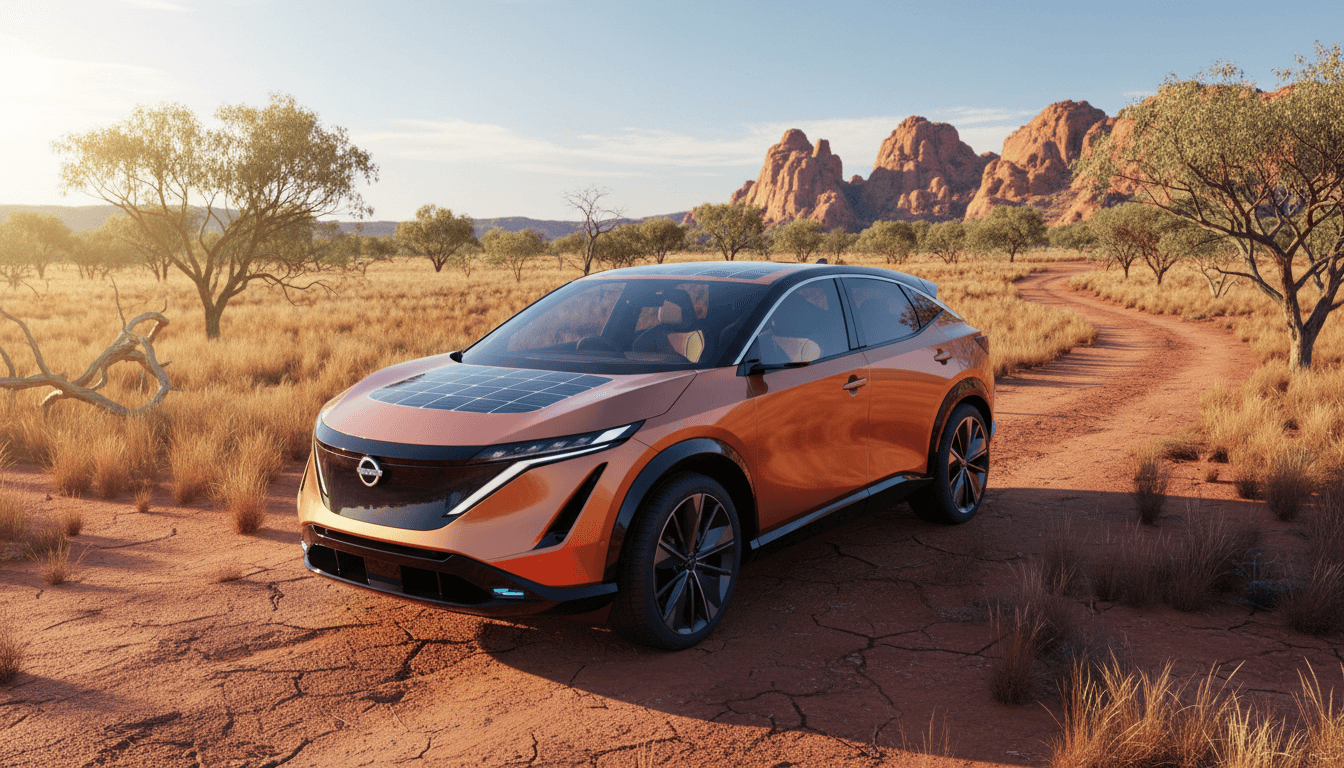
Nissan has just unveiled the solar-powered version of the Ariya. The model opens a new chapter in electromobility, offering photovoltaic panels integrated into the bodywork.
In theory this is a breakthrough. In practice we live in Poland – a country where “sunny weather" often means no rain for fifteen minutes, which means such electric cars face real climate challenges.
Nissan claims the Ariya can run on sunlight. In Dubai that would work, but in Warsaw in winter you would grow moss on the roof before collecting any free kilowatts.
Free kilometres straight from the sky
Data table 1
| Version & Drivetrain |
Battery (net) |
Power [KM] |
0-100 km/h |
Price [PLN] |
| Engage FWD |
63 kWh |
214 KM |
7.5 s |
194,900 zł |
| Advance FWD |
87 kWh |
238 KM |
7.6 s |
229,900 zł |
| Evolve FWD |
87 kWh |
238 KM |
7.6 s |
244,900 zł |
| e-4ORCE Advance AWD |
87 kWh |
306 KM |
5.7 s |
259,900 zł |
| e-4ORCE Evolve+ AWD |
87 kWh |
394 KM |
5.1 s |
318,900 zł |
Nissan engineers, together with the Dutch company Lightyear, packed almost four square metres of high-efficiency photovoltaic panels onto the bonnet, roof and tailgate.
These are not the bulky, bluish wafers you know from suburban rooftops. They are integrated, nearly invisible silicon cells built to withstand hail, automatic car washes and everyday conditions. The new Nissan Ariya becomes a mobile power plant.
The result? On an ideal sunny day the car can add 23 kilometres of range. In Dubai, California or Barcelona that sounds like a brilliant plan for free commutes.
But Nissan also tested London – a city with a climate close to Warsaw's. The result? Ten kilometres.
That is roughly what you cover while looking for a parking spot or sitting in traffic. Still, it is worth looking at the numbers calmly.
For someone driving around 6,000 km per year in the city, the number of sessions requiring a traditional charger could drop from twenty-three to just eight per year.
That means for most of the year you can forget about heavy rubber cables. The Nissan Ariya becomes a leader in this shift away from plug-in thinking.
Technology salvaged from bankruptcy
The partnership with Lightyear is a bold move, bordering on technological gamble. Lightyear went bankrupt in 2023 while trying to sell the world an ultra-expensive, aerodynamic model called “0" for two hundred thousand euros.
The project was beautiful but economically fragile. Instead of buying a sinking ship, Nissan went all in – taking over patents and engineering know-how to refine the Nissan Ariya.
The key to the Ariya Solar's success is not just the presence of the panels but how efficiently they cooperate with the car. The panels feed the main traction battery directly with direct current (DC), eliminating unnecessary inverter losses.
The system works whether you are cruising on the motorway or stuck in traffic. What's more, the electronics can prioritise feeding the air conditioning, which on hot days takes additional percentage points off the battery load.
Checking the official catalogue shows how innovative this approach is. The whole package looks surprisingly civilised – it is not a rolling laboratory.
It is still an elegant Nissan Ariya designed in the “Timeless Japanese Futurism" style. The difference is that the roof actually does useful work.
How much does the Nissan Ariya and its solar luxury cost?
Let's look at the wallet, because that is usually where the eco-dream ends. In Polish showrooms today the “regular" Ariya starts at 194,900 PLN for the base Engage version with a 63 kWh battery.
If you want real punch – 394 KM in the e-4ORCE all-wheel-drive version – the price of the Nissan Ariya climbs to around 318,900 PLN.
For a car that sprints to one hundred in 5.1 seconds and has a cabin resembling a luxury Tokyo lounge, that feels like a fair deal in a world where a well-equipped hatchback also costs a fortune.
The solar version remains a technological manifesto for now. Given how fast Nissan is moving toward carbon neutrality, expect it in price lists sooner than anyone can correctly pronounce “photovoltaic".
The expected premium for this solar luxury is said to hover around the price of a few-year-old city car.
Performance versus the harsh Polish reality
The standard Nissan Ariya with the 87 kWh battery offers up to 533 km of range under WLTP. Adding “solar" kilometres in a country where sunshine is a rare guest seems like a daring move.
Imagine the frustration: the morning looks beautiful, you step out full of hope for free watt-hours, and ten minutes later the sky turns the colour of a dirty rag.
On the other hand, let's be realistic. Even those 10–15 km a day add up to thousands of free energy units per year.
You just need to leave the car outside, in the open sky rather than in a sealed underground garage. The Nissan Ariya thus promotes a lifestyle in which electric cars become an integral part of the environment.
The Nissan Ariya Solar is not only about the panels – it is a whole efficiency ecosystem. The car has a heat pump as standard, which in our climate is a necessity.
The engineers made sure every bit of energy – from the sun or from recuperation – is used to the maximum. Even when a traditional charger is not at hand, the Ariya still fights for every metre of range.
Final verdict
Will the Nissan Ariya Solar save the planet from overheating? Of course not. But it is a first, exceptionally bold step toward a world where cars stop being passive consumers of energy.
The solution is brilliant in its simplicity and ambitious in execution. Browsing the catalogue of modern vehicles, it is hard to find a more interesting project from Japan.
If you live in a block of flats with no private garage or parking socket, sunlight can become a real hope for stress-free electromobility.
In short: a great-looking SUV that can feed itself whenever the sun appears.
FAQ – Frequently asked questions
How much energy can the solar panels on the Ariya actually generate?
The solar system of the Nissan Ariya uses high-efficiency silicon cells (above 22%) and produces around 450–500 Wp in peak conditions. That translates into 1.5 to 2.5 kWh of recovered energy per day.
Do the solar panels also work while driving?
Yes, the system is fully active both when parked and while driving. Thanks to a high-voltage DC-DC converter, the solar energy can power the air conditioning or directly assist the electric motor of the Nissan Ariya.
What happens to the solar roof during hail or a collision?
The panels are protected by a layer of tempered composite glass. In case of damage, the Nissan Ariya's roof uses a modular design, although replacing the main panel may cost between 15,000 and 25,000 złoty.
Does dirt on the body significantly lower charging efficiency?
Yes, a layer of dust or mud can cut cell efficiency by 15% and even up to 50%. Keeping the roof clean is key, and Nissan's factory hydrophobic coatings help with that.
What is the lifespan of the photovoltaic cells on a Nissan roof?
Nissan designs the solar systems for 15–20 years of use. Power degradation is slow – after 10 years efficiency typically remains at around 90% of the original value on the Nissan Ariya.
Does the solar system affect the car's centre of gravity and handling?
Integrating the panels adds around 30–45 kg at the highest point of the vehicle. Because the heavy traction battery sits in the floor, the impact of the solar roof on the handling of the Nissan Ariya is practically imperceptible for the driver.