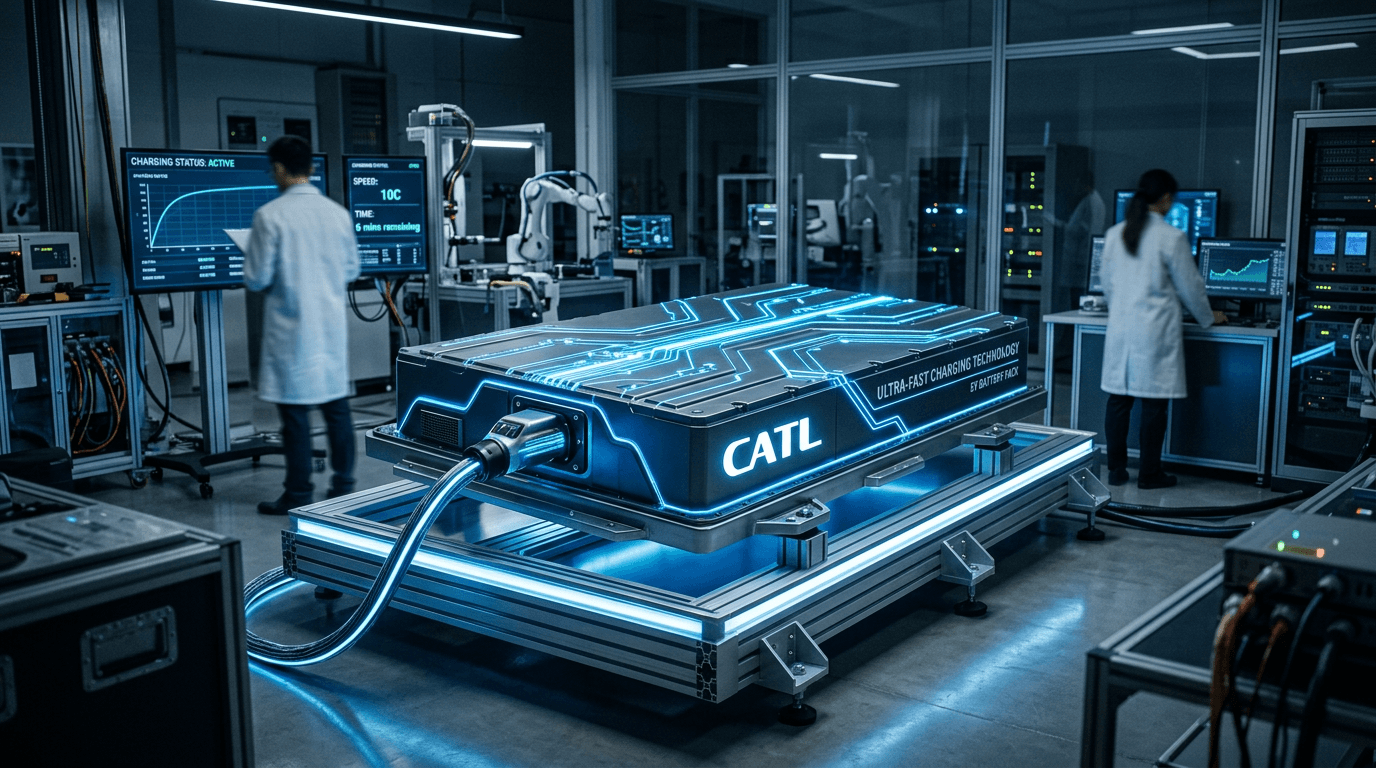
A novel crystalline network architecture lets lithium ions move significantly faster, while new cathode coatings and self-healing electrolyte additives are designed to enable 3,000 full charge cycles at 20°C. That translates into a range of about 1.8 million kilometres. Under extreme conditions – at 60°C – the CATL battery retains 80% of its capacity after 840,000 kilometres.
The CATL battery and the end of pharmacist-precision charging
Buying a used EV used to feel like a game of minesweeper. Buyers had no way of knowing whether the previous owner had only ever charged with AC power or had pushed the battery hard on DC fast chargers. Cars that had never seen a fast charger fetched noticeably higher prices. Everyone feared that after 100,000 kilometres the battery would be in the shape of an old-timer, and the real-world range would only get you to the nearest discount store.
CATL's engineers say their new cells are resistant to fast charging. The novel crystalline network architecture lets lithium ions move faster, while the new cathode coatings and self-healing electrolyte additives are designed to support 3,000 full charge cycles at 20°C.
The maths is clear: 1.8 million kilometres of range. In Dubai, under 60°C heat – an extreme condition for lithium chemistry – the CATL battery retains 80% capacity after 840,000 kilometres. That's a longer distance than the legendary Mercedes diesels of the 1990s, while modern combustion engines often require major repairs after just 200,000 kilometres.
A technological knockout and the chemistry of the future
The key to these results is the move to a new generation of LFP (lithium iron phosphate) cells with additives that suppress the problem of so-called dendrites – tiny lithium whiskers that pierced the separator in older cells. A structure has been developed in which lithium ions essentially "glide" across the anode surface instead of slamming into it. To see which models already use similar solutions, visit our catalogue.
The new CATL Shenxing Plus battery delivers an energy density of 205 Wh/kg at pack level – something that seemed unattainable for LFP technology just a year ago. For comparison, classic LFP cells rarely exceeded 160–170 Wh/kg. The result is a range of around 1,000 kilometres (CLTC) on a single charge.
Can Poland's infrastructure handle modern cells?
It is March 2026 and the situation in Poland is, to put it mildly, dynamic. The number of fast DC charging points is growing and now accounts for almost half of the network, but teething problems remain. What good is a modern CATL battery that charges in the time it takes for an espresso, if most of our chargers still deliver a much slower charge rate? Plugging a car that can accept 400 kW into a standard charger rated at 50 kW is like trying to water an elephant through a straw.
Still, the market isn't waiting for slow network operators. The Kia EV2 enters showrooms with a starting price of 99,900 PLN. The "NaszEauto" programme adds up to 40,000 PLN in subsidy, making new electric cars cheaper than a decent road bike. Ford is releasing the Explorer and Capri models, in which the CATL battery is designed to resist Siberian frost and African heat. Meanwhile, Toyota is communicating progress on solid-state technology.
The CATL battery backed by BMS "intelligence"
The most fascinating part of this technology is not just the claimed resistance to fast charging – the cells are supported by new battery management systems (BMS). They can direct coolant exactly to where a cell starts to heat up under high current. Special "responsive agents" on the separators react to temperature and automatically adjust internal resistance, protecting the CATL battery at the molecular level.
The result is a product you don't need to baby – you don't have to worry whether you charged to 80% or 100%. The cell is technically prepared to accept high power whenever a suitable charger becomes available.
Verdict on combustion cars
If these claims are confirmed in long-distance testing, the last argument of EV opponents – that "batteries die" – has just landed on the scrapheap of history. The electric car is no longer a costly gadget with a short shelf life. Thanks to the technology represented by the CATL battery, it becomes a machine you can hand down to your grandchildren without fearing a dramatic performance loss. Browsing our catalogue, you'll see how many manufacturers now focus on durability.
One question keeps grid operators up at night: can Poland's transmission grid survive the moment when many neighbours on one housing estate plug in their packs at the same time? Even if a home charger cannot squeeze full power out of them, the aggregate load will be a challenge. But hey, look on the bright side: at least the CATL battery in your garage will still be at full performance, ready to drive as soon as someone at the power station throws the right switch.
This technology is a breakthrough, and every new CATL battery leaving the factory adds another argument for the end of legacy technologies. Today's electric cars are ready for new user demands.
FAQ – Frequently asked questions
What exactly does the term "5C battery" mean in CATL technology?
The "C" rate defines the relationship between charging current and battery capacity. A 5C rating means the charging current is five times the battery's capacity expressed in amp-hours. In practice, this allows a theoretical full charge from 0 to 100% in just 12 minutes. It is made possible by drastically lowering the cell's internal resistance and using a highly conductive electrolyte, which minimises heat generation.
How does Shenxing Plus technology cope with degradation under fast charging?
CATL applied a "full nano-tab" technology that distributes current more evenly across the entire electrode surface, eliminating critical hot spots. In addition, the SEI (Solid Electrolyte Interphase) layer has been reinforced with polymers to prevent cracking. As a result, the battery withstands 3,000 cycles – roughly 1.5–1.8 million km before capacity drops below 80%. Every modern CATL battery undergoes rigorous durability testing.
Will CATL's new LFP batteries perform well during a Polish winter?
Yes, the new CATL LFP chemistry includes an integrated BMS heating system capable of raising the cell temperature by 10°C within a few minutes. Even at -20°C the system allows charging at more than 50% of maximum power. That is a huge leap compared with traditional LFP cells, which lost performance dramatically in the cold. A properly specified CATL battery keeps you mobile regardless of the weather.
Why is an energy density of 205 Wh/kg a breakthrough for LFP technology?
Classic LFP technologies rarely exceeded the 160–170 Wh/kg barrier, largely because of the weight of cooling hardware. CATL hit 205 Wh/kg by using CTP 3.0 (Cell-to-Pack) technology, in which the cells are part of the load-bearing structure, and by modifying the cathode. This packs more energy into the same volume while keeping production costs low. Today's CATL battery is lighter and more efficient than ever.
Does 5C charging require special cables or home infrastructure?
Home (AC) charging is typically limited to 11 or 22 kW, and here 5C technology changes nothing. The full potential of 5C can only be used at ultra-fast public charging stations (HPC) with power levels in the 400–600 kW range, equipped with liquid-cooled cables. Nevertheless, every CATL battery is technically prepared to accept such high power whenever the opportunity arises.
What is the environmental impact of such a long battery life (1.8 million km)?
This is a key aspect of sustainability. A battery built to last this long can "outlive" several car body lifecycles. After the vehicle is decommissioned, the pack can go into another car or serve as a stationary energy storage system for decades. That drastically reduces the carbon footprint per kilometre, and every new CATL battery contributes to this revolution.