Darkness, I see darkness – why your new Korean car suddenly went blind
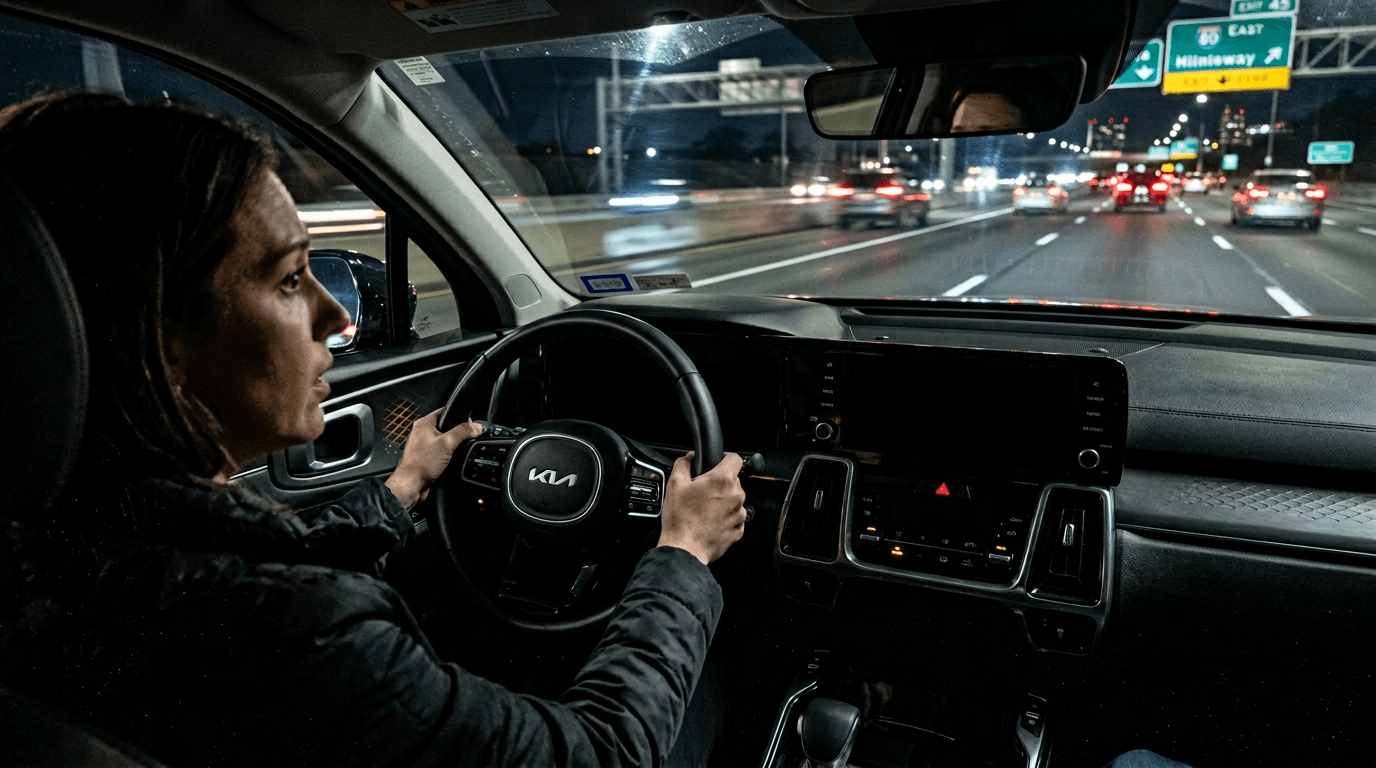
Picture this: you are flying along the left lane of the A2 motorway in your brand-new Kia Sorento, the radio is playing something you'd be embarrassed to admit to your friends, and all you can think about is dinner.
Suddenly – click. Your shiny panoramic digital cockpit, for which you paid the equivalent of a small flat in Radom, turns into a black hole. You don't know if you are doing 120 or 200 km/h.
You don't know if the engine is still alive or has just decided to give up the ghost. Welcome to the world of modern technology, where Hyundai and Kia digital models show the emotional stability of a teenager after three energy drinks.
It's like hiring the best surgeon in the world and having them decide halfway through the operation that they need a nap. Korean technology is like a modern smartphone – wonderful, until you remember that your life depends on it at 140 km/h on wet asphalt.
This isn't a cheap sci-fi horror scenario, but the reality thousands of drivers have to face. The era of analogue gauges, where the only problem was a blown backlight bulb, is a thing of the past.
Today we have 4K-resolution screens that can display a feed from side cameras, an augmented-reality route, and the state of your bank account after buying a subscription for heated seats.
The problem is that when Hyundai and Kia models lose their image, you become pilots flying blind in fog with no instruments.
Causes of Hyundai and Kia system failures
The problem hitting the Seoul giants is as absurd as it is irritating. More than 83,000 Hyundai and Kia vehicles – including nearly the entire 2026 model-year showcase – suffer from technological dementia.
The cause is "electrical noise" in the power supply units delivered by the subsidiary Hyundai Mobis. In practice, this means that the precisely calibrated voltage flowing to the graphics processors suddenly gets the "hiccups".
Screens glitch, restart without warning, or simply enter overheat protection mode, leaving the driver with a view worthy of a switched-off Soviet-era TV.
Technically speaking, we are dealing with an error at the level of the data bus architecture and signal filtering. In a modern car such as the Hyundai Santa Fe, the length of electrical wiring can be measured in kilometres.
It only takes one module – for example the climate control unit or the fuel pump – to generate an electromagnetic impulse that isn't properly damped, and the digital cockpit treats it as a hacker attack and simply shuts down.
It is fascinating that in 2026, when we can manage batteries from the cloud and plan ranges of around 960 km in EREV models, we are still struggling to keep a piece of screen from going dark due to a small voltage spike.
When choosing modern electric cars, users expect the kind of reliability that is clearly missing here.
List of models affected by the fault
The list of models that may suddenly make you guess your speed from the wind noise reads like the catalogue of dreams of the Polish middle class.
From the dependable Tucson, which has become almost the national SUV of Polish drivers, through the mighty hybrid Santa Fe, to the flagship vessel of the electric fleet – IONIQ 9.
When it comes to Hyundai and Kia, no one was spared. Even owners of the sporty IONIQ 5 N, who paid a fortune for a car that can simulate gear changes and exhaust bangs, can wake up in a digital void.
This phenomenon is all the more dangerous because in today's Hyundai and Kia models, screens aren't just a luxury add-on. They are the only source of information about the operation of driver assistance systems (ADAS).
When the screen goes dark, you don't know if the active cruise control is still keeping distance, or if Lane Assist has just decided that the hard shoulder is a great place to park. This is a risky balancing act on the edge of safety, showing our degree of silicon dependency.
Fixing the problem at authorised service centres
What does this mean for the Polish customer? If you've just picked up your Tucson N Line and noticed the speedometer flickering like a neon sign over a kebab bar, congratulations – you've become part of a great, global family of the unlucky.
The official service campaign for Hyundai and Kia vehicles is set to start at the end of March 2026. The repair mechanism is two-pronged. Models based on a newer software architecture will receive an Over-The-Air (OTA) update.
The system will download new drivers on its own, remap the cockpit energy management, and everything will probably return to normal while you drink your coffee.
The rest? Those who chose versions with an older architecture or simply have bad luck will need to visit a service centre. There, specialists will plug the car into a diagnostic computer and upload new software.
Its job is to increase the processor's tolerance to voltage spikes. In extreme cases, full replacement of the screen control modules may be needed, which at current component prices means accountants in Korea probably aren't sleeping at night.
It is worth checking whether the right charger affects the stability of systems while parked.
Performance of new Korean models
It's a shame, because beneath this layer of unstable silicon lie truly brilliant machines. Hyundai and Kia have taken a giant leap forward in automotive technology.
The new generation of batteries, announced for 2027, promises 15% greater energy density and charging times shortened to the length of a quick cigarette break.
The Koreans are now building some of the best chassis and drivetrains in the world, but they failed on the wiring. A classic case – a brilliant mechanical engineer and a software engineer who forgot about the physics of alternating current. We forgive them, because an EV2 with a 450 km range sounds like a knockout for the competition.
The Kia EV2 has a chance to demolish the small electric car market with a real-world range of 448 km, which in the city means charging once every two weeks. Meanwhile, the announced IONIQ 3 may be the final nail in the coffin of combustion-powered city cars.
But does any of that matter if the heart of these machines is a power system sensitive to interference? When buying a car for 200 or 300 thousand zloty, I expect the only black hole within my range to be the one in my wallet after paying the lease instalment.
It's a matter of trust. If once on a route covered by Hyundai and Kia you see a black screen at high speed, you'll never look at your car the same way again. You'll be waiting for the next click.
Engineering challenges in modern motoring
The electrical noise problem is a classic example of marketing triumphing over classical engineering. In the race for ever-larger displays that merge into a single sheet of glass (Curved Display), solid cable shielding was forgotten.
A car is an extreme environment: vibrations, temperature swings from -30 to +60 degrees Celsius, humidity, and hundreds of radio waves inside the cabin. Today's electric cars are more computers than vehicles.
Hyundai and Kia are currently among the most innovative brands in the world, but this slip-up reminds us of an old truth: the more electronics, the more reasons to worry.
If your display has just gone dark, don't panic. The steering and braking systems are still mechanically linked or have independent fail-safe systems.
Just enjoy a moment of silence from the safety systems, which were probably beeping at you constantly over some minor slip-up anyway. Then head straight to the service centre.
Just take a paper map with you – just in case the Hyundai and Kia navigation also decides it's taking the day off. When browsing the available options in the catalogue, remember about regular updates.
FAQ – Frequently asked questions
Which specific Hyundai and Kia models are covered by the service campaign?
The campaign covers more than 83,000 vehicles from the 2026 model year. The main models are the Hyundai Tucson (petrol, HEV and PHEV versions), Hyundai Santa Fe, IONIQ 5 N, IONIQ 9, as well as the Kia EV9 and Kia Sorento. The issue concerns units equipped with an integrated curved panoramic module above 12 inches in diagonal.
What exactly causes the LCD screens to suddenly go dark?
The cause is a design fault in the DC-DC power supply unit delivered by Hyundai Mobis. Under certain engine load or alternator operating conditions, electrical noise (electromagnetic interference, EMI) is generated, exceeding the tolerance thresholds of the display controller. This causes a software error and a forced restart of the infotainment system.
Will the OTA update actually fix the problem permanently?
The Over-The-Air update introduces better digital filtering of input signals and optimises power management in the graphics module. This allows it to ignore short voltage spikes that cause restarts. However, if the physical damage to filter components is too great, replacement of parts at an authorised service centre (ASO) may be necessary.
Is driving with a non-working screen safe?
From a mechanical standpoint, the car retains steerability and braking capability. However, from a regulatory and active safety standpoint – no. The lack of a speedometer or failure warnings makes safe driving impossible. Moreover, driving a car without a working speedometer can result in a fine in many regions.
How can I check if my Hyundai/Kia model is covered by the campaign?
The most reliable method is to verify the VIN number at a dealer or in the official manufacturer system. Information is also sent via the BlueLink (Hyundai) and Kia Connect apps. Official service recall notices in Central Europe will be sent out in March 2026. A properly working home charger will help prepare the car for the visit.
Can the fault affect other vehicle systems?
The error is isolated to the data presentation layer (HMI). It does not directly affect the engine control unit (ECU) or the electric drivetrain. However, a system restart may temporarily disable the sound of parking sensors and the 360-degree camera image. Modern Hyundai and Kia electric cars require stable software for full assistant functionality.