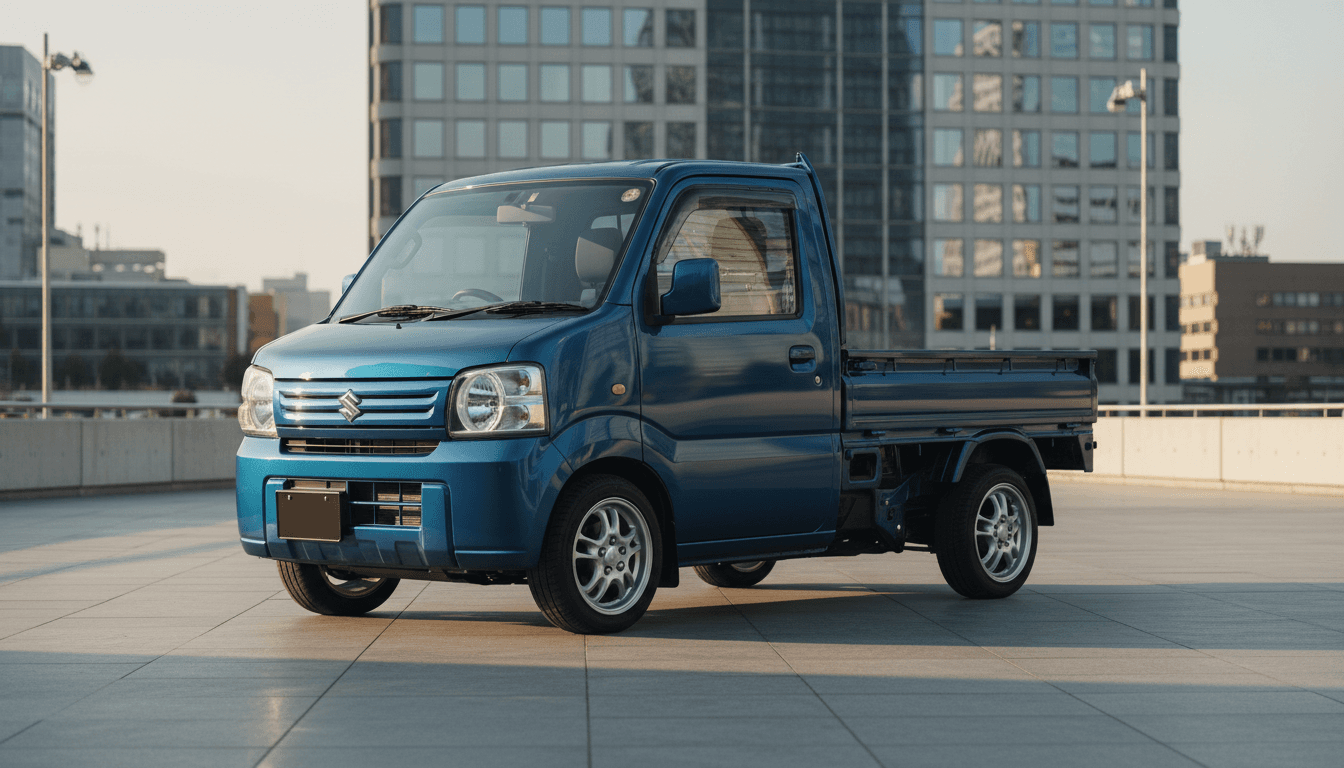
Let's cut straight to it. Suzuki Carry for PLN 26,950? A small truck cheaper than some fancy electric car. And what? It still rules – unchanged for nearly 12 years, powered by a 658 cc three-cylinder with 50 horsepower and as much torque as a decent scooter. Yet it gets a refreshed look, LEDs, digital gauges and systems like AEB or traffic sign recognition. Why? Ready for Clarkson-style chaos in 700–900 words? Let's go.
New face, same old truck
Suzuki refreshed the Carry and Super Carry with barely two silly LEDs at the front, a wider air intake and small black accents on the X Limited – it looks slightly sharper. Like it put on a pair of sunglasses. The rest is the same: metal, practical cargo bed, fold-down sides – like a flying carpet, just without the aero. The engine is still 658 cc, 50 HP, 59 Nm, available with manual and automatic, RWD or 4×4 with diff lock and "mud escape assist" function – doesn't that sound like 4-inch undies in car form?
Polish price – does the wallet complain?
In Poland this wonder costs PLN 26,950 for the basic Carry with RWD and manual – less than an average city car from a dealership. Cold math: for that money you get almost nothing anywhere else. And here? You get gear from Japan's bygone era, but with LEDs and a digital gauge. And if someone says it's too expensive, you can send them to Magda Gessler to judge whether it's luxury or brilliant simplicity.
Model comparison
The comparison shows that the Suzuki Carry, despite smaller dimensions and payload, offers better fuel consumption, making it a more economical choice for urban transport.
Competition trembles – Hijet, Fiorino and company
Among the rivals is the Daihatsu Hijet – similar class, competitive price, but less popular in Poland. Autogalant states that the Carry has a payload of 800 kg, dimensions of 340×147×180 cm and fuel consumption of 6.2 l/100 km. For comparison: Ford Transit – 1,000 kg payload, consumption of 8.5 l, dimensions of 497×207×197 cm. And the Suzuki is small, nimble and burns 2.3 litres less. Does that make it a hero of urban transport? Yes. Does that make it boring? It does, but nobody protests.
Used imports from Japan – budget time machines
On the secondary market, an imported Carry from Japan from 2015–2018 costs between PLN 9,600 and PLN 12,500 – versions with mileages of 23,000–162,000 km. Seriously? For the price of a new smartphone you can have a vehicle that lasts longer than most SUVs. Naturally, it needs servicing: belts, water pump, maybe worse tyres – but that's a few hundred zloty more, not thousands.
Kei-mania in Poland – is it even legal?
Kei trucks are a Japanese class of micro-vehicles: limits on size, displacement and power, ideal for narrow streets, ideal for Poland. Wikipedia estimates their popularity in the US is growing – over 7,500 imports in 2024, but they require a 25-year age to be registered legally. In Poland there are no such restrictions, so you can fire up a 2025 Carry without asking officials whether "it's legal?". And you buy a piece of practical, cheap equipment.
Polish context
In Poland the kei truck market is gaining popularity, and the Suzuki Carry is becoming one of the favourites among entrepreneurs. In 2022 around 3,200 kei trucks were registered, showing growing interest in these small trucks. What's more, in 2023 it is expected that the government will grant around 40,000 subsidies for the purchase of electric vehicles, which may influence further market development. However, the Suzuki Carry, despite competition, still maintains its leading position, combining low price with practicality.