Home battery grants in Poland in 2026: eligibility and notification
Check PME2, grid and building notifications, the register threshold and Polish tax-relief rules.
EvCompass Editorial TeamPublished3 min read
PME2 status as of October 27, 2026
As of October 27, 2026, the PME2 application window is open. It opened on October 20, 2026 at 9:00, and the official page lists October 1, 2027 as the closing date; applications are submitted online through GWD. The program is for prosumers with renewable microgeneration connected to the grid; eligible expenses start on November 1, 2025.
An eligible electrical battery must have nominal capacity of at least 10 kWh and capacity at least twice the cooperating PV system's peak power. Check the required EMS and island-operation capability too. To estimate home charging costs, use the home-charging calculator; compare public rates on charging prices.
PME2: status and caps as of October 27, 2026
PME2: status and caps as of October 27, 2026
Area
Rule
What to check
Application window
Opens October 20, 2026 at 9:00; closes October 1, 2027 or when funds run out.
As of October 27, 2026, the application window is open; applications are submitted online through GWD.
Prosumer and capacity
A prosumer with grid-connected renewable microgeneration; storage of at least 10 kWh and capacity at least twice the PV peak power.
Check the grid-connection confirmation and the documented kWh capacity and PV peak power.
Electrical battery
Up to 30% of eligible costs and up to PLN 800/kWh; the cap is PLN 16,000 for net-billing or PLN 8,000 for net-metering.
Use the lowest applicable limit: cost share, per-kWh cap, or settlement-regime cap.
PLN 19,000 headline per PPE
This is the maximum combined support per point of delivery, not the battery-only cap.
Separate the battery cap from up to PLN 1,000 for thermal storage and the conditional bonus of up to PLN 2,000 for EU-made storage with its inverter.
Technical requirements
The storage system must have EMS and support island operation.
Check both functions in the equipment specification.
How much is the battery grant?
NFOŚiGW sets the electrical-battery grant at up to 30% of eligible costs and PLN 800 per nominal kWh. A separate cap is PLN 16,000 for net-billing or PLN 8,000 for net-metering. The applicable ceiling is the lowest of the cost share, per-kWh amount and settlement-regime cap. For example, 10 kWh gives a per-capacity ceiling of PLN 8,000; it does not guarantee that award.
The headline maximum of PLN 19,000 per point of delivery is not the battery-only limit. The detailed rules separate the battery grant, up to PLN 1,000 for thermal storage and a conditional bonus of up to PLN 2,000 for an EU-made battery with its inverter. Check each component's conditions before adding them.
Decision table: user inputs and the applicable process
Decision table: user inputs and the applicable process
Input
Rule
Next step
Battery capacity (kWh) and PV peak power (kWp)
PME2 requires at least 10 kWh and capacity at least twice the PV peak power.
Compare both values with the installation records; PV power alone does not decide notification duties.
Storage / inverter-system power (kW) and site's connection capacity (kW)
If storage power is no greater than connection capacity, notify the DSO; if higher, request connection conditions.
Compare the documented kW values; request conditions if storage power exceeds the site's capacity.
Installed storage power (kW)
The DSO register applies to storage with installed power greater than 50 kW.
Exactly 50 kW does not exceed this threshold; assess connection duties separately.
Installation location and capacity outside a building (kWh)
Up to 30 kWh: no building notification or permit; 30–300 kWh: notification and fire documentation; 300–2,000 kWh: an additional PSP plan; above 2,000 kWh: building permit.
The published bands overlap at exactly 30 kWh and exactly 300 kWh; confirm both cases with the competent authority.
Installation location and capacity inside a building (kWh)
30–300 kWh: notification and fire documentation; above 300 kWh: building permit.
Check requirements for the exact location; the 50 kW register threshold does not replace building rules.
Home ownership and type of thermal-modernisation project
Relief is for the owner or co-owner of a single-family home; storage and infrastructure are listed, and the project must be completed within 3 years.
Check that the purchase and installation form part of a listed project and meet the deadline.
Grant, refund, invoice and previous deductions
Amounts funded by NFOŚiGW/WFOŚiGW, refunded or already deducted from income or revenue on another return are excluded; an invoice is required and the taxpayer cap is PLN 53,000.
Separate eligible unreimbursed cost and check documentation, remaining cap and tax base.
When must a home battery be notified?
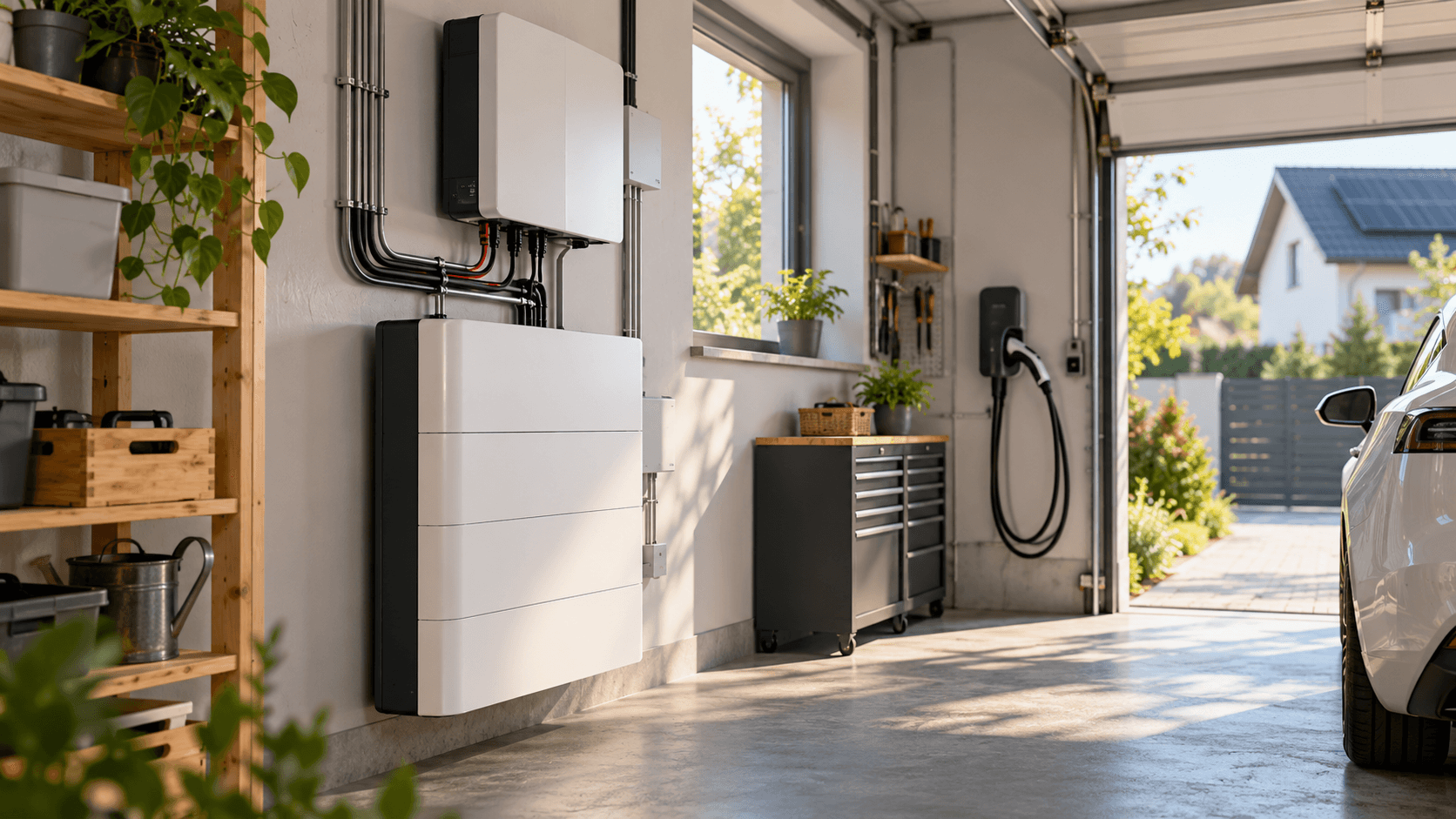
Keep stored capacity in kWh separate from power in kW. For grid connection, compare storage power with the site's connection capacity: if storage power is equal or lower, notify the distribution system operator; if it is higher, apply for connection conditions. This is separate from the storage register, which applies to installed power greater than 50 kW. Exactly 50 kW is not above the register threshold, but staying below it does not rule out a building permit.
Building duties depend on location and capacity. Outside a building, the gov.pl process page lists no notification or permit up to 30 kWh, notification and fire-safety documentation in the 30–300 kWh band, an additional PSP plan in the 300–2,000 kWh band, and a building permit above 2,000 kWh. Inside a building, it lists notification for 30–300 kWh and a permit above 300 kWh. The published bands overlap at exactly 30 kWh and exactly 300 kWh, so confirm both cases with the competent authority. A permit can also be required in some cases for installations up to 50 kW.
Can you claim Polish thermal-modernisation relief?
The regulation lists an energy or heat storage system and necessary infrastructure, but purchase alone does not guarantee relief. You must own or co-own a single-family home, and the expense must form part of a thermal-modernisation project completed within 3 consecutive years counted from the end of the year of the first expense. An invoice from an active VAT taxpayer is required.
Do not deduct amounts financed or co-financed by NFOŚiGW or a voivodeship environmental fund, or amounts refunded to you. Do not claim amounts already deducted from income or revenue on another return either. The cumulative limit is PLN 53,000 across the taxpayer's thermal-modernisation projects. Check whether you have taxable income or revenue from which the rules allow the deduction. The grant and any tax deduction therefore depend on your documents, tax position, power, capacity and installation location; there is no single yes-or-no answer without those inputs.
The installation route depends on unit count, rights to the parking bay and the building's electrical system. We show the relevant Polish Act provisions and a separate, explicit time-and-cost scenario.
The NaszEauto application window is closed, and added funding concerns applications already submitted. Here is the current programme status and a dated view of Polish catalogue prices and charging costs.
We compare 2026 Polish PIT and CIT limits with a declared lease scenario and a separate rental-invoice cash flow. Neither is presented as an offer or a rental tax result.