The yellow invasion: why the Dutch are borrowing billions
It is April 2026, and the automotive world still looks like a fight over fire. This time, however, the fire flows through copper cables, and we desperately search for matches that have not been dampened by political regulation.
While most traditional automakers sweat over spreadsheets, trying to understand why people still prefer hybrids over battery electric cars, Dutch operator Fastned is doing something outright brazen.
Instead of panicking, it walks into banks and says: "Give us another €200 million, because we intend to put a yellow canopy on every corner of Europe."
It is fascinating that while we argue about whether an EV will burn down the garage, the Dutch are building an empire on our fears. They serve electricity faster than you get a cold burger at a drive-thru window.
This is not ordinary self-confidence. It is pure, distilled arrogance backed by hard facts and a steel structure. Companies offering high-power chargers gain in value, and Fastned has just announced that revenue per station jumped 25%.
Stations reached an impressive average of €335,000 per year. These futuristic structures earn money faster than influencers on scandals. Fastned already operates more than 400 locations across nine countries and plans to reach 1,000 by 2030.
The question is: will we in the land on the Vistula even notice this revolution? Or will we once again stay at the back of the peloton, charging our electric cars at the speed of a dripping tap?
Atomic-scale power and Fastned in a few minutes
Data table 1
| Model |
Price (est.) |
Range (km) |
Power (KM) |
Consumption (kWh) |
| Tesla Model Y |
190,000 – 240,000 PLN |
490 – 575 km |
258 – 460 KM |
12.7 kWh/100 km |
| Kia EV6 |
210,000 – 280,000 PLN |
394 – 528 km |
170 – 585 KM |
15.9 kWh/100 km |
| Volkswagen ID.4 |
185,000 – 230,000 PLN |
420 – 510 km |
170 – 299 KM |
16.5 kWh/100 km |
Let's be honest: charging an EV on a regular AC (alternating current) post is about as exciting as watching paint dry. In 2026, nobody has time for that.
Time has become the hardest currency, and Fastned knows it well. Its new strategy does not play at half-measures — it relies on brutal, pure power.
Fastned installs 400 kW units. That is power that could supply a small town, pumped straight into the underbody of your car through a cable as thick as a bodybuilder's arm.
The result of this engineering violence is lightning fast. If you drive an 800-volt architecture vehicle, which you can find in any modern catalog, you will recover 300 kilometers of range in 15 minutes.
That is exactly enough time to grab a coffee at the station and reply to two emails. Poland already has close to 240,000 plug-in vehicles, so this kind of speed is becoming a necessity.
Engineering under the yellow canopy
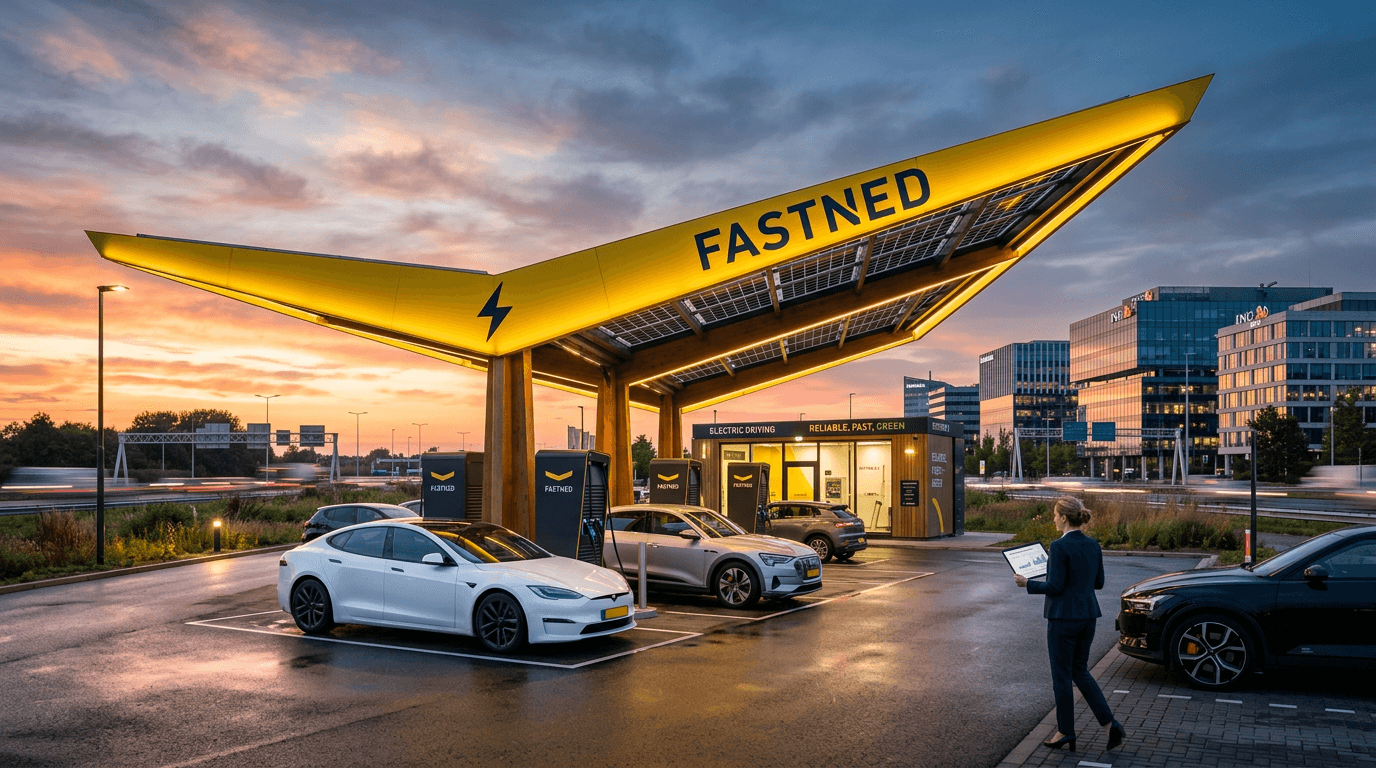
What separates market leaders from amateurs is the approach to infrastructure. Fastned does not just drop a post in a parking lot — its stations are intelligent energy hubs.
Each new location is designed for extreme load. Cables must be liquid-cooled, because at 500 amperes the temperature inside the conductor rises in an instant.
The Dutch also care about aesthetics. Their canopies shield against rain, which you will appreciate during a downpour on the road, and they are additionally covered with photovoltaic cells.
Solar energy will not charge a Tesla in ten minutes, but it is enough to power the infrastructure itself, the LED lighting, and the payment systems.
Polish realities: wallet versus plug
In Poland, the situation is specific. We are a nation that loves technological novelties but hates overpaying for them.
Prices at public stations are currently a real rollercoaster. For fast DC charging, we pay from 1.80 to as much as 2.80 PLN per kWh.
Without a subscription, filling a 60–70 kWh battery can cost up to 180 PLN. That hurts more than a visit to the dentist.
Buying an EV without access to fast charging is like buying a yacht in the Sahara. It looks great in photos, but you will not sail anywhere without liters of sweat and curses.
Competition is not sleeping. GreenWay tempts drivers with loyalty packages, and its chargers are an increasingly common sight along key routes.
But Fastned targets premium drivers. For them, time is worth more than twenty zlotys saved on a single charging session.
Energy infrastructure and Fastned's plans
The biggest challenge in Poland is not a lack of willing drivers, but the state of our power grids.
Building a 2 MW station requires distribution system operators to invest heavily in upgrading transformers.
The Dutch have a workaround: battery storage. Instead of waiting a decade for a new cable, they install large battery arrays that slowly "sip" electricity from the grid, only to deliver it at full power when you pull up to the charger.
Verdict
Will Fastned save the Polish driver? If its expansion keeps the pace of its bond issues, soon we will have more yellow canopies than mushrooms after rain.
Its arrival is a signal that the era of the "electric province" and makeshift solutions is ending. Local operators must learn to install high-power devices or be swept away by the Dutch wave.
We can complain about prices and reminisce about the sound of a V8, but the truth is brutal. At 400 kW chargers, the only bottleneck becomes the chemistry inside your battery.
Browsing any catalog of new models, you can see that carmakers are ready. Fastned is the promise that traveling by EV across Europe will finally become boringly simple.
FAQ — Frequently asked questions
Is the 400 kW power offered by Fastned safe for the battery?
Yes, modern Battery Management Systems (BMS) control the charging process with millisecond precision. The car communicates with the device using the CCS protocol and draws only as much power as it can safely accept under current conditions. The 400 kW power is dedicated mainly to vehicles with an 800V installation, equipped with advanced cell cooling systems.
Why do Fastned stations have characteristic yellow canopies?
This is intentional branding and functionality. The certified-timber structure supports photovoltaic panels that power local systems. The yellow color makes the station visible from a distance, like traditional fuel stations. In addition, the canopy protects the user and equipment from rain, improving comfort and electronics reliability.
What are the real costs of charging at Fastned stations in 2026?
For one-time payments, prices range from 2.20 PLN to 3.10 PLN per kWh. Subscription plans are also available, lowering the rate by about 30%. At average energy consumption, the cost of driving 100 km is comparable to fuel costs in an efficient combustion car, while delivering huge time savings.
Can my older car limited to 50 kW use a 400 kW charger?
Yes, the CCS connector is backward compatible. You can plug in any car with that socket, but the charging speed will be limited by your car's systems to its technical maximum. You will not damage the battery, because the vehicle dictates the conditions and the infrastructure supplies exactly as much current as the controller requests.
Why are chargers in Poland still slower than the ones Fastned builds?
The key issue is grid connection capacity. Power grids need modernization to support multi-megawatt hubs. Administrative procedures around new transformer stations can be lengthy. Fastned bypasses these barriers by using battery storage, which allows fast-charging points to be activated in places with weaker infrastructure.
Is payment by bank card the standard at Fastned stations?
Yes, in line with new EU regulations, payment terminals supporting debit and credit cards are standard. You can pay by card or phone without creating an account in a dedicated app. This eliminates the need to carry multiple RFID cards and makes charging easy for every driver.