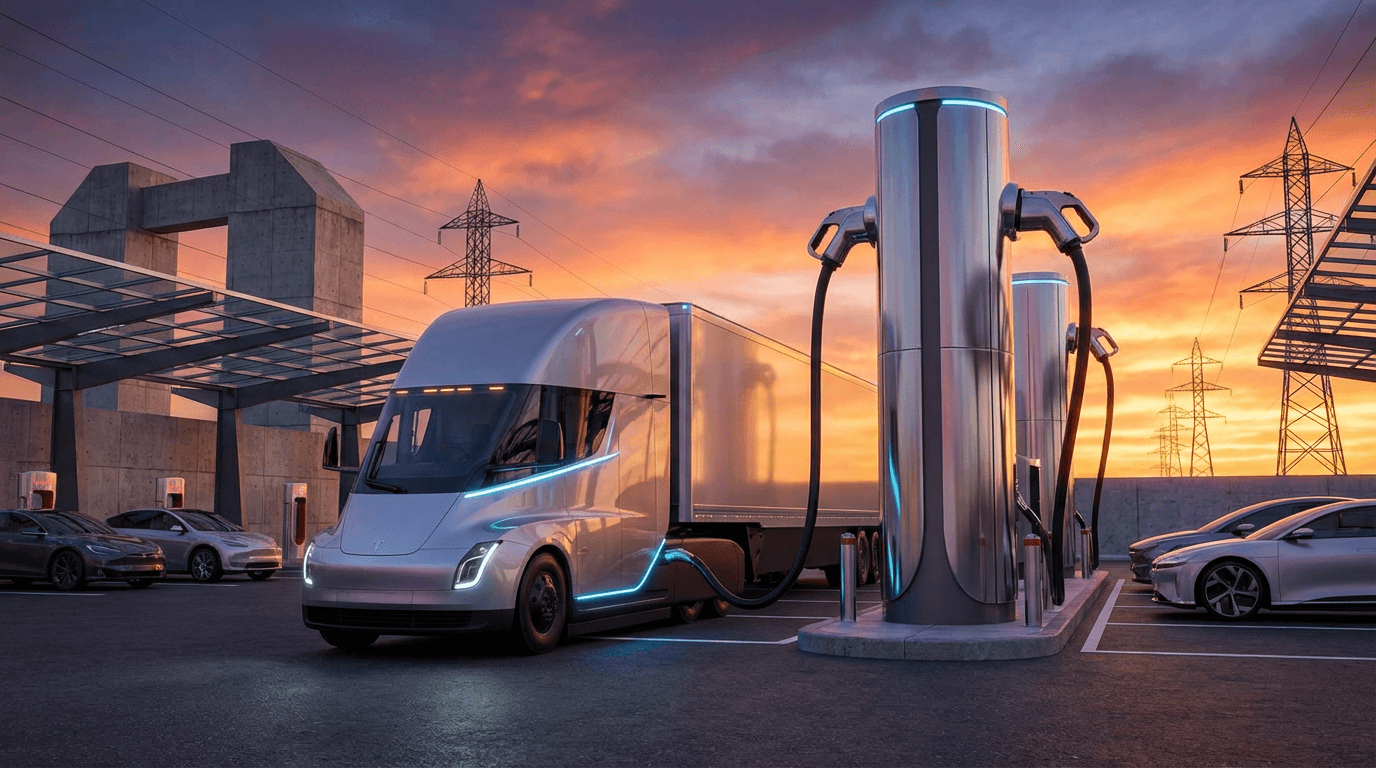
Let's look at the numbers. The Tesla Semi Long Range offers 800 kilometers of range at a full load exceeding 37 tons. Under the cab it hides a battery of around 850–900 kWh, enough energy to power an average Polish home for half a year.
Engineers in Fremont had to pack cells with an energy density that, only a few years ago, seemed physically impossible for series production. More importantly for a Polish carrier, the Tesla Semi consumes less than 1.06 kWh per kilometer. Three independent electric motors on the rear axles, the same ones that drive the Model S Plaid, generate a combined 1088 HP. Acceleration from 0 to 100 km/h under full load takes 20 seconds.
A modern high-power charger is the absolute key to unlocking this potential.
Tesla Semi performance in practice
Time has always been the biggest problem with "EVs". This is where Tesla enters with a strategic agreement with infrastructure giants, building a Megacharger network delivering 1.2 MW. In 30 minutes the Tesla Semi recovers 70% of its range, enough energy to power eight Tesla Model 3 units at once.
Tesla is opening the Megachargers to other manufacturers, pushing to standardize the MCS (Megawatt Charging System) connector. Browsing the catalog of available vehicles, it is clear that this is a breakthrough solution on a global scale.
Cabin engineering and bullet aerodynamics
Traditional trucks have the aerodynamics of a brick. The Tesla Semi's drag coefficient is just 0.36. For comparison, the Bugatti Chiron sits at 0.38. Every detail serves to eliminate drag at highway speeds.
Inside, the driver sits in the center. This is not a designer's whim but above all safety and visibility. The lack of a combustion engine means a drastically lower center of gravity. Add a traction control system that reacts in milliseconds, preventing the so-called "jackknife". No wonder these electric cars are changing the rules of the game.
Tesla Semi price and real profit
Although official price lists for the Polish market in 2027 are still closely guarded, the Standard Range version is expected to start from around 700,000 – 800,000 PLN, and the Long Range will exceed 950,000 PLN.
Thanks to 4680-type cells and vertical integration, the unit weight has been reduced. The Tesla Semi weighs between 9.1 and 10.4 tons without a trailer, and payload is almost identical to a diesel. Service costs drop thanks to the absence of a transmission, complex exhaust systems, and AdBlue. If your company has its own charger, the savings will be colossal. This truck has fewer moving parts than an average blender, reducing fleet maintenance costs by over 40% per year.
The era of electric transport
The Tesla Semi is a brutally efficient work tool that makes modern diesels look like old-time mail coaches. If infrastructure in Central Europe keeps up with this megawatt frenzy, soon the only smoke on the roads will be from burned sausages at a truck stop. Checking the latest catalog, it is hard to find a competitor with similar parameters.
The key here is integration: Tesla produces its own cells, motors, and charging network. Choosing modern electric cars builds real market advantage today.
FAQ – Frequently Asked Questions
What is the real range of the Tesla Semi under full load?
The Tesla Semi Long Range offers 805 kilometers (500 miles) of real-world range at a gross combination weight of 37,195 kg. The Standard Range version provides around 480 kilometers. These results are achieved thanks to an extremely low drag coefficient (0.36 Cd) and record drivetrain efficiency.
How long does it take to charge the battery, and does it require special stations?
The vehicle uses Megacharger technology with up to 1.2 MW of power. This allows charging the batteries from 5% to 70% in just 30 minutes. The system relies on liquid-cooled cables and MCS connectors, which are becoming the new standard in heavy transport.
Is the Tesla Semi heavier than a traditional diesel truck?
The tractor unit in the longer-range version weighs around 10.4 tons, which is higher than light combustion tractors (around 7–8 tons). However, thanks to regulations allowing additional mass for zero-emission vehicles, real cargo payload remains nearly identical.
What motors drive this truck, and how much power do they produce?
The Tesla Semi has three independent electric motors with carbon-sleeve rotors. One motor works in continuous mode, while two additional motors engage during acceleration and hill climbs. Combined output reaches 1088 HP, allowing the truck to maintain 100 km/h even on significant gradients.
Doesn't the central driver position make daily work harder?
The central seat drastically improves side visibility and eliminates blind spots. Although it requires getting used to (for example at highway toll gates), the 360-degree camera system and two 15-inch screens on the sides make maneuvering more precise than in any classic tractor.
What are the estimated annual operating savings?
Thanks to low energy costs and less frequent engine and transmission servicing, savings can reach 200,000 USD over the first three years. Additionally, regenerative braking drastically extends the life of brake pads and discs, which is crucial in long-distance transport.