When BMW announced it would fully electrify the British style icon, die-hard fans raised on roaring combustion engines were devastated, while environmentalists started popping champagne.
Today, in February 2026, we are looking at the refreshed MINI Countryman and must admit one thing: this car currently has about as much Britishness as a curry from a Berlin food stand. But you know what? In a world dominated by boring, plastic soap bars on electricity, that doesn't have to be a flaw.
It is in fact a manifestation of common sense dressed in trendy clothes, represented by modern electric cars.
Engineering in the service of millimetres
The Germans, instead of wasting precious time changing the brilliant, angular silhouette of this "small-but-big" SUV, decided to peek under the bonnet. And what did they find? Silicon. Lots of silicon.
The new inverter uses silicon carbide (SiC) semiconductors. It sounds like dialogue cut from a technical "Star Wars" script, but in reality it means current flows to the wheels with less resistance than a rumour in a tax office.
MINI engineers spent years proving that a drag coefficient of 0.26 Cd is possible in an SUV. It is like trying to teach a brick to fly – and darn it, they pulled it off!
800V technology hasn't quite arrived here yet, but the optimization of energy flow in the current 400V system has approached the limits of physics.
The effect of all this work? The magic 500-kilometre range barrier has finally been broken, an achievement for the Leipzig engineers on par with summiting K2 in winter.
The MINI Countryman E, the front-wheel-drive version, will now travel up to 501 kilometres under the WLTP procedure. That is nearly 40 kilometres more than the previous iteration, even though the battery itself grew by a mere 600 watt-hours, reaching a net capacity of 64.6 kWh.
It is as if you suddenly ran two kilometres further in a marathon just because you ate one extra blueberry in the morning. It is not magic, it is the obsessive cutting of energy losses in every nook and cranny of the drivetrain.
MINI Countryman performance, or how fast you can deliver a latte
If you choose the base MINI Countryman E, you get 204 HP and 250 Nm of torque at your disposal. In the combustion world these would be hot-hatch-worthy figures, here it is the "sensible minimum".
That is enough to pull away briskly from the lights and reach 100 km/h in 8.6 seconds, but do not expect rear passengers to spill coffee on the upholstery every time you press the throttle harder.
This is a car for moving efficiently between an office block and a trendy café in the city centre.
The real fun and the reason to visit a MINI showroom in the first place starts with the SE ALL4 version. Here things get serious: we get two electric motors – one per axle – giving us all-wheel drive and a combined output of 313 HP.
Torque of 494 Nm makes the car launch forward with the enthusiasm of a labrador chasing a ball, catapulting this two-tonne box to 100 km/h in just 5.6 seconds.
You are now in territory where you can embarrass the occasional Porsche at the lights. It is worth checking out this model in our catalogue of zero-emission vehicles.
Interestingly, despite permanent all-wheel drive, range in the SE version has also improved, rising to a solid 467 kilometres. This is thanks to improved control electronics, new wheel bearings with extremely low rolling resistance and a refined regenerative braking system.
Yes, the MINI Countryman has become so obsessively efficient that even friction in the wheel hubs keeps the designers up at night. The regenerative braking system now works smarter, using satellite map data and radar sensors to automatically adjust regenerative deceleration before corners.
Design and aerodynamic tricks
Visually? Well, unless you are a psychofan of the brand who can tell British Racing Green from Rebel Green from a kilometre away, you will probably not notice any drastic changes.
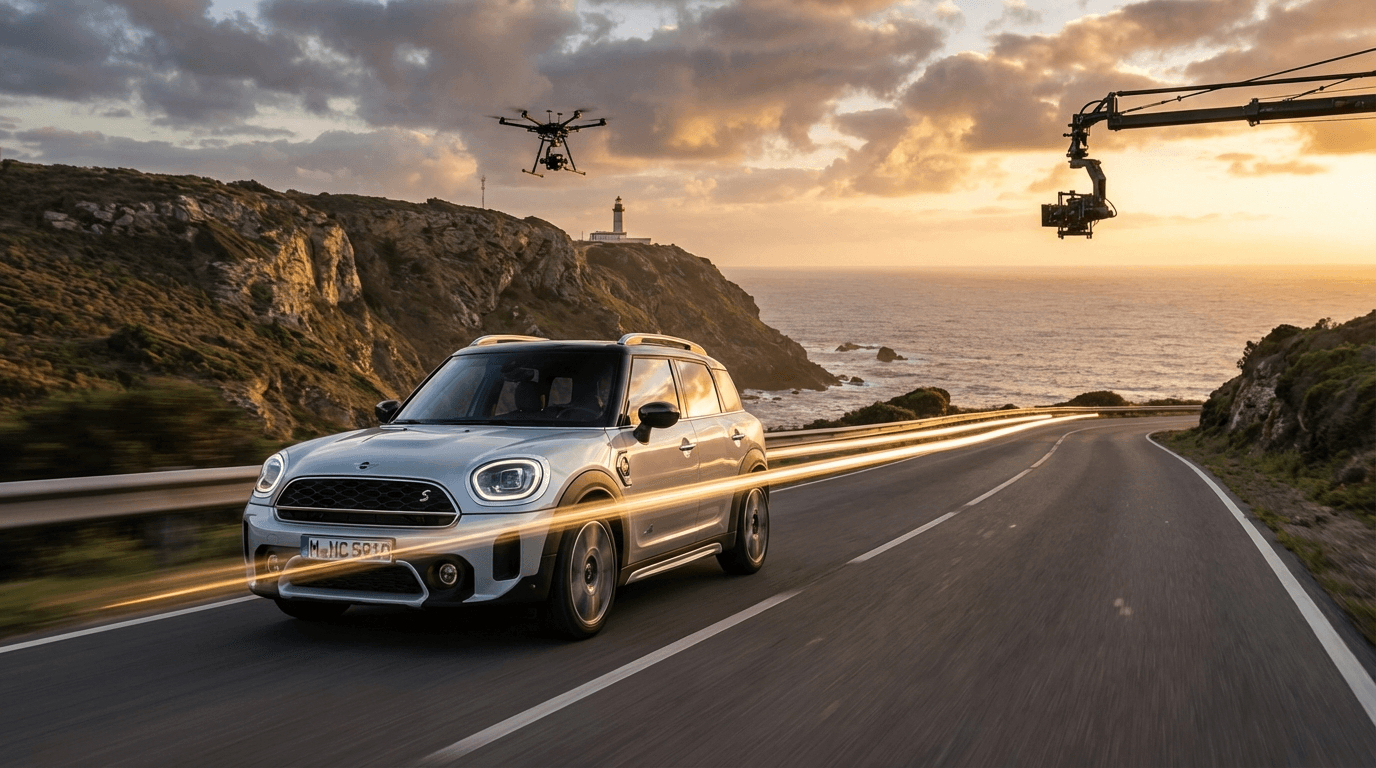
The new MINI Countryman looks almost identical to the model from two years ago, which is great news. The car still looks brilliant, retaining proportions that make it appear smaller and lighter than it actually is.
It has that specific British cheekiness that makes it look equally good outside the opera and covered in mud on a back road.
An interior made from PET knit? It sounds like MINI is forcing you to sit on old water bottles, but in reality it is more luxurious than most "leather" interiors from the competition.
The latest range stars the Favoured Trim package with striking Vibrant Silver accents. This is no ordinary silver; it is a colour that changes depending on the angle of the light, giving the bodywork depth.
Combined with the new Blazing Blue paint and 20-inch Windmill Spoke wheels, the car looks as if it has just stepped off the runway at London Fashion Week, not off the assembly line in Saxony. More and more, electric cars come with this level of attention to visual detail.
The key to the range success, however, lies in what is not visible at first glance. An aerodynamic figure of 0.26 Cd is a notable result in the SUV world.
Engineers smoothed the underbody, added active flaps in the front air intake and redesigned the side mirrors. It is thanks to these details that the MINI Countryman cuts through the air so quietly and efficiently, eliminating the irritating wind noise that plagues many EVs.
Interior: digital minimalism
Inside, the MINI Countryman continues the "less is more" revolution. Forget traditional dials behind the steering wheel. Everything happens on a central, round 240 mm OLED display.
It is a tribute to the classic speedometer of the original Mini Cooper, but in a version worthy of Silicon Valley. The interface, based on the MINI 9 operating system, is fast, colour-saturated and offers so-called Experience Modes.
You can transform the interior into the minimalist "Core" space, the dynamic "Go-Kart" mode with red ambient lighting, or even the nostalgic "Timeless" mode that imitates 1960s gauges.
The materials used in the cabin are another step towards sustainability that, surprisingly, does not feel cheap. Instead of leather we get high-quality recycled textiles that look like a modern sofa in a loft apartment.
The dashboard is covered in a two-tone knit that feels to the touch like an expensive sweater. Space is impressive – thanks to the increased wheelbase, two adults sit comfortably in the rear, and the 460-litre boot easily swallows gear for an active weekend. To fully enjoy this interior, it is worth checking which charger will be best for a home garage.
How much does the MINI Countryman cost in 2026?
In Polish showrooms, the base but already very decently equipped MINI Countryman E costs around 189,500 PLN.
That is the price of a ticket into the premium world, where style matters more than the number of cup holders. If, however, you dream of the luxury of all-wheel drive and power that effectively irons out wrinkles with every overtake, the SE ALL4 version will lighten your wallet by at least 221,100 PLN.
Is that a lot? For that money you get a piece of advanced German technology in a British suit, capable of charging from 10 to 80 percent in under 30 minutes (thanks to DC charging at up to 130 kW).
In my opinion, that is a fair price for being the most stylish user of the public charger outside the supermarket. The right charger is the basis for comfortable everyday use of this model.
Verdict
The new 2026 MINI Countryman is a car for someone who wants to care for the planet without looking like a sad lab technician. It is a car with a strong character that, after this latest update, has finally stopped suffering from range anxiety.
Maybe those extra forty kilometres are the result of inverter optimization, but in the world of electric cars every metre is worth its weight in gold.
Buy it in Blazing Blue, make sure to add the Harman Kardon sound system, choose the more powerful motor and enjoy the fact that the future of motoring does not have to be as boring as a Sunday afternoon at the in-laws.
This car proves you can be a grown-up SUV without losing the go-kart fun gene that MINI has been famous for for decades. When choosing this model, take a look at our catalogue.
FAQ – Frequently asked questions
What is the real-world range of the MINI Countryman E in winter conditions?
Although the official WLTP range is 501 km, in winter conditions at temperatures close to 0°C with the heating on, real-world range in a mixed cycle drops to about 340–360 km. On the motorway at a constant 120 km/h, expect about 300 km between charges. Other electric cars in this class perform similarly.
What is the maximum charging power of the new Countryman?
The car supports DC fast charging at up to 130 kW. This allows topping up from 10% to 80% in about 29 minutes. AC charging is done at up to 22 kW thanks to the optional on-board charger, cutting the full home charge time to under 4 hours. A mobile charger can be a great on-the-road addition.
Does the SE ALL4 version have permanent all-wheel drive?
The ALL4 system in the electric version is implemented by two independent motors. There is no physical driveshaft connection between the axles. Electronics distribute torque in milliseconds, allowing much faster response than in traditional mechanical all-wheel-drive systems. This model is currently the most interesting entry in our catalogue.
Can leather upholstery be ordered in the new model?
No, MINI has dropped the use of natural leather. Instead, high-quality Vescin eco-leather and innovative textile materials made from polyester fibres recycled from PET bottles are used, offering high durability with a smaller carbon footprint.
What is the net and gross battery capacity?
The battery mounted in the floor has a total (gross) capacity of 66.5 kWh. The user has a usable (net) capacity of 64.6 kWh at their disposal. The battery management system maintains a safety buffer to prevent premature cell degradation.
Can the electric MINI Countryman tow a trailer?
Yes, the electric Countryman SE ALL4 is type-approved to tow a braked trailer of up to 1,200 kg.