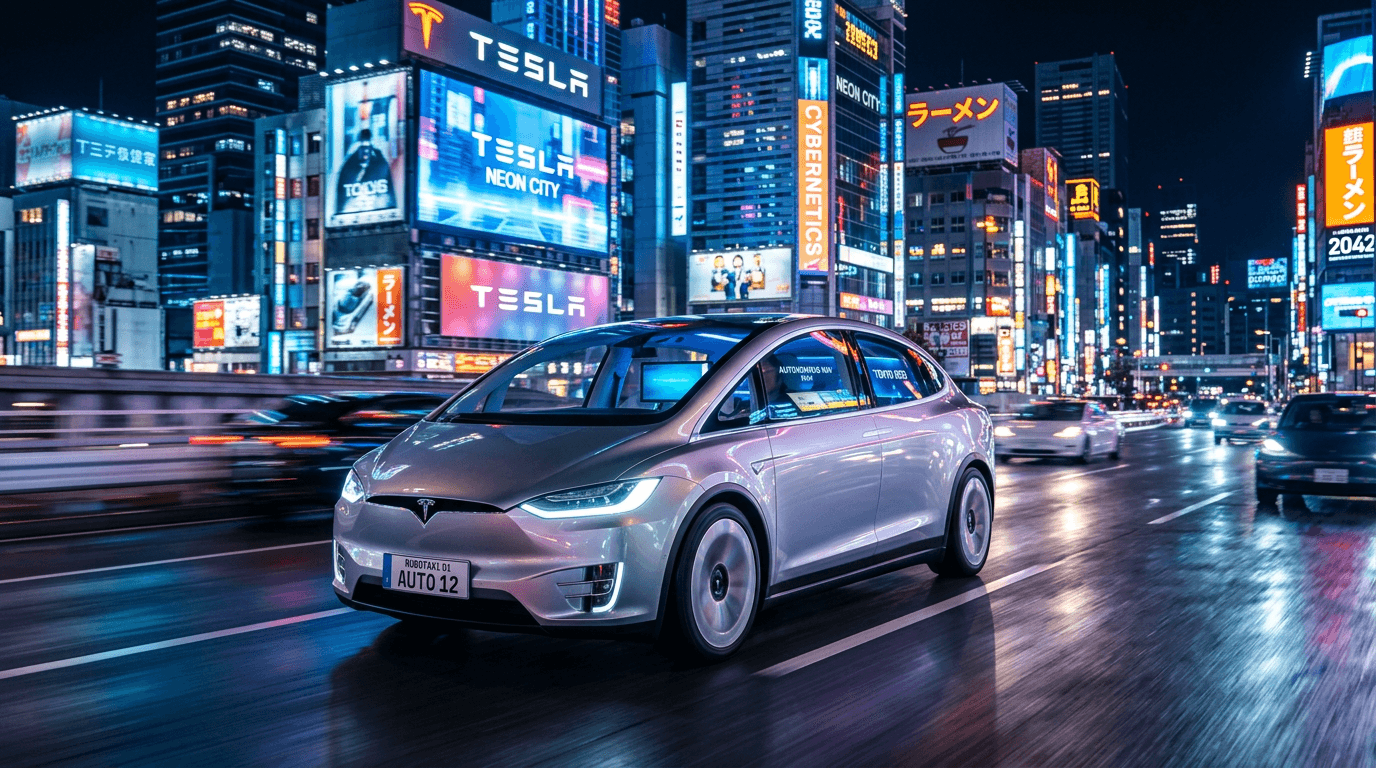
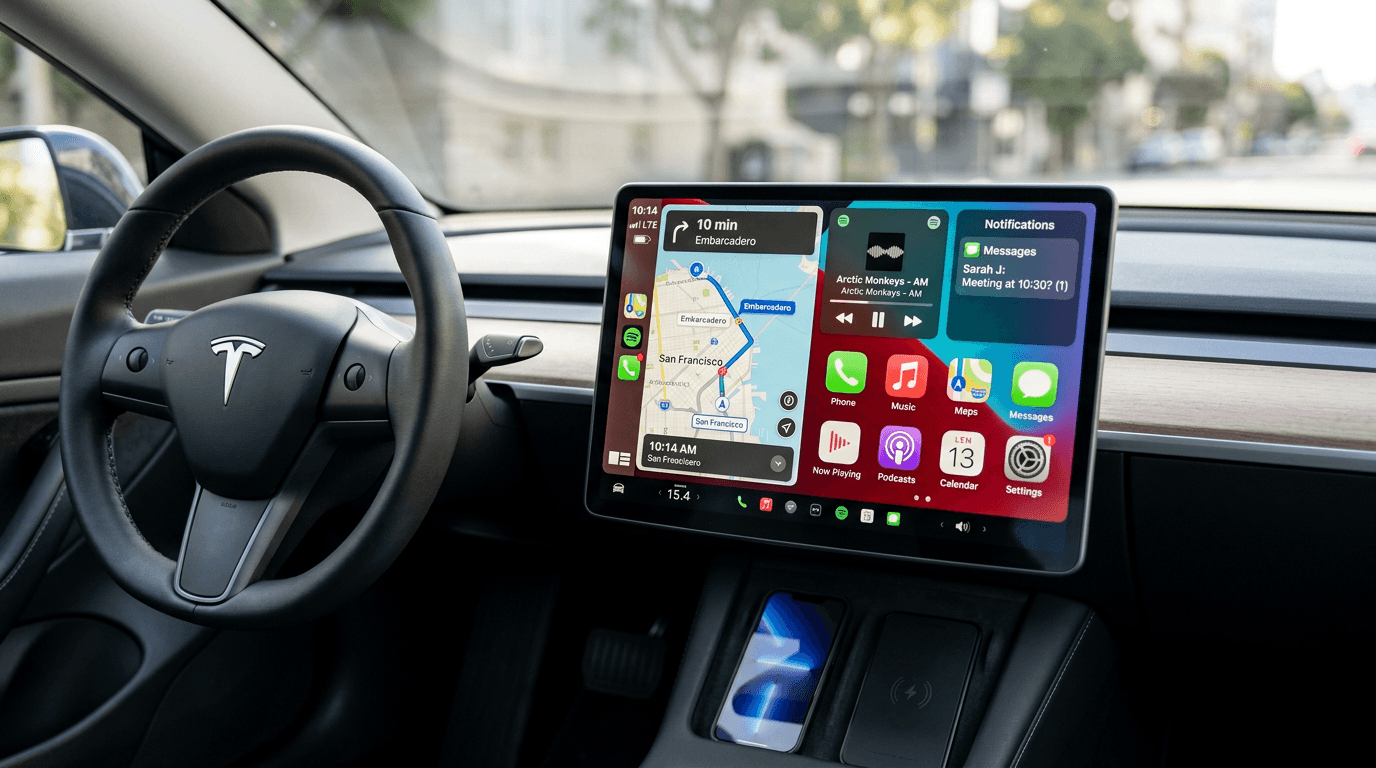
If you thought the Model 3 interior was the peak of asceticism, the Tesla Cybercab will make you feel like you are sitting in a baroque palace full of unnecessary trinkets. Inside you will find only two seats and a giant 21-inch screen.
The cabin resembles a luxury sleeping capsule rather than a traditional cockpit. No center console, no turn signal stalks, not even rear-view mirrors – because why would anyone need them if they do not have to look at the road?
Building a car without a steering wheel is like producing a bicycle without pedals – technically possible, but it demands passenger faith bordering on religious fanaticism that the FSD system will not mistake a cement mixer for a setting sun.
The body itself is a festival of minimalism fused with aggressive futurism. The stainless-steel skin known from the Cybertruck here takes on more rounded, aerodynamic shapes. The doors open upwards, just like on a proper Lamborghini.
Why only two seats? Over 90% of urban rides carry one or two people anyway. Instead of building a car that fits your mother-in-law and the dog, Tesla built one in which you simply do not have to take them.
If you need to travel in a larger group, Tesla will offer the Robovan, designed to carry twenty people. Every new catalog from this brand consistently pushes the boundaries of the norm.
Technology without a cable and without a shadow of doubt
The Tesla Cybercab is not just the absence of a steering wheel – it is also the death of the classic charger. This car charges exclusively by induction: you drive over a special plate in the asphalt and the energy travels to a battery of around 40-53 kWh.
This technology is still in its infancy in the automotive world because of energy losses during transfer. Tesla, however, claims the efficiency of their system is above 90%, which would be a true engineering breakthrough.
The battery capacity may seem modest next to luxury sedans, but it is enough for a real-world range of 320 kilometers. Given that the average daily mileage of a car in Europe is only 40 kilometers, the energy will last for a week.
Although early prototype tests showed that the dedicated wireless charger offers around 25 kW, the final version is meant to be refined for speed.
Inductive charging in a car has one drawback: if you do not align perfectly with the plate, your modern taxi will charge slower than a first-communion watch.
Most fascinating is what manages all this – the unsupervised FSD (Full Self-Driving) system, relying solely on cameras. Elon Musk insists that radars and LiDARs are costly crutches, and that AI trained on millions of kilometers will handle any challenge.
The system is supposedly ten times safer than the average human. The Level 4 autonomy promise sounds like a science-fiction scenario we very much want to believe, despite the brand's numerous schedule "slips."
Sharing economics in Polish conditions
The Tesla Cybercab is supposed to cost under 30,000 US dollars. In Polish conditions, after VAT and margins, we are looking at roughly 120,000 – 140,000 PLN.
That sounds like the deal of the century, especially if we factor in potential subsidies from the "Moj Elektryk" program.
Musk wants owners to enroll their car into the Robotaxi network when they are not using it. You sleep while your Tesla Cybercab deals with passengers, earning money for the lease installment.
Operating cost is meant to drop to about 20 cents per mile, which in Poland would translate to roughly 50-60 groszy per kilometer.
Will white seats survive an encounter with a passenger returning home from a kebab place at night? Tesla plans automated cleaning and UV disinfection, but reality can be more brutal than Californian simulations. Looking at other electric cars, hygiene in shared mobility remains the biggest challenge.
Verdict: futurism on the edge of chaos
Series production of the Tesla Cybercab is scheduled to start in 2026 at Gigafactory Texas. Will it work in Poland? Our Road Traffic Law needs a revolution before we let machines take the wheel on the potholed streets of Łódź or the jammed flyovers of Warsaw.
How will a system without LiDAR cope with thick fog or lanes completely buried under snow? These are questions Tesla answers with a short: "AI will handle it."
If Musk delivers on the promised price, traditional manufacturers may start packing their bags. Browsing the current catalog of transport solutions, it is hard to pass over this project in silence.
This is the end of the car as a status symbol and the beginning of the car as a tool for moving from point A to point B. Once your inductive charger finishes its cycle, the car will head off on its own.
FAQ – Frequently asked questions
What are the exact technical parameters of the Cybercab battery and range?
The Tesla Cybercab uses a 4680-type cell pack with an estimated usable capacity between 40 and 53 kWh. Thanks to the vehicle's low mass and drag coefficient of about Cx 0.20, the car allows up to 320 kilometers on a single charge (EPA). The drivetrain is a single motor on the rear axle.
What happens if the autonomous system fails during a trip?
The Cybercab features full redundancy of critical systems. It is equipped with two independent onboard computers (AI5), two power systems, and duplicated steering and braking actuators. In the event of a hardware failure, the backup system safely brings the vehicle to the roadside.
Is inductive charging the only way to add energy?
The production version of the Cybercab has been designed mainly around resonant inductive charging. Nevertheless, for homologation reasons, the model will feature a hidden NACS-compatible port, enabling the use of Superchargers at up to 120 kW.
How does Tesla plan to solve the cleanliness problem in an autonomous taxi?
The vehicle will be equipped with an interior camera system that analyzes the state of the upholstery. After each ride, AI assesses the cleanliness level. If contamination is detected, the car automatically heads to a service center. In addition, UV-C lamps disinfect the cabin between rides.
Are there legal regulations allowing driving without a steering wheel in Poland?
Currently, Polish law requires the presence of a driver in control of the vehicle. However, work is underway on EU legal frameworks for Level 4 and Level 5 autonomous vehicles. The Cybercab will require special permits to operate in designated zones, expected for the years 2026-2028.
How does the FSD system cope in extreme weather conditions?
The Vision-Only system processes images from 8 cameras in real time. In difficult conditions, the algorithms rely on physics-based modeling. The cameras have built-in heating and air-jet cleaning systems to prevent visibility being reduced by frost or rain.