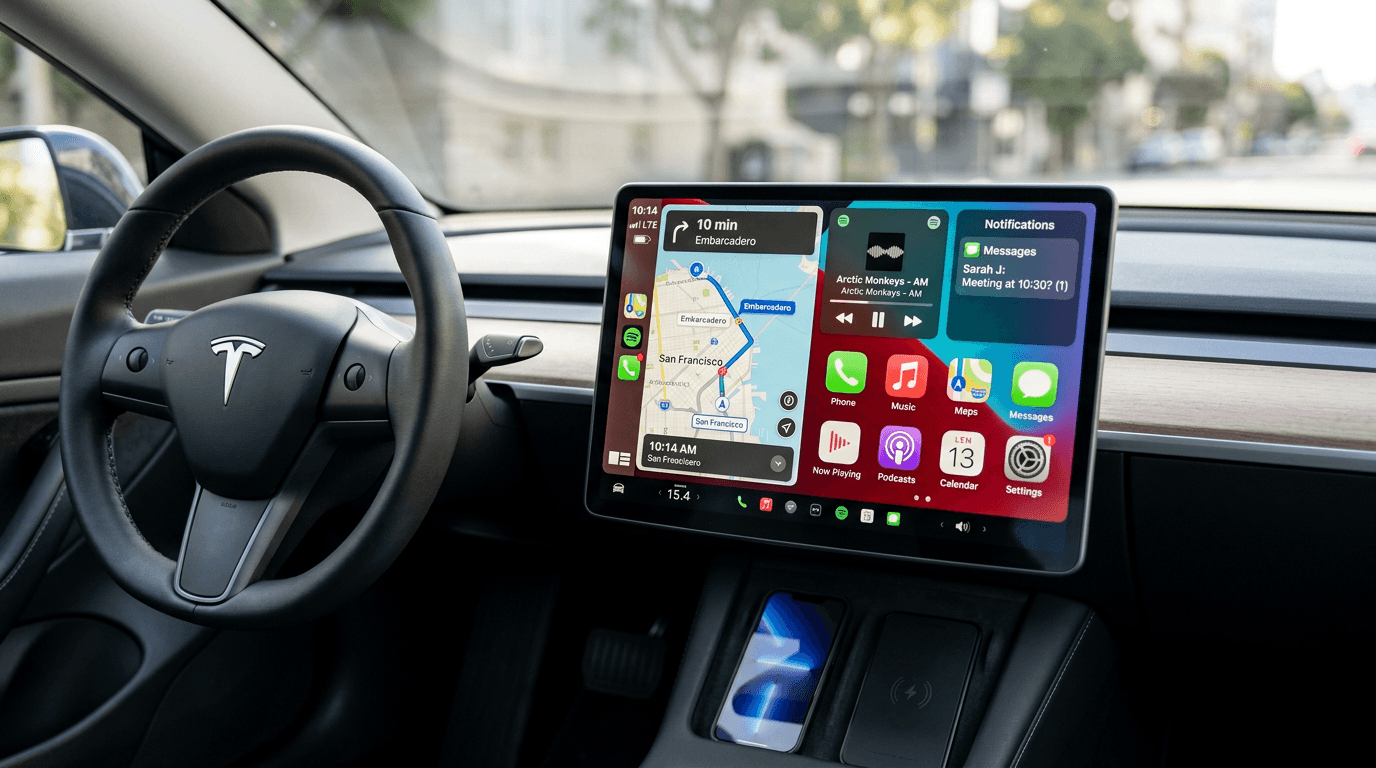
The world has gone mad. Carmakers compete to mount screens on dashboards so large they could display a 1:1 sky map, while door handles hide from their owners as if ashamed of being touched.
Every new launch is a festival of unnecessary gadgets, sensors monitoring the driver's stress level, and systems that beep the moment you dare glance at your watch.
And then he steps in – Chris Barman, an engineer with experience that could embarrass half of Silicon Valley, backed by Jeff Bezos's billions, saying: "Listen, it's 2026, so we built a car with crank windows and a plastic dashboard with the soul of an 80s calculator."
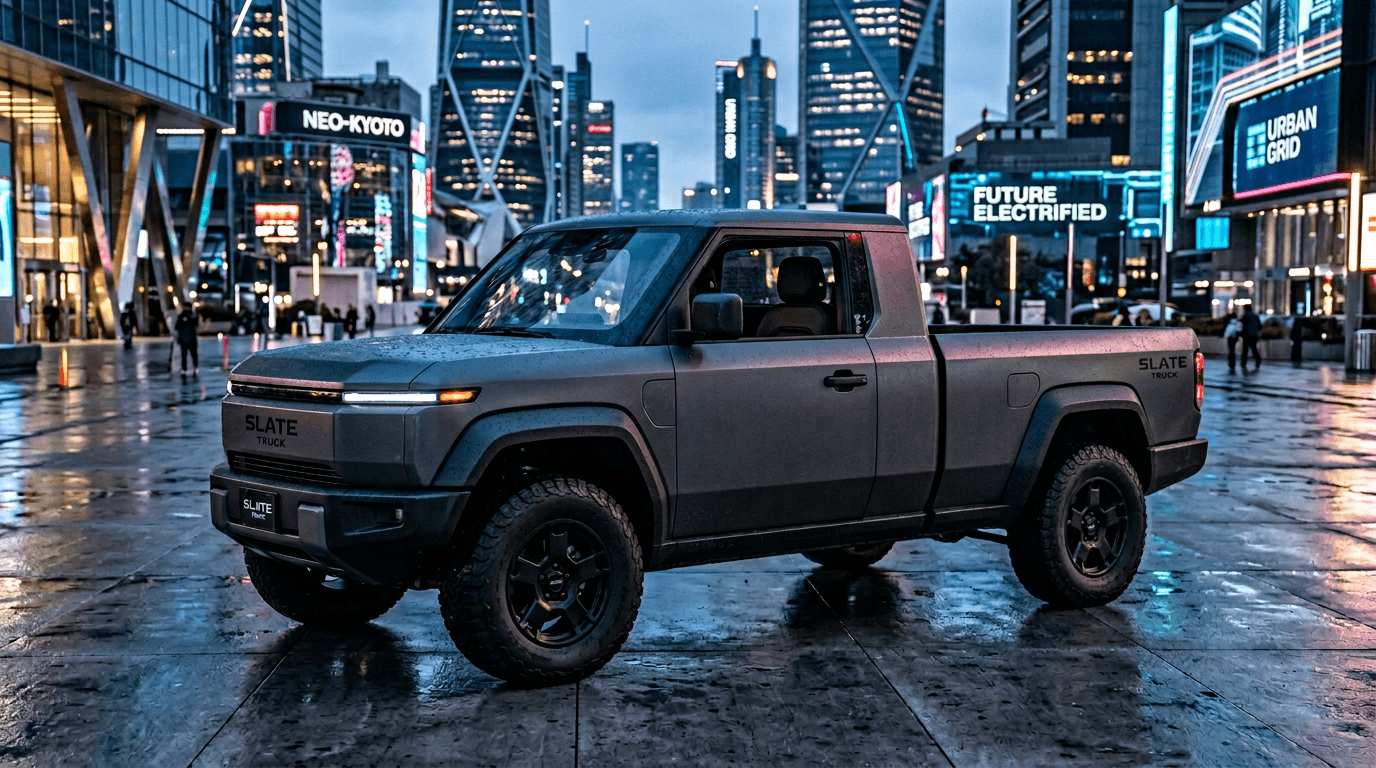
Meet the Slate Truck. A car so shamelessly cheap and simple that it makes the Tesla Cybertruck look like a gold-plated yacht abandoned in the middle of the desert by someone with more money than common sense.
While Elon Musk builds a spaceship on wheels that is afraid of an automatic car wash, Slate built a hammer. It is cheap, raw, and nearly indestructible. And that is exactly why it is brilliant.
This is not another ecological manifesto. It is a brutal redefinition of what a car should be in times when inflation eats our savings and technology becomes its own prison.
By choosing this model, electric cars enter a completely new era of pragmatism, where utility matters more than processor count.
Slate Truck and the simplicity that hurts and delights
Data table 1| Model | Power (HP) | Range (km) | 0-100 km/h | Estimated price |
|---|
| Slate Truck (SL01) | 201 HP | 240-386 km | 8.0 s | ~100,000 PLN |
| Tesla Cybertruck (RWD) | 315 HP | 402 km | 6.7 s | ~245,000 PLN |
| Ford F-150 Lightning | 452 HP | 380 km | 5.0 s | ~310,000 PLN |
| Rivian R1T | 533 HP | 435 km | 4.5 s | ~330,000 PLN |
Slate's design rule is brutal: if something is not essential for surviving a nuclear disaster, it probably is not here.
Forget infotainment systems that update more often than your smartphone and require a subscription to heat the seats.
In Slate, the only "entertainment system" is your own tablet or phone, which you can attach to the dashboard with an armored mount. It is a brilliantly insolent solution.
The Slate Truck has opted out of the consumer electronics arms race. In ten years, the screen in a Mercedes or Audi will look like an old black-and-white GameBoy with burned-in pixels, evoking only pity.
In Slate, you simply swap your tablet for a newer model and the car suddenly gains the most modern navigation on the market.
The interior is a festival of hard plastic, steel wheels, and – I swear – manual window cranks. In a world where even fridges have Wi-Fi and try to order milk without your consent, driving such a car is an almost mystical experience.
This is a return to roots, to a time when a car was a tool, not a rolling server vulnerable to hacker attacks. Nothing here will "lag".
The crank will always lower the window, even if the operating systems of the entire world happen to go into sleep mode. Importantly, every public charger will handle this vehicle without issue, despite its raw nature.
Modularity for grown-up kids
The most interesting thing is that this small pickup – leaving the factory only in matte grey, because paint is a frivolity that raises costs – is a car LEGO set for adults.
The construction is based on a frame that allows unprecedented personalization. For around 20,000 PLN you can buy an SUV kit that in a few hours turns a two-seat workhorse into a five-seat family vehicle.
Slate Truck believes you don't need to change cars and take on another lease when your family grows – you only need to buy an additional module mounted on the bed.
This approach makes the Slate Truck resistant to moral obsolescence. Instead of buying a new model every four years, you simply upgrade what you already have.
Need more ground clearance? You buy different fender flares. Want to turn it into a camper? There are dedicated modules that click into the car's structure with the precision of a Swiss watch.
Browsing our catalog, it is hard to find another project as flexible and well thought out.
The basic Slate Truck technology under the skin
Under the hood – or rather in the floor, between the axles – we have 201 horsepower sent to the rear axle. The electric motor is not meant to win stoplight races, but to deliver the steady torque needed for work.
The base version with a 52.7 kWh net battery promises around 240 km of range. Not much? Maybe only for someone who drives from Warsaw to Lisbon every day.
In Poland this truck is supposed to cost under 100,000 PLN. That is less than you currently pay for a well-equipped city compact with an engine the size of a milk carton.
For those planning longer trips, a larger battery option (84.3 kWh) is available. That unit stretches range to 386 km, which given brick-like aerodynamics is a very solid result.
240 kilometers of range is a pitiful result for someone who wants to pretend to be a traveler, but absolutely sufficient for someone who actually works or drives to the store. For the money saved you could buy a house in Masuria.
Furthermore, LFP (lithium iron phosphate) cell technology provides enormous durability – these batteries will survive thousands of charging cycles without a noticeable drop in performance.
Remember that a properly chosen home charger will shorten the energy top-up time to the absolute minimum.
Performance and utility without pointless pretension
Don't expect the Slate Truck to rip up the asphalt. It reaches 100 km/h in a respectable 8 seconds – still faster than most fleet diesels on our roads.
Its top speed is limited to 145 km/h. That is exactly enough to move smoothly on the highway without the immediate risk of losing your driving license.
However, the Slate Truck was not built to set speed records. In the city and on suburban roads these performance figures are more than sufficient.
A payload of 650 kg and a towing capacity of 450 kg won't impress owners of American V8 monsters. But for hauling a lawnmower, cement, or a new washing machine – this truck is ideal.
This is a car you are not afraid of scratching. If you hit a post with the door, you simply ignore it. If a dog dirties the upholstery with mud, you wipe it with a wet cloth and the problem is solved.
Durability for decades
The biggest asset is supposed to be complete resistance to the passage of time. Since the body is unpainted composites and the interior can be washed almost with a garden hose, the Slate Truck will hold its value better than luxury sedans.
The construction is so simple that an average DIYer with a basic wrench set can handle most routine repairs.
Visiting our catalog, you will see that against the competition this vehicle stands out for its unique resistance to aging.
If you ever want to refresh it, you just peel off the vinyl wrap. The car will again look exactly as it did on the day it left the factory.
The Slate Truck is a return to the philosophy of an object built for decades, not a service rented from a corporation. Modern electric cars rarely offer such independence.
Verdict: a car for people who think
The Slate Truck is the most refreshing and insolent launch of this decade. Chris Barman is not telling us we need autopilot to drive three kilometers for fresh bread.
He doesn't claim that without seat massage our lives lose meaning. He gives us a solid chassis, a durable drivetrain, and peace of mind from unnecessary notifications and updates.
If you are looking for prestige and want to impress your neighbors, buy a Tesla and tremble at every scratch on paint worth a small municipality's annual budget.
But if you are tired of the digital theater and want a car that will get you to your destination, haul a load, and not ruin your wallet, the Slate Truck is the only right answer.
It is an automotive "middle finger" aimed at the world's unnecessary complication. As next-generation electric cars, these vehicles prove that less is more.
FAQ – Frequently asked questions
Does the lack of a built-in screen in the Slate Truck complicate daily use?
Absolutely not. The Slate Truck uses a BYOD (Bring Your Own Device) architecture. Instead of a closed manufacturer system, you use your own smartphone or tablet, which connects to the car via a lightweight app and a Bluetooth/USB-C interface.
How durable is the LFP battery in such an affordable vehicle?
The lithium iron phosphate (LFP) cells used are significantly more durable than NMC batteries. They survive 3,000 to 5,000 full charging cycles while retaining 80% of their original capacity.
Is the modular body construction of the Slate Truck safe?
Yes. The Slate Truck is based on a high-rigidity steel ladder frame. The cabin modules are attached using certified industrial quick-release connectors that meet passive safety standards.
How fast can the Slate Truck be charged using fast chargers?
Slate supports DC fast charging at up to 130 kW. This allows topping up energy from 10% to 80% in about 25-30 minutes in the case of the smaller battery.
Why is the Slate Truck's top speed limited to 145 km/h?
This is an efficiency optimization. Air drag grows quadratically with speed, and the Slate Truck has container-like aerodynamics. 145 km/h is a compromise that allows smooth driving without drastically shortening range.
Doesn't the grey body composite fade in the sun?
The panels are made of glass-fiber-reinforced polypropylene with UV stabilizers. This means that even after years of sun exposure the color remains uniform, confirming the unique character of the vehicle in our catalog.