Electric car fires – facts vs. myths you should know
Do electric cars catch fire more often than petrol cars, and are EV fires impossible to extinguish? We examine statistics from Sweden, the UK and the US, and explain how firefighters handle EV incidents.
EvCompass Editorial TeamPublishedUpdated4 min read
I often hear readers' concerns about the safety of electric cars (EVs). One of the most repeated myths is the belief that EVs are more flammable than traditional internal combustion engine (ICE) cars and that EV fires are practically impossible to extinguish. These fears are fuelled by sensational media headlines, but they rely on misinformation. Scientific data and reports from around the world paint a very different picture. In this article, based on reliable sources, we will debunk these myths step by step, presenting facts, statistics, and practical guidance for extinguishing EV fires.
Myth 1: Electric cars catch fire more often than petrol cars
This is one of the most common stereotypes: "Lithium-ion batteries in EVs can explode at any moment, and fires happen more often than in petrol cars." Statistics indicate that EVs are significantly safer in terms of fire risk.
Other sources confirm these trends. In the United Kingdom, according to the Department for Transport and insurer AXA, the fire rate for EVs is around 25 per 100,000 vehicles, while for ICE vehicles it is as high as 1,530 per 100,000. A report from the US National Transportation Safety Board (NTSB) indicates that EVs burn far less frequently than petrol or hybrid cars. Moreover, Tesla reports just 5 fires per billion miles driven – 10 times fewer than the average for the US vehicle fleet.
Why are EVs safer? The batteries are equipped with advanced battery management systems (BMS) that monitor temperature, voltage, and current, preventing overheating. EV fires usually result from accidents, manufacturing defects, or improper charging, not spontaneous ignition – the myth of "self-ignition" is pure fiction. In contrast, in an ICE vehicle the fuel tank can explode after a collision, making it more dangerous.
It is also worth noting that worries about fires while charging are exaggerated. Certified chargers have safeguards against overheating, and fast charging is safe thanks to thermal monitoring.
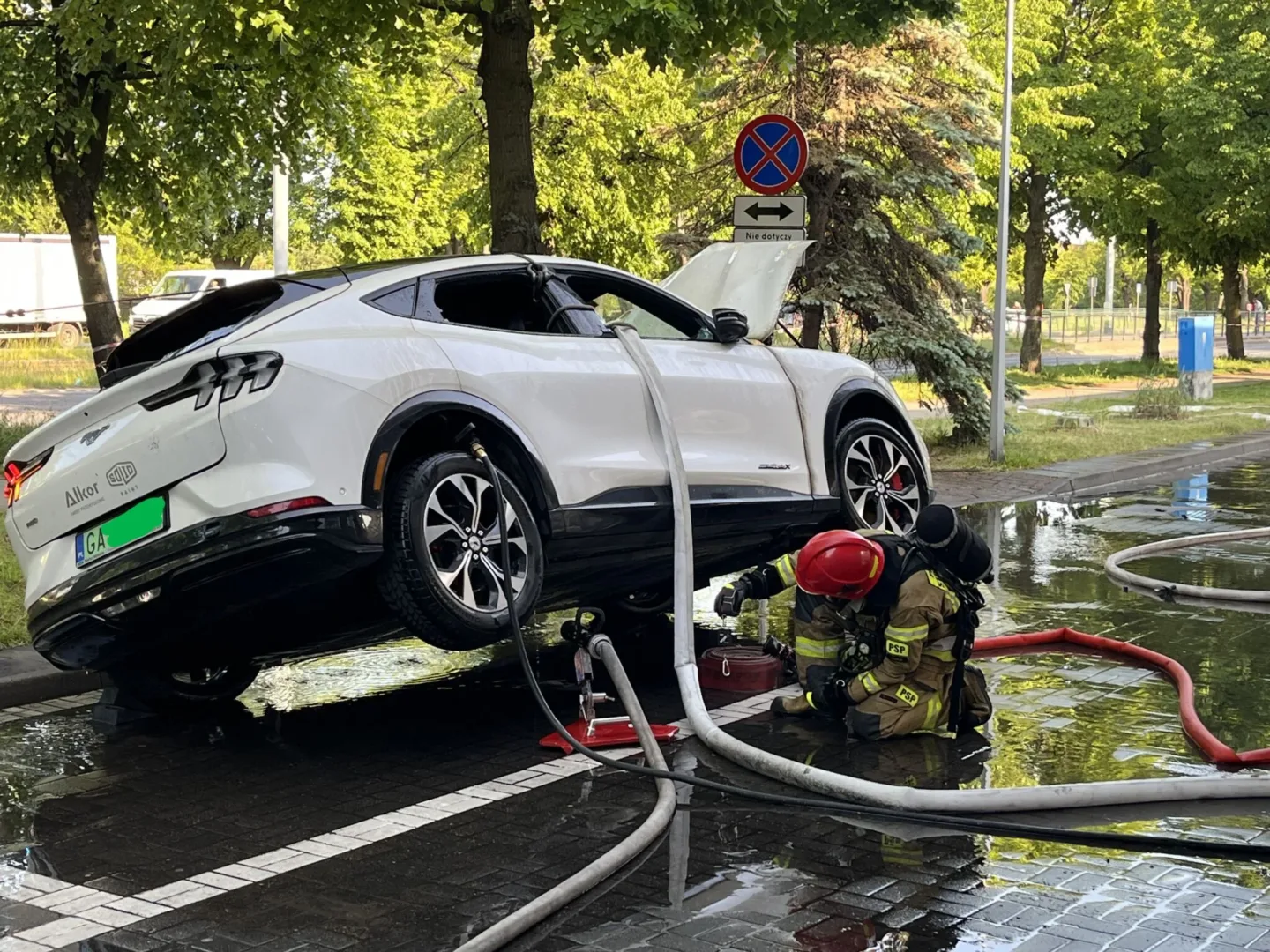
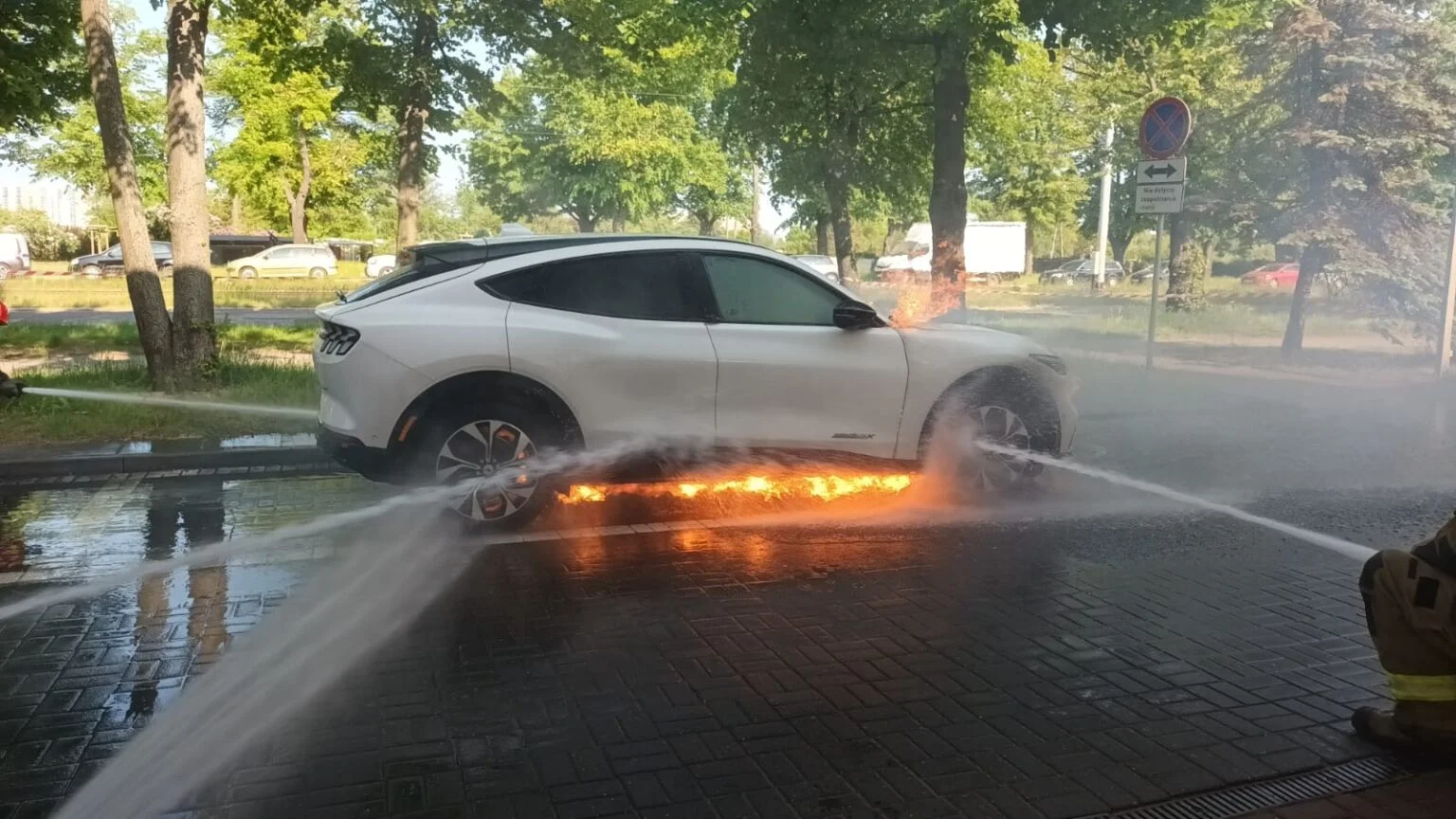
photo: KM PSP Gdańskphoto: KM PSP Gdańsk
Myth 2: Electric car fires are impossible to extinguish
Another myth claims that lithium-ion battery fires "cannot be extinguished" because of thermal runaway, where the chemical reaction sustains itself. The truth is that although EV fires require a specialised approach, they are fully manageable, and firefighters around the world are trained for them.
The key challenge is not the extinguishing itself but cooling the battery, which can reignite even after several days. Traditional methods such as water are effective, but in large quantities – sometimes 10,000 litres or more to cool the cells. The battery casing should not be penetrated, to avoid the risk of electric shock, although in open damage water can be applied directly.
Modern methods speed up the process. For example, the Swedish MSB tested a new technique that extinguishes a battery fire within minutes. In Europe, extinguishing lances and fire blankets are popular, as they smother the fire and prevent it from spreading. In one US test, a Tesla battery fire was extinguished after 2 hours of continuous water cooling, using more than 2,600 gallons. Another method is to submerge the vehicle in water for 24 hours after initial extinguishing.
Firefighters should always check the vehicle's Rescue Sheet and the Emergency Response Guide (ERG) to locate the battery – usually under the floor. Importantly: do not apply water directly to a burning battery if this risks escalation; focus instead on suppression and cooling. Class D extinguishers are recommended for small fires, but for a full incident professional intervention is required. After extinguishing, the vehicle should be monitored and the damaged battery safely disposed of.
EV manufacturers work with emergency services, offering training and tools, which makes extinguishing EV fires a routine procedure rather than a "mission impossible".
Conclusion: Facts, not fear
Myths about the flammability and the impossibility of extinguishing EV fires are not only unfounded, but also hinder the adoption of greener technologies. The data show that electric cars are safer, and their fires – although requiring a specialised approach – are rarer and manageable. As e-mobility enthusiasts, we encourage choosing EVs not only for environmental reasons but also for the real safety they offer. Remember: knowledge is the best protection against misinformation. If you have questions, write to the editors – we are here to help!
Ford is handing Geely the keys to its Valencia and German plants to bypass EU tariffs and accelerate EV development. In return, it gains the G-ASD technology and access to Chinese software engineering. Here is what this partnership means for the European EV market and drivers' wallets in Poland.
Tesla finally opens up to Apple CarPlay. How does Elon Musk's change of heart affect the Model 3's position, its Polish price of 156,240 PLN, and the rivalry with the BMW i4, Hyundai Ioniq 6, and BYD Seal?
Mini Countryman Electric for March 2026: 65.2 kWh battery, SiC inverter, WLTP range up to 501 km (E) and 467 km (SE ALL4). Performance, pricing and rivals compared.