Applied EV Blanc Robot: An autonomous logistics platform from Melbourne built on a Suzuki Jimny ladder frame
Before you put down your morning coffee and start writing protest letters to Palo Alto, let's get one thing straight: the future of mobility does not belong to shiny sedans. Forget cars that promise a nap in an eco-leather seat on the way to the office.
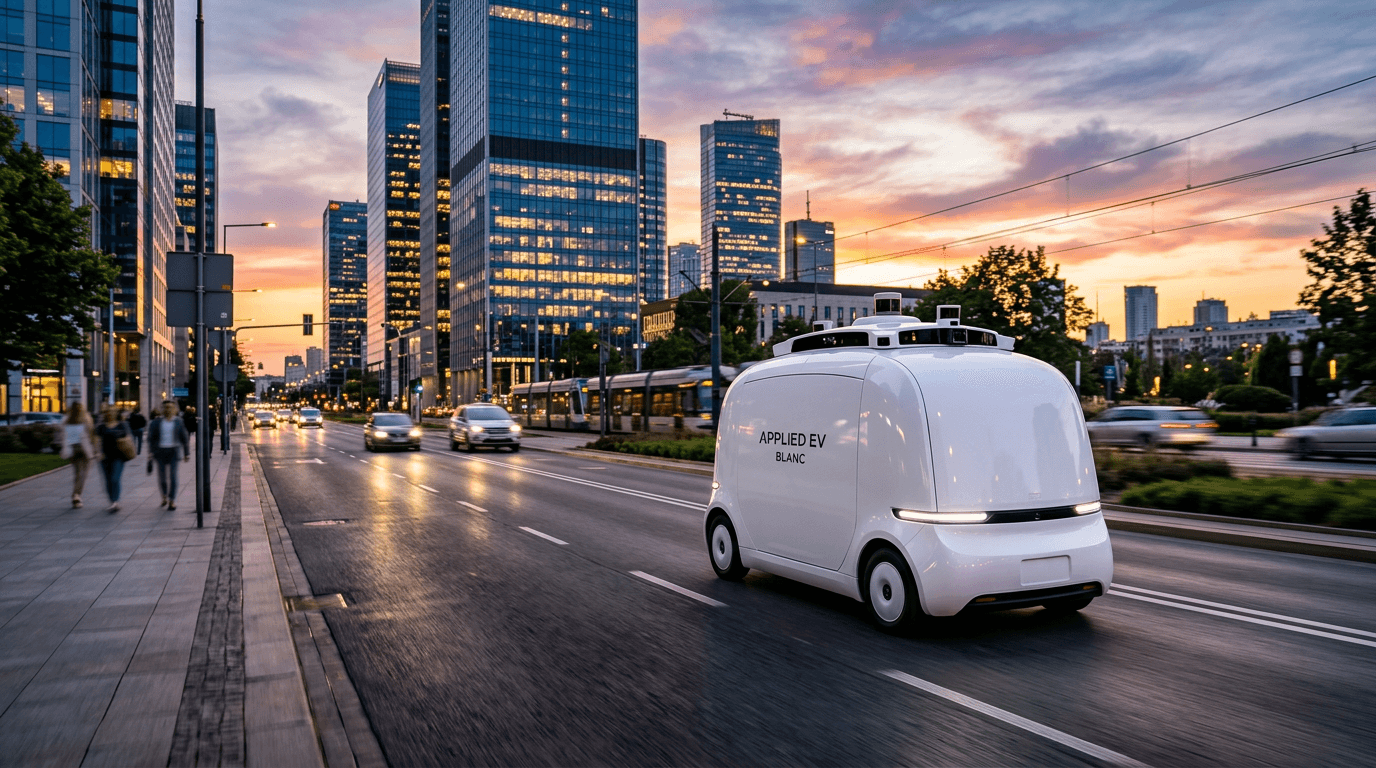
The future has just arrived from Melbourne. It looks like a cross between a LEGO brick and a drilling platform, and there is no room in it for your favorite thermos mug. Ladies and gentlemen, meet the Applied EV Blanc Robot – a machine that proves that, in the world of autonomy, less is decidedly more.
This innovative design shows what future electric vehicles dedicated to the heaviest transport tasks could look like.
Off-roader chassis and a NASA-grade brain
While Elon Musk tries to teach his cars to tell a traffic cone apart from a child, the Australians simply pulled the spine out of an armored off-roader and inserted a processor that never blinks. This is not a car. It is a loading terminal on steroids that does not need vacation or health insurance.
While most industry giants are sweating over how to cram even more redundant touchscreens into the dashboard, the Australians did something brilliantly cheeky. The team led by Julian Broadbent – a former Holden engineer – bet on raw functionality.
They took the ladder frame from a Suzuki Jimny. Yes, that small, brave goat you can drive up a mountain and bring back without a scratch. The chassis is armored, simple, and nearly indestructible, but the engineers stripped out everything that smacks of the 20th century.
The combustion engine went in the bin, along with oil fumes and a failure-prone timing belt. The cabin is an unnecessary luxury that adds drag, so it disappeared too. A steering wheel? In a world of algorithms, that is an artifact as useful as a hand crank.
The result is a sixth-generation modular platform – the Applied EV Blanc Robot. Inside it hides more proprietary software than the average telecommunications satellite. Each such vehicle is a mobile charger on wheels, ready to work in any conditions.
The latest catalog of transport solutions clearly indicates that it is precisely these unattended designs that will dominate logistics.
This is not another "concept car" molded from clay and the dreams of a marketing department. It is a ready, certified working beast. Thanks to a giant 40 million dollar injection, this machine is now entering regular, mass production.
One hundred units are already waiting on the factory yard, scanning their surroundings with LiDAR sensors, ready to earn their keep. While others draw visions, the Applied EV Blanc Robot simply drives off to work.
Applied EV Blanc Robot performance and capabilities
The Applied EV Blanc Robot specifications read like a logistics operator's wish list focused on maximum efficiency. The heart of the drivetrain consists of two advanced electric motors – one per axle.
This delivers not only all-wheel drive but also outstanding precision when maneuvering in tight warehouse aisles. Combined system output is a solid 140 kW (about 190 hp), which in a light cabin-less vehicle means massive torque available from zero rpm.
The real hero here, however, is the battery. A 51 kWh pack lets this "rolling tray" cover up to 400 kilometers on a single charge. In the world of urban logistics, that is nothing short of stunning.
For comparison, in Poland in 2026 covering a similar distance in a passenger car, such as the announced Audi A2 e-tron, will cost a fortune. Meanwhile, these modern electric cars in platform form waste no energy on unnecessary mirrors or cabin air conditioning.
The Applied EV Blanc Robot can lift 1,500 kilograms of payload without any effort. It is as if you strapped an adult rhinoceros to your back and told it to run a marathon – without complaining about fuel prices or driver fatigue.
The efficiency of this platform makes modern courier vans look like stagecoaches by comparison. It is a new standard that redefines the entire TSL industry.
Level 4 autonomy without supervision
When I hear "supervised autonomous driving," I picture someone holding a dog on a short leash and insisting the dog is walking on its own. The Blanc Robot gets off the leash, closes the gate, and does its job, while the owner can comfortably manage the fleet from the office.
Here we reach the point that may cause serious concern for the competition. While others keep promising "Cybercabs" and require users to babysit the autopilot, the Australians and their Applied EV Blanc Robot are targeting Level 4 right away.
This solution is far more advanced than standard passenger electric cars. The Applied EV Blanc Robot features a "digital backbone" – a by-wire control system based on lightning-fast electrical impulses and redundant safety systems.
It does not need a human to navigate mines, large warehouses, or airports. It interprets camera imagery, radar data, and Wi-Fi far faster than any driver, operating with complete detachment and precision.
In Polish conditions, where logistics giants are expanding their bases and every charger at a warehouse serves hundreds of vehicles, such technology is the foundation of profit. Imagine silent platforms moving with surgical precision through the centers of Warsaw or Krakow.
Reviewing the catalog of modern vehicles, it is hard to find a second such a polished work tool that eliminates the human error variable.
Verdict on the Applied EV Blanc Robot
Is the Applied EV Blanc Robot sexy? Yes, if your fetish is supply chain optimization and digital precision. It is a brutally honest vehicle – it does not pretend to be your friend and does not try to have a soul.
It is a cold, efficient tool that exploits the fact that cheap LFP batteries and autonomously controlled electric cars are simply more cost-effective than traditional freight. The EV revolution is not just about quiet drop-offs at preschool.
The real change, whose face is the Applied EV Blanc Robot, has no windows or doors. It completely reorients global freight transport, proving that electric cars can change the world without copying the form of traditional vehicles.
Verdict: If your job consists solely of turning a wheel, start considering new options. The Applied EV Blanc Robot is arriving in force and, unlike humans, it never needs a coffee break.
Commercially available electric cars for businesses have just gained a powerful, digital competitor. Investing in such a fleet is the future, where every charger works toward profit free of personnel costs.
FAQ – Frequently asked questions
What is the real payload capacity of the Applied EV Blanc Robot platform at full range?
The platform is designed to carry loads of up to 1,500 kg. This mass is distributed across the rigid Suzuki Jimny frame, minimizing stress. At full load, the 400 km range may be reduced by about 15-20%, still leaving more than 300 km of effective operation, outclassing most electric LCV-type delivery vehicles.
Can the Level 4 autonomy system handle extreme weather conditions?
The Digital Backbone system fuses data from LiDAR sensors, radars, and cameras. Unlike vision-only solutions, the Blanc Robot uses millimeter-wave radar that penetrates dense fog or dust. This enables precise 3D mapping of the surroundings even at zero visibility.
What batteries are used in this vehicle?
Modular 51 kWh packs based on lithium iron phosphate (LFP) cells are used. They feature a lifespan exceeding 3,000 full charge cycles. The system supports DC fast charging, enabling energy replenishment from 10% to 80% in about 45 minutes.
Why was the Suzuki Jimny construction chosen as the base?
The choice of the Suzuki Jimny ladder frame was dictated by durability, low weight, and global parts availability. The frame, designed for operation in difficult terrain, is an ideal base for an autonomous platform. It also drastically reduced design-stage costs.
Can the Applied EV Blanc Robot drive on public roads?
The vehicle is currently undergoing homologation in the category of low-speed vehicles. Many countries are working on regulations for Level 4 autonomy. Technically, the machine is ready for V2X system integration, which will enable safe driving on public roads within low-emission zones once appropriate regulations are implemented.
What is the durability of the drive-by-wire system?
The control system eliminates the steering column and power steering pumps, which are the most failure-prone points. The Applied EV system uses multiple electronic redundancy. The absence of mechanical friction translates into lower maintenance demand and long service intervals.
How much does a single Applied EV Blanc Robot unit cost?
The price is in the range of 45,000 – 60,000 USD. However, the total cost of ownership (TCO) is about 40% lower than for a traditional van. This results from eliminating driver labor costs, cheaper servicing, and exceptional energy efficiency of 12 kWh/100 km.