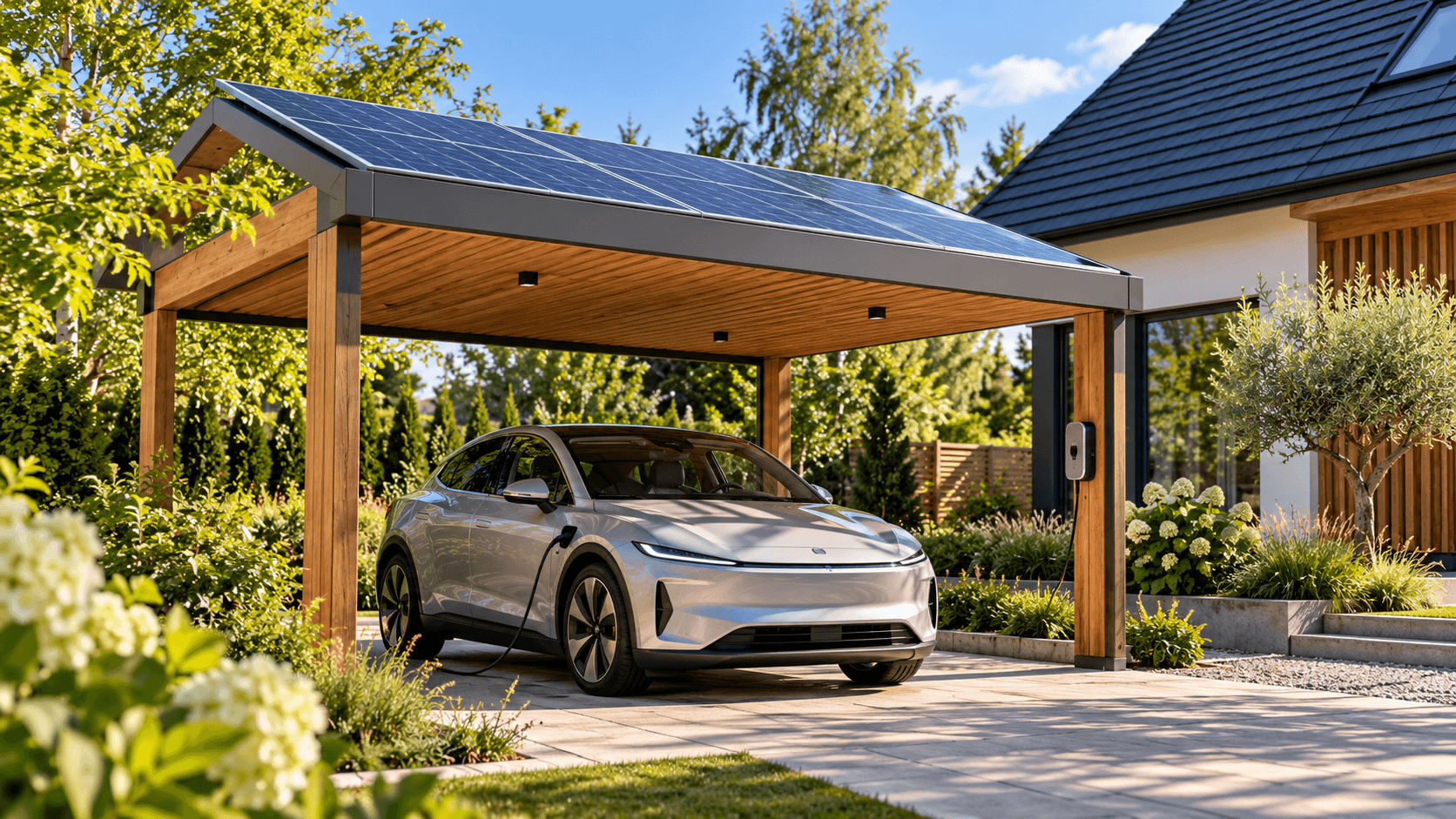
Solar carport with a charger: how much energy could it produce?
PVGIS models annual output for a declared 5 kWp Warsaw reference case. We convert it to an energy equivalent for driving, without treating production as car charging or savings.
EvCompass Editorial TeamPublished2 min read
Start with generation, then ask about savings
A solar carport can combine parking with electricity generation, but annual system output alone does not tell you how much power will reach the car. We therefore show a transparent PVGIS case for Warsaw: a fixed 5 kWp system facing south, with a 10-degree slope and 14 percent system losses. The model uses free-standing mounting; this is a reference scenario, not a design for a particular carport.
For this result, PVGIS uses the PVGIS-SARAH3 radiation database and ERA5 weather data from 2005–2023. At the declared Warsaw coordinates, average annual production is 4,765.59 kWh. That is not a guarantee for any single year: actual output depends on the site, shade and structure geometry, which this example does not model.
Warsaw PVGIS scenario and energy-equivalent distance
Warsaw PVGIS scenario and energy-equivalent distance
Input or result
Value
How to read it
Location
Warsaw — 52.2297° N, 21.0122° E
PVGIS calculation point
System
5 kWp; crystalline-silicon modules; 14% system losses
PVGIS-SARAH3 for radiation; ERA5 for other data; years 2005–2023
Historical database used in the calculation
Annual generation
4,765.59 kWh/year
PVGIS annual average for these inputs
Vehicle input
18.6 kWh/100 km
BMW i4 upper combined WLTP consumption figure
Energy equivalent
25,621 km/year
Generation divided by consumption; not a self-consumption or mileage forecast
How many kilometres are energy-equivalent?
For the conversion, we use BMW's upper combined WLTP consumption figure for the i4: 18.6 kWh/100 km. Dividing all modeled annual production by that figure gives about 25,621 km per year. This is an energy equivalent, not a mileage forecast or a promise that the car will receive all of the carport's output.
The car has to be connected while the energy is available, and production is uneven across the year. An annual total does not account for parking hours, the building's concurrent use, exported electricity or charging losses. We therefore do not calculate self-consumption or savings; that would require hourly generation and demand, the current purchase price, export settlement and installation cost.
When reviewing a design, keep three figures separate: annual system output, the building's demand during those same hours, and the energy the car can take while parked. The distance above is only a conversion of annual production. Before discussing cost, ask for a case based on the actual address, orientation and shading; peak kWp alone describes neither the structure nor its installed price.
PVGIS output and manufacturer data were checked on October 27, 2026. Before deciding, replace the reference inputs with the actual site and carport roof geometry.
Charging time depends on usable capacity, the car’s power curve, charger rating and state of charge. See a transparent calculator scenario and what battery research can—and cannot—tell us.