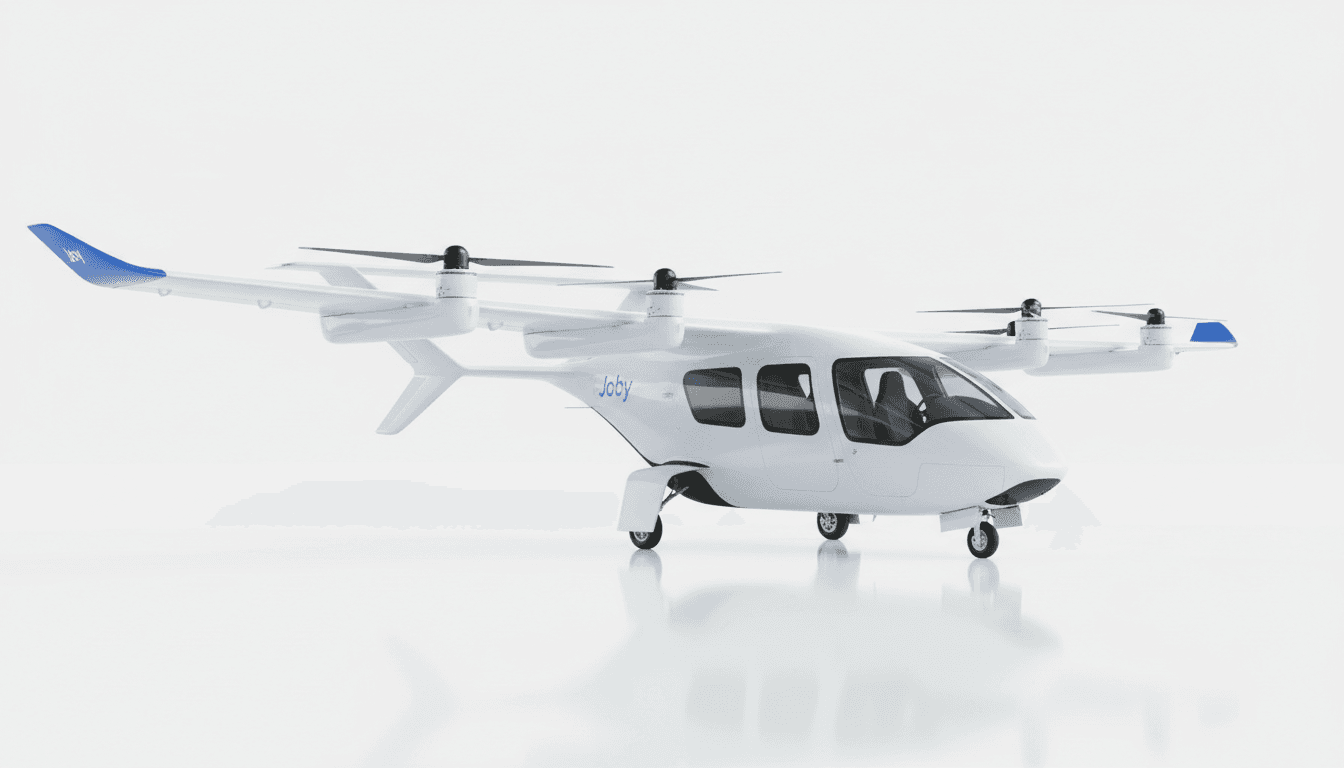
Imagine standing in a traffic jam on Łazienkowska Route in Warsaw while a sleek Joby S4 electric air taxi glides overhead, bypassing the chaos faster than a self-driving Ferrari. Joby S4 represents the future of mobility – an approach that may shift the conversation around traditional EVs.
Joby Aviation: Toyota's backing and the eVTOL build
In a world where Tesla pretends to be a rocket and Chinese EVs resemble AliExpress washing machines, Joby Aviation enters the stage. Backed by Toyota with 2 billion PLN (according to early-2026 data), the company is building the Joby S4 – an eVTOL, or electric vertical take-off and landing aircraft. It is not a drone toy; it carries one pilot and four passengers, with a range of up to 240 km and a cruising speed of 320 km/h. It is significantly quieter than a helicopter – ideal for not waking neighbours in city centres.
Production started in California, and a second factory is now planned in Ohio, where from 2027 the company aims to produce four units per month. FAA certification is in progress, but the first commercial flights are scheduled for 2026, including in Dubai. Poland remains quiet for now, yet industry reports suggest the European sky is opening to eVTOLs faster than expected. Electric cars in Poland may soon face new competition.
Metropolis partnership: vertiports on existing parking sites
To fly, you need to land. Joby partnered with Metropolis, an American parking giant managing more than 4,200 locations. The plan covers 25 vertiports in the US, using existing parking facilities – no building from scratch. Joby CEO JoeBen Bevirt says: „We need to connect this with ground transport to deliver seamless travel.” Picture a vertiport at Chopin Airport or near the Palace of Culture – VIP luggage with biometrics, no queues.
In New York, services start with Blade Urban Air Mobility, where helicopters already carry passengers from Manhattan to JFK in 5 minutes. Now with Metropolis luggage handling and soon with eVTOLs. In Poland, a competitor lurks in the shadows – Sydron Air Mobility, with a Polish team, is pursuing a similar path, but Joby operates in a different league with Toyota behind it. Electric vehicles may soon gain a new dimension thanks to these innovations.
Joby S4 technical data
Joby S4 features a high-capacity battery delivering 160 km of range with reserve (test data per FAA reports). A WLTP equivalent for aircraft does not yet exist, but the real-world 240 km range exceeds most compact EVs in Poland. The 320 km/h top speed clearly outpaces the Volkswagen ID.3 (160 km/h). Noise levels are lower than a neighbour's lawn mower.
Price? Western estimates put it at 5–6 million PLN per unit (converting US market data), but in Europe it may be cheaper thanks to EU subsidies. A flight? In Dubai probably 1,000–2,000 PLN per transfer. In Poland, we are waiting for the Civil Aviation Authority (ULC) and the first vertiports – possibly near CPK?
Competition in Poland: Sydron vs Joby
Poland is not falling behind. Sydron Air Mobility competes with Uber and global players. However, Joby, with Metropolis and Toyota, operates at a different scale of resources and infrastructure. Other eVTOLs, such as Lilium and Archer, remain in the testing phase. Market news in the automotive industry may soon surprise.
Verdict: a new era of transport?
This is not just another EV – it signals the end of the car era as we know it. Joby S4 is a flying, electric, and quiet vehicle that may prove one of the most revolutionary solutions in automotive history. In Poland, vertiports may emerge around CPK, which could become a hub. Instead of sitting in traffic, passengers may choose an air taxi subscription.
„Joby S4 changes the approach to traditional EVs!”
FAQ (Frequently Asked Questions)
How much will a Joby S4 electric air taxi flight cost in Poland?
Joby S4 does not yet operate commercially in Poland, but based on Dubai and US prices, a 50 km transfer may cost 800–1,500 PLN per person. In the future, as vertiport infrastructure expands and competition grows, prices may drop to 400–600 PLN. For comparison, a helicopter in Warsaw currently costs around 3,000–5,000 PLN for a similar distance, so Joby S4 already wins on price.
When will the Joby S4 electric air taxi start flying over Warsaw?
Realistically, the first commercial Joby S4 flights in Poland may launch around 2028–2029. EASA certification (the European equivalent of the FAA), vertiport construction, and approval from the Polish Civil Aviation Authority (ULC) are all required. CPK, the planned airport near Warsaw, could be an ideal air taxi hub – but only after 2027. Meanwhile, Dubai and New York are launching in 2026.
How does the Joby S4 compare with traditional electric cars?
The Joby S4 is in a different league. The 240 km range matches compact EVs like the VW ID.3 (420 km WLTP), but the 320 km/h speed exceeds most cars – even the Tesla Model S Plaid reaches 322 km/h. The key difference: Joby S4 bypasses traffic. A Warsaw–Łódź transfer takes 20 minutes instead of 2 hours by car. The battery charges in 30 minutes, similar to modern EVs.
Is the Joby S4 safer than a helicopter?
According to FAA test data, the Joby S4 has six independent rotors – if one fails, the others keep the aircraft airborne. Helicopters have one main rotor, so engine failure is a serious problem. The electric air taxi has 80% fewer moving parts than a traditional helicopter, reducing the risk of mechanical failure. Battery and avionics redundancy systems work like those in passenger aircraft. FAA certification requires safety standards 10 times higher than for cars.